MC14 opens in Yaoundé with call to reinvigorate WTO in time of crisis.
Ministers Gather in Africa to Discuss Reform, E-Commerce, Agriculture
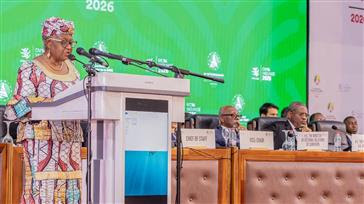
Yaoundé: The 14th Ministerial Conference (MC14) of the World Trade Organization (WTO) opened here in Cameroon today, amid mounting global trade disruptions and geopolitical uncertainties.
The four-day gathering, chaired by Cameroon’s Minister of Trade Luc Magloire Mbarga Atangana, brings together more than 2,000 trade officials, including over 80 trade ministers, and marks only the second time a WTO Ministerial Conference has been held in Africa.
WTO Director-General Ngozi Okonjo-Iweala acknowledged the challenging context for global commerce and the multilateral trading system, describing it as “the worst disruptions in the past 80 years.” She said that the world trading order has changed irrevocably, noting, “We will not get it back. The organisation must look to the future. That means figuring out what worked well in the old order, so we can keep it and build on it. It means figuring out what did not work well, so we can repair it. And it also means identifying the gaps in the renewed order we are shaping, so we can close them.”
Highlighting the agenda ahead, Okonjo-Iweala said ministers would deliberate on WTO reform, the e-commerce work programme and moratorium on customs duties, agriculture trade post-MC14, support for least developed countries (LDCs), and the possible incorporation of the Investment Facilitation for Development Agreement (IFDA) into the WTO legal framework. She emphasised the critical choices facing members, stating, “It is now really up to you, members, to decide whether you want the organisation to continue or you want to pull it apart. On my side, I am full of hope… that collaboration and cooperation will be the order of the day… and deliver tangible results… to face forward,” referencing Kwame Nkrumah.
Atangana welcomed participants, noting that the WTO has been a cornerstone of trade, contributing to stability, predictability, transparency, improved living standards, expanded economic opportunities, and integration into global systems. He added that the organisation must evolve to address fragmentation and changing trade dynamics, saying, “Reform must lead to a stronger, more effective WTO able to respond to challenges of today and restore confidence in the multilateral trading system.”
The opening session celebrated the entry into force of the Agreement on Fisheries Subsidies, adopted at the 12th Ministerial Conference (MC12) in June 2022 and effective from 15 September 2025 following ratification by two-thirds of WTO members. Türkiye’s Minister of Trade Ömer Bolat announced that his country would no longer object to the incorporation of IFDA into the WTO framework as a plurilateral agreement.
MC14’s work programme includes ministerial sessions on WTO reform on 26–27 March, covering foundational issues, decision-making and past mandates, development, and level-playing-field topics. These sessions are facilitated by ministers from Norway, New Zealand, the Republic of Korea, the United Kingdom, Singapore, and Costa Rica. Ambassador Petter Ølberg of Norway has prepared a draft Yaoundé Ministerial Statement on WTO Reform and Work Plan, which will be discussed in a transparency plenary session on 27 March, structured in two parts: facilitator reports on breakout sessions, followed by ministerial views on adoption.
Dedicated ministerial sessions on 28 March will address dispute settlement reform, fisheries subsidies, IFDA incorporation, the e-commerce programme and moratorium, agriculture, and development, including LDC integration. Minister-facilitators for these sessions are from the Philippines (fisheries subsidies), Saint Vincent and the Grenadines and Nigeria (IFDA), Jamaica (e-commerce work programme and moratorium), Pakistan (agriculture), and Cameroon (development and LDC issues). The final day will include an informal heads of delegation meeting to review facilitator reports and any outreach conducted, followed by a formal session to consider decisions, with closing statements from the MC14 Chair and the Director-General.
India is participating under the leadership of Commerce and Industry Minister Piyush Goyal, accompanied by senior officials, technical and legal experts, and representatives from its Permanent Mission in Geneva and other ministries. India’s engagement is constructive, balanced, and development-oriented, supporting WTO reforms while emphasising food security, safeguarding the livelihoods of small farmers and fishers, and maintaining policy space for developing economies.
Also read: WTO MC14: Why India Must Lead, Not Just Defend
India has stressed an open, fair, inclusive, and non-discriminatory multilateral trading system, reaffirming the **principle of non-discrimination** enshrined in the Marrakesh Agreement. India supports a permanent solution on Public Stockholding (PSH) for food security, citing the reliance of low-income, resource-constrained farmers on the Minimum Support Price (MSP) system. On fisheries subsidies, India advocates a balanced approach that addresses sustainability while protecting livelihoods and expects distant water fishing nations to progressively reduce capacities. India also supports investment facilitation initiatives for developing countries, including LDCs, and has highlighted the need for policy space in emerging digital trade areas under the e-commerce agenda.
India’s engagement extends to bilateral trade, with recent Free Trade Agreements (FTAs) concluded with the United Kingdom and Oman, progress with New Zealand and the European Union, and ongoing negotiations with other partners. Bilateral meetings on the sidelines of MC14 will allow discussions on key agenda items and trade issues.
Further details, including the full text of the Director-General’s opening remarks and background on WTO reform discussions, are available on the WTO website.
– global bihari bureau