First-Ever Section 122 Tariff Takes Effect
Tariff Move Triggers Legal, Congressional Clock
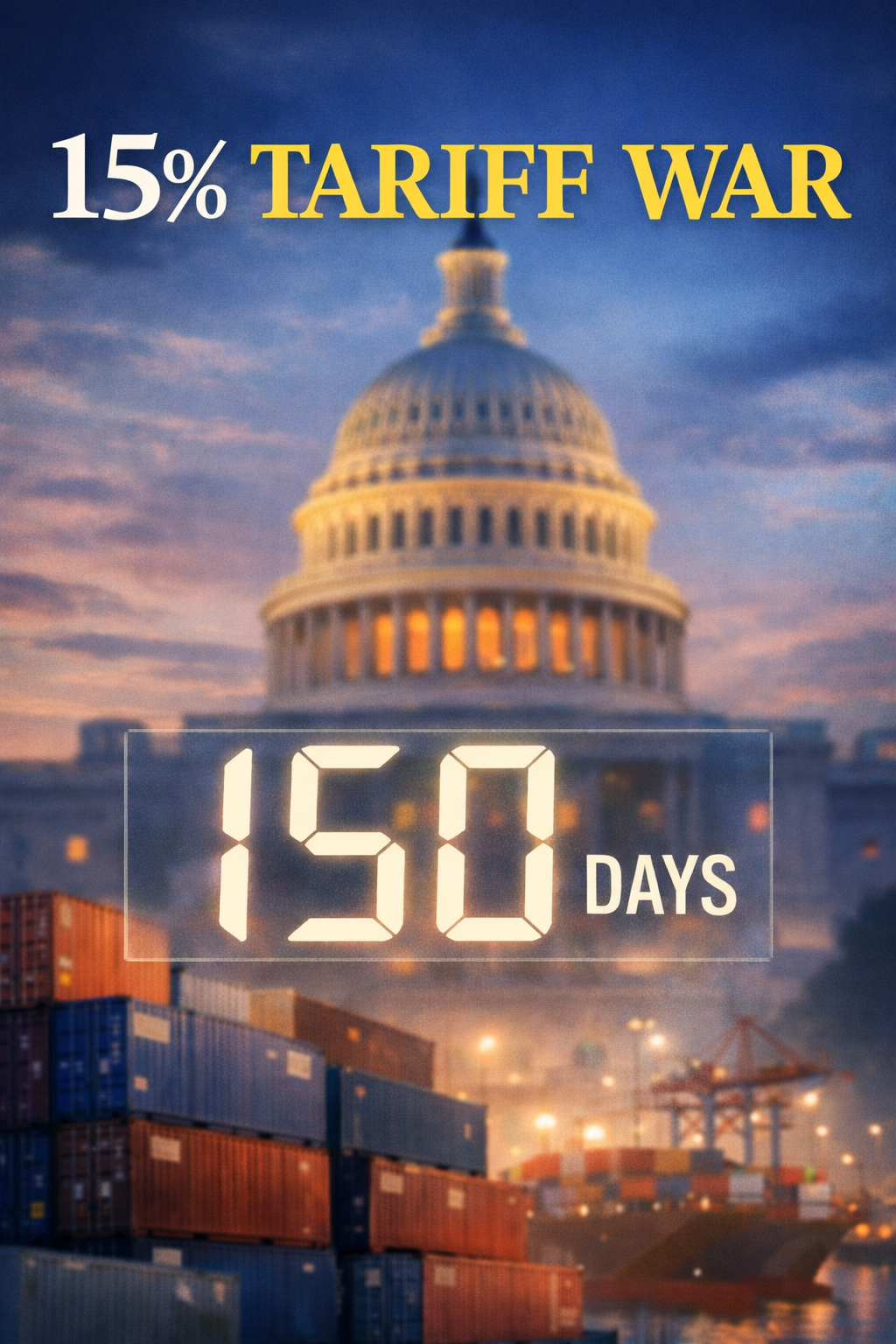
Washington: United States President Donald Trump’s 15 per cent tariff on most imports from nearly all trading partners took effect at 12:01 a.m. Eastern Time on Tuesday, February 24, 2026, marking the first-ever use of Section 122 of the Trade Act of 1974. The surcharge, initially set at 10 per cent in a February 20 proclamation and raised within days to the statute’s 15 per cent ceiling, is temporary by law and will expire after 150 days unless Congress votes to extend it.
The move follows judicial scrutiny of earlier tariffs imposed under the International Emergency Economic Powers Act. By invoking Section 122 instead, the administration has shifted to a narrower statute that explicitly caps both the rate and the duration of import restrictions.
In its proclamation, the White House argues that persistent U.S. trade deficits amount to a large and serious balance-of-payments problem warranting temporary corrective action. Officials say the measure is intended to strengthen domestic production and address structural imbalances in trade flows while longer-term policy discussions continue.
The legal foundation of that justification is already being debated.
Section 122 permits temporary import surcharges of up to 15 per cent for 150 days to address balance-of-payments deficits. Economists note, however, that the United States is not facing a traditional balance-of-payments crisis marked by currency instability or depletion of foreign exchange reserves. While the country runs a significant goods trade deficit, it also records strong capital inflows that finance that gap — a structural feature of the dollar’s role as the world’s primary reserve currency.
That distinction is central to emerging legal challenges. Analysts at the Cato Institute and the Peterson Institute for International Economics argue that using Section 122 absent acute external financing stress stretches the statute beyond its intended purpose. Some point to prior filings by the Department of Justice in earlier tariff litigation, where government lawyers acknowledged that trade deficits are conceptually distinct from balance-of-payments crises — a position that could resurface in court if new suits are filed.
Litigation may arrive quickly, though the statute’s 150-day lifespan complicates judicial timing. Courts would need to determine whether the administration’s interpretation fits within the statutory trigger or represents an expansive reading vulnerable to reversal.
The international ramifications add another dimension. Under Article XII of the General Agreement on Tariffs and Trade, balance-of-payments measures must be temporary and proportionate and are subject to review by World Trade Organization members. Such actions typically require consultation with the International Monetary Fund to assess whether a genuine external payments crisis exists. Historically, these safeguards have been used by emerging economies confronting currency or reserves emergencies. The U.S. position — in a context of continued dollar strength and stable reserves — may face scrutiny or formal dispute proceedings.
Major trading partners are evaluating responses. China has indicated it is reviewing countermeasures, and trade analysts caution that retaliatory steps could compound the impact if layered onto existing tariffs.
For India and other export-oriented economies, the effect will vary by sector. India’s exports to the United States span pharmaceuticals, textiles, engineering goods and electronics. A 15 per cent surcharge compresses price margins in competitive industries, though the temporary nature of the measure introduces uncertainty about how firms adjust supply chains during the 150-day window.
Domestically, the most decisive factor may be Congress.
Section 122 requires legislative approval for any extension beyond 150 days. That means both chambers must pass a joint resolution. In the Senate, such a resolution would likely need 60 votes to overcome a filibuster. In an election year in which tariffs are often portrayed by opponents as consumer taxes, assembling that majority could prove politically difficult.
Several lawmakers from both parties have signalled caution about prolonging across-the-board import duties that risk pushing up retail prices. While short-term inflationary effects may be limited, economists warn that sustained or layered tariffs can ripple through supply chains, affecting costs for manufacturers and consumers alike.
The design of Section 122 places those decisions squarely before Congress. Enacted in 1974 partly to impose limits and procedural guardrails after earlier episodes of unilateral executive trade action — including President Richard Nixon’s 1971 import surcharge — the statute embeds both a rate ceiling and a hard expiration date.
At its core, therefore, the current episode does not represent an open-ended restructuring of U.S. tariff policy. It represents a temporary measure operating within statutory guardrails and under a defined legislative clock.
Whether the surcharge becomes a short-lived policy instrument or the foundation for a longer-term shift will depend on three parallel tracks: judicial interpretation of the statute, congressional willingness to extend it, and the response of trading partners within the World Trade Organization framework.
For now, the tariff is in force. But its future — legally, politically and economically — is governed not by executive discretion alone, but by a 150-day countdown that has already begun.
– global bihari bureau