Centre Clears Major Highway Projects in Maharashtra, Odisha
New Delhi: The Union Cabinet today approved two highway infrastructure projects in Maharashtra and Odisha involving a combined capital outlay of more than ₹20,600 crore, according to official statements issued after the Cabinet Committee on Economic Affairs meeting chaired by Prime Minister Narendra Modi.
₹19,142 Cr Greenfield Corridor Approved in Maharashtra
In Maharashtra, the Cabinet cleared the construction of a six-lane greenfield, access-controlled Nashik–Solapur–Akkalkot corridor on Build-Operate-Transfer (Toll) mode. The project has a total length of 374 kilometres and an estimated capital cost of ₹19,142 crore. The corridor is proposed to provide connectivity to regional centres, including Nashik, Ahilyanagar and Solapur, with onward linkage towards Akkalkot and Kurnool, as indicated in official maps.
The proposed highway will connect with the Delhi–Mumbai Expressway near the Vadhawan port interchange, the Agra–Mumbai corridor at Nashik at the junction with NH-60 at Adegaon, and the Samruddhi Mahamarg at Pangri near Nashik. From the eastern side, four-lane corridors are already under development from Chennai to Hasapur at the Maharashtra border via Thiruvallur, Renigunta, Kadappa and Kurnool, covering a length of about 700 kilometres. According to the government, the Nashik–Akkalkot corridor is planned to provide through connectivity between the western and eastern parts of the country and to facilitate integrated transport infrastructure development under the PM GatiShakti National Master Plan.
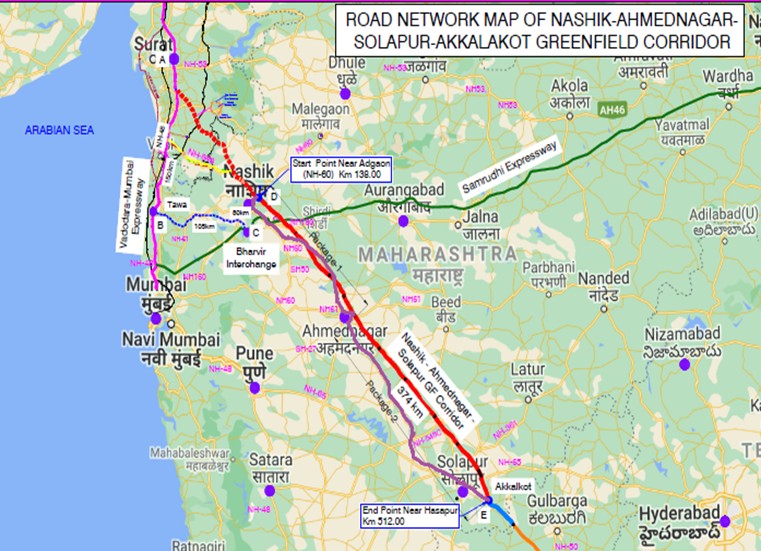
The access-controlled greenfield corridor is designed to improve travel efficiency and reduce both travel time and distance. Official estimates indicate a reduction in travel time of about 17 hours and a shortening of travel distance by approximately 201 kilometres compared to existing routes. The six-lane highway will be built with a design speed of 100 kilometres per hour and an average vehicular operating speed of about 60 kilometres per hour, reducing overall travel time from around 31 hours to about 17 hours.
The government stated that the project is expected to improve logistics efficiency for freight originating from and destined to major National Industrial Corridor Development Corporation nodes, including Kopparthy and Orvakal. The Nashik–Talegaon Dighe section also addresses the requirement for a Pune–Nashik Expressway, which has been identified by the NICDC as part of a proposed expressway project being taken up by the Maharashtra government. The corridor is designed for controlled access and uninterrupted traffic movement, with provisions aimed at improving safety, reducing congestion and lowering vehicle operating costs.
The approval of the Nashik–Solapur–Akkalkot corridor follows earlier clearances for expressways and high-capacity highways intended to expand long-distance connectivity across regions. In Maharashtra, this includes the Mumbai–Nagpur Samruddhi Mahamarg and the Delhi–Mumbai Expressway, with which the new corridor is proposed to integrate near the Vadhawan port interchange. The Agra–Mumbai corridor, intersecting the project at Nashik, has also formed part of previous approvals aimed at improving north–south and west–central connectivity. On the eastern side, four-lane highway works from Chennai to Hasapur at the Maharashtra border, passing through Andhra Pradesh and Telangana, were approved in earlier phases and are currently under various stages of implementation. The Nashik–Akkalkot corridor is designed to connect with these stretches, providing continuity between existing and under-construction corridors.
The project is expected to contribute to economic activity in the districts of Nashik, Ahilyanagar, Dharashiv and Solapur through improved connectivity and infrastructure development. During the construction phase, the project is estimated to generate about 251.06 lakh man-days of direct employment and 313.83 lakh man-days of indirect employment, with additional employment expected due to increased economic activity along the corridor.
NH-326 Upgradation in Odisha Approved at ₹1,526 Cr
In a separate decision, the Cabinet approved the widening and strengthening of an existing section of National Highway-326 in Odisha, upgrading it from a two-lane highway to a two-lane highway with paved shoulders between kilometre 68.600 and kilometre 311.700. The project will be implemented under the National Highways (Original) programme on Engineering, Procurement and Construction mode at a total capital cost of ₹1,526.21 crore, including a civil construction cost of ₹966.79 crore.
The approved project covers the Mohana–Koraput section of NH-326, which currently has sub-standard geometry, including deficient curves, steep gradients and varying carriageway widths that constrain the movement of heavy vehicles. According to the government, these constraints reduce freight throughput and affect safe and efficient travel. The upgradation will involve geometric improvements such as curve realignments and gradient corrections, removal of accident-prone locations, pavement strengthening and other safety-related interventions.
Once completed, the upgraded corridor is expected to reduce travel time between Mohana and Koraput by approximately 2.5 to 3 hours and shorten the route by about 12.46 kilometres. The improved highway will provide enhanced connectivity with NH-26, NH-59, NH-16 and the Raipur–Visakhapatnam corridor, and improve last-mile access to Gopalpur port, Jeypore airport and several railway stations.
The NH-326 corridor connects industrial and logistics facilities such as JK Paper, NALCO, IMFA, Utkal Alumina, Vedanta and HAL, along with educational and tourism centres including the Central University of Odisha, Koraput Medical College, Taptapani and Rayagada. The government stated that the improved road connectivity will facilitate the movement of goods and passengers and support socio-economic development in the districts of Gajapati, Rayagada and Koraput, including tribal and aspirational areas.
Economic analysis of the NH-326 project indicates an economic internal rate of return of 17.95 per cent under the base case scenario, while the financial internal rate of return is estimated at minus 2.32 per cent. According to the government, the economic justification is driven by travel-time savings, reductions in vehicle operating costs and safety benefits captured in the economic appraisal.
The project will be implemented on EPC mode, with construction targeted for completion within 24 months from the appointed date for each package, followed by a five-year defect liability and maintenance period. Implementation will involve quality-assurance and monitoring tools, including precast structural components, cement-treated sub-base layers, network survey vehicles, drone-based mapping, supervision by an appointed Authority Engineer and monitoring through the Project Monitoring Information System. Contract awards will be finalised after completion of statutory clearances and land possession requirements.
The NH-326 corridor was declared a national highway in August 2012 through a Gazette notification covering the stretch from its junction with NH-59 near Aska to its junction with NH-30 near Chinturu in Odisha, passing through Mohana, Raipanka, Amalabhata, Rayagada and Laxmipur.
– global bihari bureau