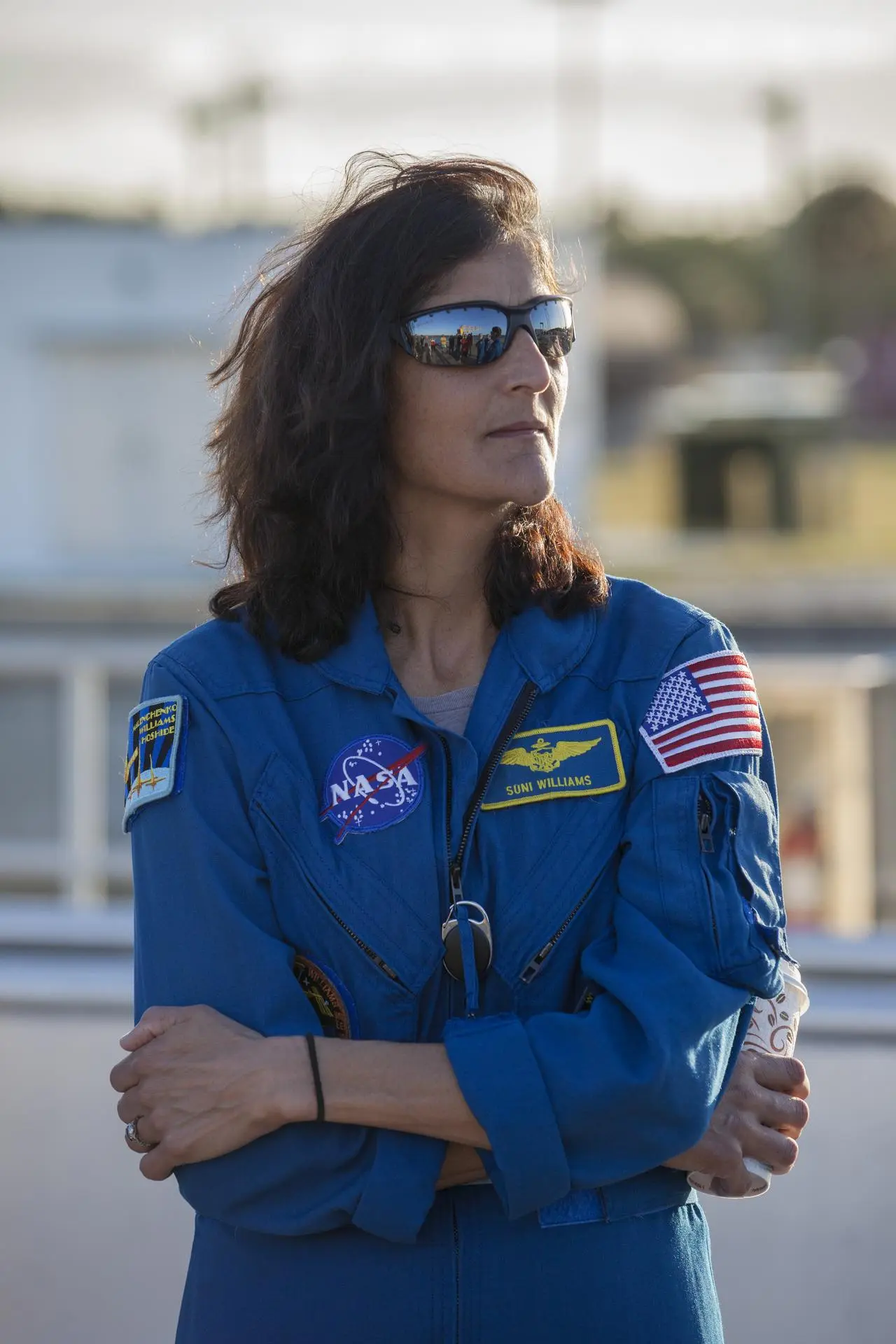
NASA astronaut Suni Williams at Cape Canaveral Air Force Station’s Naval Ordnance Test Unit basin in Florida on March 28, 2018. Credit: NASA/Kim Shiflett
India’s Star Beyond the Sky
High above Earth, where the deep blue of oceans melts into the endless black of space and night plunges every forty-five minutes, Sunita “Suni” Williams once floated tethered to the International Space Station. Her gloved hands clasped the cold metal handrails—the thin line dividing fragile human life from the vacuum beyond. Beneath her, continents drifted in serene silence: oceans dark as ink, deserts shimmering with subtle glow, city lights threading like fragile filaments through the night.
“Anyone who knows me knows that space is my absolute favourite place to be,” she reflected—a simple truth that defined a career devoted to making the cosmos her home.
Her recent visit to India, just weeks before retirement, brought the astronaut’s extraordinary journey closer to her roots. In Kozhikode, Kerala, she joined long queues for falooda, shared laughter and conversations with eager students, and recounted vivid stories of life aboard the space station. Speaking at the Kerala Literature Festival, she described how the view from orbit erases borders and awakens a profound sense of shared humanity. Her Indian heritage—through her father’s roots—lent these moments special resonance with South Asian audiences, who embraced her as a living bridge between continents and a radiant beacon of aspiration for generations to come.
On December 27, 2025, Williams formally retired from NASA, drawing the curtain on an extraordinary 27-year odyssey that expanded the horizons of human spaceflight. Across three missions, she accumulated 608 days in space—second among American astronauts in cumulative time aloft—and ranks sixth in longest single spaceflight by a NASA astronaut, tied with Butch Wilmore at 286 days. She completed nine spacewalks totalling 62 hours and six minutes—the most by any woman and fourth-most overall. In one of her most captivating feats, she became the first person to run a marathon in space, transforming a solitary treadmill challenge into an inspiring global spectacle beamed from orbit.
Her ascent began firmly on the ground. Born in Needham, Massachusetts, she earned a degree in physical science from the United States Naval Academy and a master’s in engineering management from the Florida Institute of Technology. As a retired U.S. Navy captain, she had already logged more than 4,000 flight hours across over forty different aircraft. That potent mix of technical mastery, unwavering discipline, and composure under pressure made her an ideal choice when NASA selected her as an astronaut in 1998.
Her inaugural journey to orbit launched in December 2006 aboard Space Shuttle Discovery (STS-116), where she joined Expeditions 14 and 15. She conducted four spacewalks totalling more than 29 hours, establishing a record for women at the time. She returned to Earth aboard Atlantis with the STS-117 crew, forever broadening the possibilities of long-duration spaceflight.
In 2012, she lifted off from Baikonur Cosmodrome in Kazakhstan for a 127-day mission spanning Expeditions 32 and 33. Appointed Commander of Expedition 33, she guided an international crew while performing three spacewalks to mend an ammonia leak and replace a vital power component on the station’s solar arrays.
“It’s been an incredible honour to have served in the Astronaut Office and have had the opportunity to fly in space three times,” she said. “I had an amazing 27-year career at NASA, and that is mainly because of all the wonderful love and support I’ve received from my colleagues.”
Her concluding mission tested resilience in unprecedented ways. In June 2024, she launched aboard Boeing’s Starliner for NASA’s first crewed test flight. Technical issues prolonged her stay aboard the ISS alongside fellow astronaut Butch Wilmore, extending across Expeditions 71 and 72. Commanding the station once again during Expedition 72, she carried out two more spacewalks before returning to Earth in March 2025 aboard a SpaceX Crew-9 spacecraft—a defining milestone in the emerging era of commercial human spaceflight.
NASA leaders honoured her trailblazing path with heartfelt tributes. Administrator Jared Isaacman described her as “a trailblazer in human spaceflight, shaping the future of exploration through her leadership aboard the space station and paving the way for commercial missions to low Earth orbit. Her work advancing science and technology has laid the foundation for Artemis missions to the Moon and advancing toward Mars, and her extraordinary achievements will continue to inspire generations to dream big and push the boundaries of what’s possible.” Vanessa Wyche, director of the Johnson Space Center, praised her “indelible contributions” and “exceptional dedication.” Scott Tingle, chief of the Astronaut Office, called her “incredibly sharp” and an inspiring colleague whose presence would be greatly missed.
Beyond her orbital flights, Williams helped shape future exploration by establishing helicopter training platforms for lunar missions, serving as Deputy Chief of NASA’s Astronaut Office, and directing operations in Star City, Russia. In 2002, she immersed herself for nine days in an underwater habitat during NASA’s NEEMO simulation, honing skills essential for extreme environments.
Now stepping into new chapters as mentor, speaker, and global ambassador for science and exploration, Williams reflects on a legacy that transcends continents, disciplines, and generations.
“The International Space Station, the people, the engineering, and the science are truly awe-inspiring and have made the next steps of exploration to the Moon and Mars possible,” she said. “I am super excited for NASA and its partner agencies as we take these next steps, and I can’t wait to watch the agency make history.”
From record-setting spacewalks and an orbital marathon to commanding the ISS and bridging the Shuttle, Starliner, and Crew-9 eras, her career concludes not in a quiet farewell but in stories rippling outward across the world. In India, where the night sky has stirred poets and dreamers for millennia, Williams’ journey affirms that reaching for the stars is profoundly human. Her falooda-sipping moments in Kerala, her warmth with students, and her reflections from orbit remind the next generation that exploration belongs to anyone courageous enough to dream.
– global bihari bureau