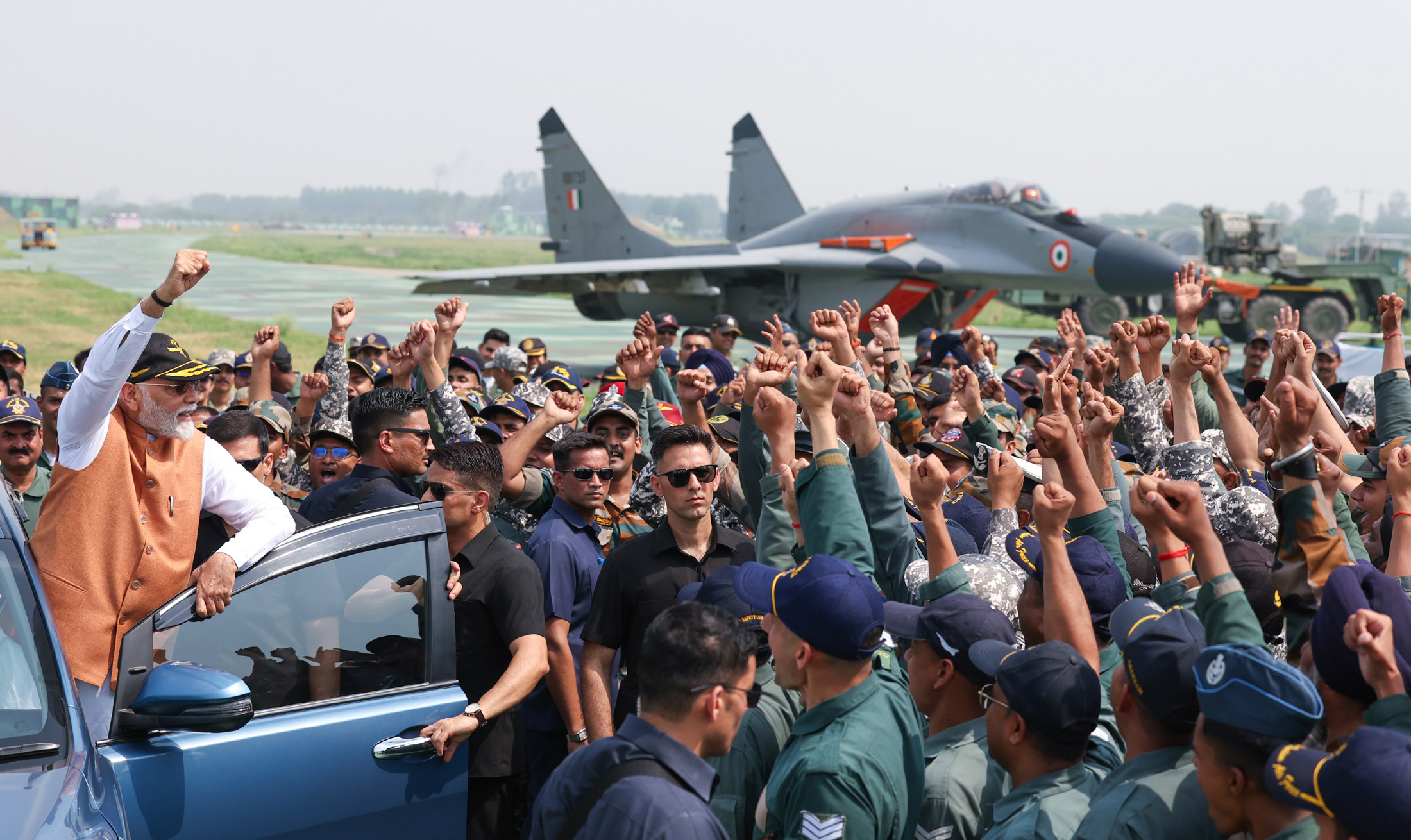
Prime Minister Narendra Modi at Adampur airforce base, in Punjab on May 13, 2025.

India’s Bold Blow Leaves Pakistan in Denial Dust
New Delhi: ‘Operation Sindoor’, India’s precision missile strikes, targeting nine terrorist camps in Pakistan and Pakistan-occupied Kashmir (PoK), has cemented its stature as a global counterterrorism powerhouse. At Adampur Air Base, Prime Minister Narendra Modi celebrated the armed forces for eliminating over 100 terrorists and dismantling terror hubs, framing the operation as a defence of national honour. In a separate press briefing, Ministry of External Affairs spokesperson Randhir Jaiswal reinforced India’s diplomatic resolve, suspending the Indus Waters Treaty until Pakistan ceases cross-border terrorism, rejecting nuclear blackmail, and clarifying that no trade talks occurred with the US, countering President Trump’s claim of brokering a ceasefire with trade promises. Pakistan’s Ministry of Foreign Affairs, in a press release today after Modi visited the Adampur Air Force Station today morning, and his speeches today and yesterday evening, responded with defiance, alleging Indian aggression and civilian casualties—claims unsupported by evidence and overshadowed by India’s evidence-based narrative. ‘Operation Sindoor’ underscores India’s military supremacy, diplomatic clarity, and a global message that terrorism, even from nuclear-armed Pakistan, will face decisive retribution.
Sindoor’s Sting: India Crushes Terror, Pakistan Cries
‘Operation Sindoor’ has delivered transformative gains across India’s military, diplomatic, and domestic fronts. The Indian Air Force’s 24 missile strikes in 25 minutes across Bahawalpur, Muridke, and Muzaffarabad showcased unparalleled precision, as Modi declared: “Our Air Force targeted terrorist bases deep inside Pakistan in just 20-25 minutes, hitting pinpoint targets.” The integration of indigenous Akash systems with S-400 defences neutralised Pakistan’s retaliatory attacks, safeguarding all Indian airbases. This synergy among the Army, Navy, Air Force, and Border Security Force (BSF), Modi noted, reflects India’s “jointness,” a cornerstone of its modernised military.
Diplomatically, India has asserted autonomy by suspending the Indus Waters Treaty until Pakistan “credibly and irrevocably abjures support for cross-border terrorism,” as Jaiswal announced. “The treaty was concluded in the spirit of goodwill, which Pakistan has violated through decades of terrorism,” he stated, grounding India’s position in international law. India’s briefings to the US, UK, Russia, and Saudi Arabia countered Pakistan’s narrative, while its push for UN sanctions on ‘The Resistance Front’ (TRF), a Lashkar-e-Taiba proxy, strengthens its counterterrorism leadership.
Domestically, ‘Operation Sindoor’ unified India, with the ruling Bharatiya Janata Party spokesperson Dr. Sambit Patra noting, “From villages to cities, every Indian stands with our brave soldiers, united in pride.” Triggered by the April 22, 2025, Pahalgam attack that killed 26 tourists, the operation’s success, with no reported civilian casualties, restored public faith. Modi’s dedication to “mothers, sisters, and daughters” whose “sindoor was snatched” amplified morale: “Every Indian stood with you, offering prayers during this operation.” This unity transcended political divides, with Congress and DMK leaders rallying behind the government.
India’s technological advancements, leveraging real-time satellite imagery and drone surveillance, enabled precise targeting. Modi’s metaphor of “lighting up the sky” underscores this edge, while the Air Force’s data-driven warfare positions India as a modern combat leader. “Our forces struck with such accuracy that Pakistan was left stunned,” Patra said, reinforcing India’s superiority. The S-400’s defensive prowess ensures deterrence against future threats.
The operation resonates with India’s cultural ethos, as Modi invoked Guru Gobind Singh’s call to make “one warrior fight 125,000” and likened modern weaponry to Maharana Pratap’s horse, Chetak: “These lines written for Chetak now fit our modern weaponry.” This narrative, framing the operation as a defence of national honour, sustains public and soldier morale, aligning military action with India’s historical resistance to injustice.
India’s Missile Might Mocks Pakistan’s Nuclear Bluff
‘Operation Sindoor’ signals India’s zero-tolerance for terrorism and its capacity for precise, non-escalatory action. By targeting terrorist infrastructure and avoiding Pakistani military or civilian sites, India demonstrated restraint. “Our military action was entirely in the conventional domain,” Jaiswal clarified, directly countering Trump’s speculation of nuclear conflict and debunking Pakistan’s escalatory claims. Jaiswal’s rejection of Trump’s ceasefire and trade narrative—“no trade talks were held between Indian and US representatives ahead of the ceasefire”—underscores India’s independent crisis management, dismissing external mediation. Modi’s assertion that “no one can tolerate nuclear blackmail” challenges nuclear powers shielding terrorism, setting a global precedent.
India’s diplomatic narrative, backed by briefings to global partners, positions it as a responsible power. “Major powers like the US and France have acknowledged India’s right to self-defence,” Patra noted, aligning with Jaiswal’s claim that “several foreign leaders admitted India’s right.” The Indus Waters Treaty suspension signals India’s strategic leverage. “Blood and water can’t flow together,” Modi declared, a stance that, while raising concerns, has garnered cautious international support. Pakistan’s press release, alleging “unprovoked aggression” and civilian casualties, lacks verification, as Indian satellite imagery confirms targeted strikes. Its accusations of “propaganda,” dismissed by Jaiswal and Patra as “a farce,” are overshadowed by India’s evidence-based narrative, urging global adoption of a “zero-tolerance” policy.
Sindoor Strikes Silence Pakistan’s Terror Haven
‘Operation Sindoor’ has inflicted severe military, psychological, and economic blows on Pakistan, exposing its complicity in terrorism. The destruction of nine terror camps, including Jaish-e-Mohammed’s headquarters in Bahawalpur and Lashkar-e-Taiba’s base in Muridke, crippled key networks. Indian officials confirmed 35–40 Pakistani military personnel were killed in LoC exchanges, with airbases like Rahim Yar Khan decimated. “Pakistan has seen its terrorism centres decimated,” Jaiswal stated. Modi’s assertion that India’s forces “ground the Pakistani army into dust” underscores the military humiliation.
Psychologically, the operation shattered Pakistan’s invulnerability. Modi’s warning that “our drones and missiles will ensure Pakistan loses sleep” reflects the fear instilled by India’s technological edge. Pakistan’s failed retaliatory attacks, neutralised by S-400 systems, and the Indian Navy’s dominance in the Arabian Sea exposed weaknesses. Pakistan’s press release claim of a “calibrated” response is undermined by India’s evidence, as Patra noted: “Pakistan was left stunned, unable to respond effectively.”
Economically, the Indus Waters Treaty suspension threatens Pakistan’s agriculture, with rivers like the Chenab critical for millions of farmers. Pakistan’s press release vow to “preserve its rights” lacks leverage, as India’s legal stance holds firm. This pressure amplifies Pakistan’s internal challenges, with domestic unrest growing amid military failures, as the press release’s defiance fails to mask.
Politically, Pakistan faces isolation. Its ceasefire request on May 10, contradicted by its press release’s denial of “despair,” was debunked by Indian imagery. The call for UN intervention and Trump’s mediation on Kashmir lacks traction, as Jaiswal reiterated: “Kashmir is a bilateral issue, and the only issue is Pakistan’s illegal occupation of territories.” India’s sanctions push on TRF further pressures Islamabad, countering Pakistan’s narrative of UN resolution-based solutions.
Pakistan’s nuclear blackmail, dismissed by India, proved irrelevant against India’s conventional superiority. The press release’s claim of defending sovereignty is hollow, given India’s precise navigation around civilian aircraft cover. Unverified civilian casualty claims, alleging “cold-blooded murder of women and children,” humiliate Pakistan’s military, aligning with Patra’s assessment. The accusation that India exploited the Pahalgam attack to deflect from human rights issues in Jammu and Kashmir lacks evidence, as Jaiswal’s focus on Pakistan’s illegal occupation exposes Pakistan’s deflection tactics. Pakistan’s claim of India’s “revisionist” mindset and “brinkmanship” fails against India’s restrained, targeted strikes, as Jaiswal’s conventional domain clarification underscores.
The press release’s contradictory stance—claiming victimhood from “India-sponsored terrorism” while defending “resolute” responses—reveals strategic incoherence. Its call for UN Charter principles is undermined by India’s targeted strikes, as Jaiswal’s rebuttals and Modi’s principles demonstrate. This denialism emboldens India’s proactive stance, positioning Pakistan as a diminished actor.
A Blow to Pakistan’s Feeble Farce
‘Operation Sindoor’ has reshaped regional dynamics, cementing India’s proactive defence posture. Its cultural narrative sustains public support, while global counterterrorism leadership, bolstered by the MEA’s clear stance against Trump’s claims, urges nations to confront state-sponsored terrorism. For Pakistan, the operation demands reform or risks further consequences, as the treaty suspension and India’s warnings imply. “This is a new India that desires peace but will crush adversaries,” Modi concluded, defining a strategic vision of restraint and resolve.