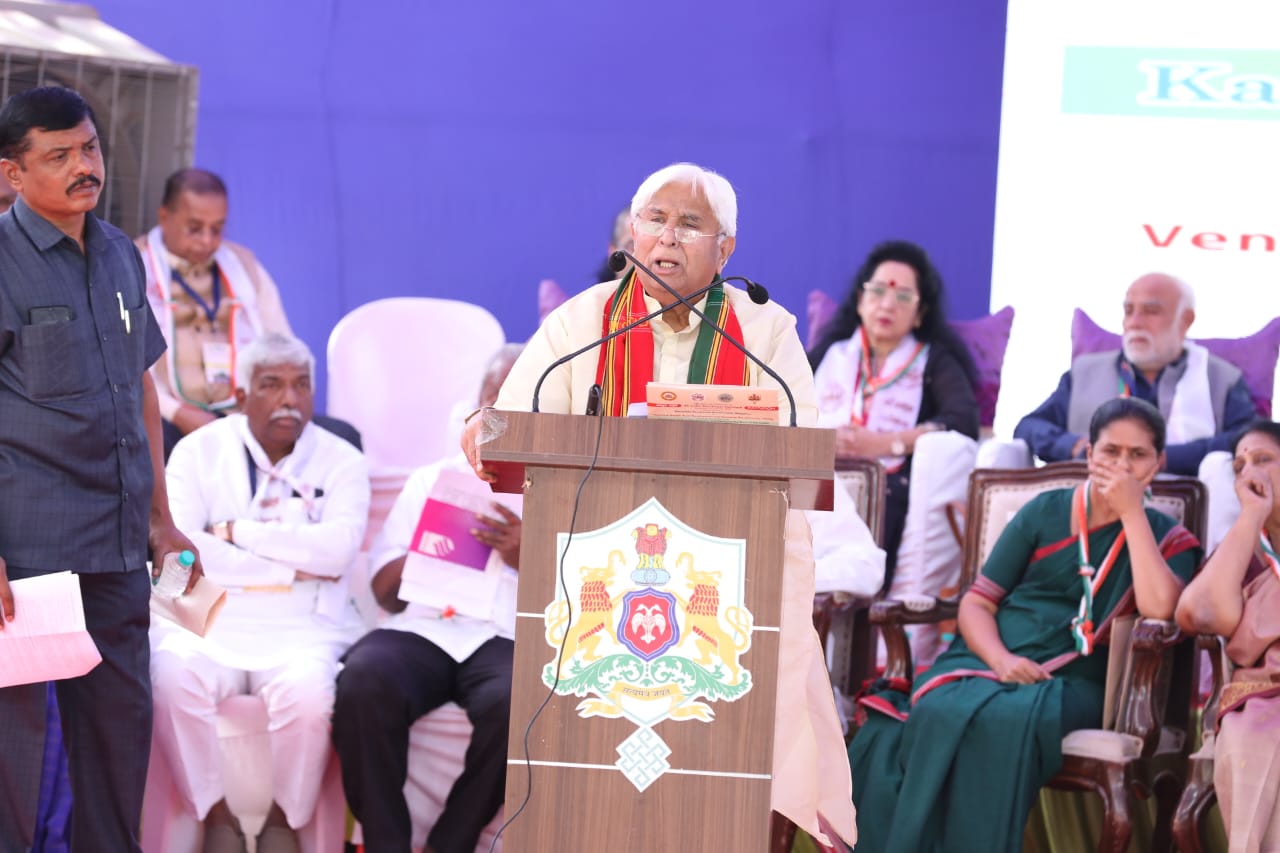
HK Patil Tourism Law and Parliamentary Affairs Minister of Karnataka and the chief guest of inaugural ceremony at AIPP meet in Gadag.
 By Kaushal Kishore
Traditional Nyaya Panchayat in the Age of Constitutional Courts
Gadag (Karnataka): The 18th National Conference of the All India Panchayat Parishad (AIPP), held this month in Gadag district of North Karnataka, focused on promoting the traditional Nyaya Panchayat, advancing the “No More Tide Funding” resolution, and emphasising the devolution of powers to local bodies. The resolutions underscored the continued relevance of village self-rule in India’s democratic framework.
Karnataka leader Siddaramaiah has long recognised the Patils from Hulkoti, renowned for their cooperative movement in Gadag district, as the most suitable advocates of the state government for the conference, which took place on the campus of Mahatma Gandhi Rural Development and Panchayati Raj University, Gadag. On one hand, the event resembled a Kumbh Mela of gaon-panchayats; on the other, it marked the centenary of Herold Laski’s concept of self-rule as proposed in A Grammar of Politics (1925). The national capital last hosted such a conference in 2008, inaugurated by then Lok Sabha Speaker Somnath Chatterjee. The dialogue series itself began in 1958, when Jayaprakash Narayan and Balwantrai Mehta convened in Jasidih near Devghar, Jharkhand, then part of Bihar.
Tourism, Law and Parliamentary Affairs Minister of Karnataka, H.K. Patil, revisited the Birkenhead challenge and referenced former British Prime Minister Winston Churchill in his inaugural address on the constitutional Panchayat. Despite being part of a Congress government, Patil has received repeated top transparency awards from leaders, including Narendra Modi and Yogi Adityanath. D.R. Patil, deputy chairman for decentralised planning and vice chairman of Karnataka’s Policy and Planning Commission (PPC), declared that devolving powers over 29 departments is their first priority, pledging to continue the fight until it is achieved. Observers compared him to Bal Gangadhar Tilak.
Tilak’s legacy, 115 years ago, was highlighted by British journalist Valentine Chirol, who described Tilak—editor of Mahratta and Kesari, known for coining the slogan “Swaraj (self-rule) is our birthright”—as the father of Indian unrest. Inspired by this, the council passed a resolution requesting a mid-term survey across states. Councils and relevant departments were asked to submit reports after thorough scrutiny of all major parameters.
The Patils invited Waterman Rajendra Singh, Gandhi Smarak Nidhi leader Annamalai, and several others, including the author, to recollect Gandhi’s dreams of Gram Swaraj as described in Hind Swaraj (1909) and align them with the United Nations’ Sustainable Development Goals (SDGs) adopted since 2015.
Waterman Singh raised critical questions about how the concept of justice has been reduced to mere decision-making. He cited a controversial Supreme Court verdict redefining two-billion-year-old ecological formations of the Aravalli, highlighting the continued significance of the Nyaya Panchayat. Just three days before his retirement, former Chief Justice B.R. Gavai delivered a ruling on 20 November that redefined mining limits below 100 metres, creating a de facto Lakshman Rekha. Before concluding his address, he reaffirmed the duties of every village and Panchayat, including recognising commendable work and addressing wrongdoing. His statesmanship attracted attention from across the country.
Annamalai referred to Gandhi’s Hind Swaraj, recalling the resignation of bullock-cart-driving Planning Commission member J.C. Kumarappa and the critiques of Indian arts and culture by Sri Lankan-born Tamil-American Ananda Coomaraswamy. He also highlighted the contributions of Pranjivan Mehta, anthropologist Nirmal Kumar Bose, and tribal rights advocate Thakkar Bapa.
Two close associates of AIPP leader Subodh Kant Sahay—Anil Sharma and Dhyan Pal Singh—presented two clauses of the resolutions. In addition to the Ram Krishna Hegde model of Panchayat, they remembered post-Gandhian proponents of Gram Swaraj, including J.P. (Jayaprakash Narayan), Dr. Lal Singh Tyagi, Pt. Binodanand Jha, S.K. Dey, and Balwantrai Mehta, as well as the School of Statesmanship, initiated in 1966 with support from S. Nijalingappa, Sucheta Kriplani, and K. Kamraj.
Dhyan Pal Singh emphasised that Article 5 of the Constitution defines nationality in terms of citizenship, converting villagers and tribes into citizens while eroding their true identities. He argued for a constitutional amendment to allow villagers and tribes to be identified appropriately, enabling them to claim the heritage of Hind Swaraj or Indian Home Rule.
Anil Sharma highlighted the concept of Nyaya Panchayat and the four-year training centres (Chatushpathi Kendra) teaching justice administration. He referred to five scholars—Aksapada Gautama, Udyotkara, Vatsyayana, Prabhakara, and Udayana—and noted the millennium-old Nabadwip School of Navya Nyaya, founded on the banks of the Hooghly River in West Bengal’s Nadiya district. The revival of these training centres and the proposal for a five-member expert committee were discussed to ensure the effective functioning of Nyaya Panchayats.
Venketrao Ghorpade, in his presidential address at the valedictory session, appreciated Panchayati Raj Minister Priyank Kharge for sponsoring the events and reiterated the slogan “No More Tide Funding.” While southern states like Karnataka and Kerala face fewer challenges, many local bodies across India, both urban and rural, continue to struggle with planning capacity.
H.K. Patil has been a key public figure since the inception of the separate Rural Development and Panchayati Raj University in Karnataka and served as Rural Development and Panchayati Raj Minister from 2013 to 2018. Earlier this year, the university was renamed after Mahatma Gandhi, reflecting the state government’s commitment to comprehensive rural development and enabling research to achieve its objectives. The revival of Nyaya Panchayat training programmes is expected to become one of the university’s most meaningful academic efforts.
Harold Laski, the London School of Economics (LSE) professor and Labour Party leader, was a strong proponent of self-governance. His works influenced S.K. Dey, V.K. Krishna Menon, and Jawaharlal Nehru, and his Grammar of Politics remains a valuable resource for Panchayati Raj students.
Gangesh Upadhyay and Kirtyanand Jha represented opposite ends of the millennium-old Nyaya tradition. Following the recent passing of Professor Jha of Banaras Hindu University (BHU) and Mithila University, Surendra Jha, former producer and editor of All India Radio (AIR), is positioned to lead the expert team dedicated to reviving the Indian school of Nyaya.