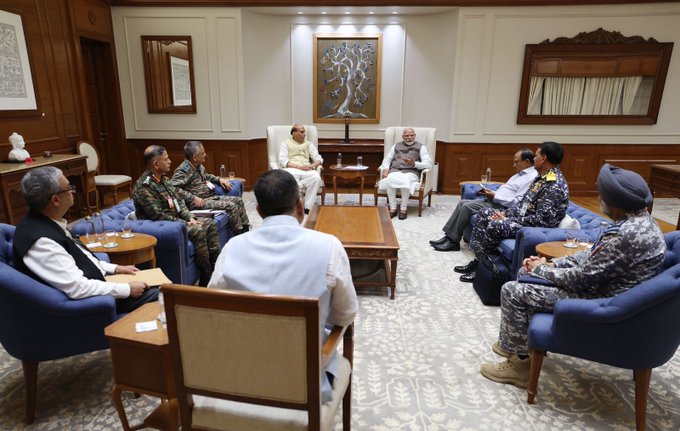
Prime Minister Narendra Modi chaired a meeting, which was attended by Defence Minister Rajnath Singh, National Security Advisor Ajit Doval, CDS General Anil Chauhan, Chiefs of the armed forces and senior officials.
New Delhi: As night fell on 9 May, Pakistani shelling and drone attacks struck India’s western border, shattering a home in Firozepur, Punjab, and leaving three residents and their livestock wounded who have since received medical care, and the area has been secured by security forces. Indian armed forces, with steadfast resolve, neutralised the onslaught, yet the strike, 10 kilometres from the Pakistan border and unfolding hours after Foreign Secretary Vikram Misri’s press briefing, laid bare the conflict’s toll on civilians. Misri condemned Pakistan’s “cowardly actions,” linking the escalation to India’s Operation Sindoor, which dismantled terrorist camps days earlier, as Pakistan’s disinformation faltered. The assault prompted Prime Minister Narendra Modi to convene an urgent meeting with Defence Minister Rajnath Singh, National Security Advisor Ajit Doval, Chief of Defence Staff General Anil Chauhan, and armed forces chiefs to bolster India’s response.
Drones launched by Pakistan up till midnight of May 9-10 were observed at 26 sites along the International Border and Line of Control with Pakistan, including suspected armed drones, the Indian Defence Ministry stated. The identified locations encompassed Baramulla, Srinagar, Avantipora, Nagrota, Jammu, Ferozpur, Pathankot, Fazilka, Lalgarh Jatta, Jaisalmer, Barmer, Bhuj, Kuarbet, and Lakhi Nala. The Indian Defence Ministry said the Indian Armed Forces are on high alert, actively monitoring and addressing all aerial threats with counter-drone systems. “The situation is being closely monitored, and prompt actions are being taken as needed,” it stated, urging citizens, particularly those in border regions, to stay indoors, minimize unnecessary movement, and adhere to safety guidelines from local authorities. “While there is no cause for alarm, increased vigilance and caution are crucial,” it emphasised.
Hours earlier, Indian forces intercepted several drones across 36 locations along the International Border and the Line of Control, as detailed by Colonel Sofia Qureshi in the briefing. She identified the 300 to 400 drones as ASISGUARD Songar models from Turkey, targeting military infrastructure from Leh to Sir Creek. A Pakistani armed Unmanned Aerial Vehicle aimed at Bathinda military station was neutralised, with forensic analysis of debris underway. Pakistan’s heavy-calibre artillery and armed drones pounded Tangdhar, Uri, Poonch, Mendhar, Rajouri, Akhnoor, and Udhampur, claiming Indian soldiers’ lives and wounding others. India retaliated, striking four Pakistani Air Defence sites with armed drones, one destroying a radar. Qureshi suggested the incursions sought to probe India’s Air Defence systems and gather intelligence, closing with a resolute, “Thank you, Jai Hind.”
The human cost was heart-rending. In Poonch, a Pakistani shell on May 8-9 struck a Gurdwara, killing local Sikhs, including the revered Ragi, an attack whose televised images, as Misri noted, “you can see on the television,” shocked the nation. On 7 May, another shell hit near Christ School, operated by the Carmelites of Mary Immaculate in Poonch, killing two students and injuring their parents, while damaging the Mother of Carmel convent’s water tanks and solar panels. Priests, nuns, and residents sought refuge in an underground hall, spared further tragedy as the school was closed. The Firozepur strike, reducing a home to rubble, deepened the grief. Misri described these attacks as a “new low,” accusing Pakistan of targeting Gurdwaras, churches, and temples to inflame communal tensions, a tactic echoing the barbaric 22 April Pahalgam attack, where terrorists massacred tourists in a religion-based assault—the deadliest since Mumbai 2008.
The Pahalgam atrocity, with its brutal execution of innocents, spurred Operation Sindoor, launched on May 6-7, 2025, to dismantle nine terrorist camps in Pakistan and Pakistan-occupied Kashmir. The targets included Lashkar-e-Taiba’s Abbas camp, focused on weapons training, and Gulpur camp, dedicated to explosives training, both in Kotli; Jaish-e-Mohammad’s Bahawalpur headquarters, training suicide squads and planning airbase attacks; Muzaffarabad’s Sawai Nala, a hub for infiltration, and Shyedna Bilal, a recruitment centre; Sialkot’s Sarjal, handling logistics, and Mehmooda Zoya, producing propaganda; Bhimber’s Barnala, specializing in jungle warfare; and Muridke’s Markaz Tayyaba, devoted to ideological indoctrination. The 25-minute missile barrage, with videos released publicly, killed 31 terrorists, 70 supporters, and 10 family members of Jaish-e-Mohammad leader Masood Azhar. Inspired by United States and Israeli tactics, and driven by Prime Minister Modi’s zero-tolerance policy, the strikes signalled India’s readiness for further action. Defence Minister Singh reviewed preparedness in a South Block meeting with General Chauhan, Army Chief General Upendra Dwivedi, Naval Chief Admiral Dinesh K Tripathi, Air Chief Marshal Amar Preet Singh, and Defence Secretary Rajesh Kumar Singh.
Pakistan’s response exposed its duplicity. After a failed drone and missile attack on May 7 at 20:30, Pakistan kept its civilian airspace open, endangering airliners like a Flynas Aviation Airbus 320, which flew from Dammam at 17:50 and landed in Lahore at 21:10 during a high-alert period, as Flightradar24 data confirmed. India, by contrast, closed its airspace, ensuring no civilian flights operated, a restraint Wing Commander Vyomika Singh underscored. Pakistan Prime Minister Shehbaz Sharif posted on X: “Spoke with my dear brother President Recep Tayyip Erdogan and thanked him for Türkiye’s solidarity and support with Pakistan at this critical time. Appreciate the prayers of our Turkish brethren for the martyrs of yesterday’s heinous missile strikes carried out by India. Briefed him on the valiant efforts of our armed forces, who repulsed the enemy with their bravery and professional superiority. We will protect our sovereignty and territorial integrity at all costs. Pakistan is grateful for Turkish efforts to promote de-escalation and maintain peace in South Asia.” Yet, Pakistani journalist Aftab Iqbal’s demand for evidence and cleric Maulana Abdul Aziz Gazi’s silence undermined Pakistan’s claims. Misri dismissed Pakistan’s accusations of India targeting Amritsar and Nankana Sahib Gurdwara as a “deranged fantasy,” accusing it of stoking communal discord.
India stood united in defiance. All political parties praised Operation Sindoor, with Pahalgam victims’ families demanding justice. Public celebrations embraced “sindoor ki raksha”—the vow to safeguard India’s sovereignty—as a rallying cry. The Kartarpur Corridor, a vital Sikh pilgrimage route, was suspended, Misri confirmed, citing security risks. Amid fears of economic disruption, Union Minister for Consumer Affairs, Food and Public Distribution Pralhad Joshi assured ample food stocks: 356.42 Lakh Metric Tonnes of rice, against a norm of 135 Lakh Metric Tonnes; 383.32 Lakh Metric Tonnes of wheat, against 276 Lakh Metric Tonnes; 17 Lakh Metric Tonnes of edible oil; and 50 Lakh Metric Tonnes of sugar, after 257 Lakh Metric Tonnes produced, 280 Lakh Metric Tonnes consumed, and 10 Lakh Metric Tonnes exported. Joshi warned traders against hoarding, threatening prosecution under the Essential Commodities Act.
The conflict exposed regulatory gaps. The Central Consumer Protection Authority issued notices to 13 e-commerce platforms—Amazon, with 467 listings; Flipkart, with 314 listings; Meesho, with 489 listings; TradeIndia, with 423 listings; OLX; Facebook; Indiamart; VardaanMart; Jiomart; Krishnamart; Chimiya; Talk Pro Walkie Talkie; and MaskMan Toys—for selling walkie-talkies without disclosing frequency ranges, licensing requirements, or Equipment Type Approval from the Wireless Planning and Coordination Wing, violating the Consumer Protection Act, 2019. The Central Consumer Protection Authority requested: names and contact details of sellers, product URLs and listing identifiers, frequency specifications, licensing information displayed, Equipment Type Approval or Wireless Planning and Coordination certification verification, and units sold per listing since January 2023. Following a stakeholder meeting on 3 May 2025, chaired by Secretary Smt. Nidhi Khare, the Central Consumer Protection Authority, proposed draft guidelines under Section 18(2)(l) of the Consumer Protection Act, 2019, to mandate due diligence before listing, seller credential and certification verification, automated monitoring and takedown of unauthorized listings, consumer awareness through disclosures, and penalties for non-compliance. A letter was sent to the Ministry of Home Affairs and the Department of Telecommunications for input. A prior advisory led to the removal of 13,118 car seat belt alarm stopper clip listings, reflecting the Central Consumer Protection Authority’s proactive stance.
Globally, the conflict drew urgent calls for restraint. United States Secretary of State Marco Rubio, in a press briefing, urged de-escalation in talks with Sharif and India’s External Affairs Minister S Jaishankar, advocating dialogue but not mediation. Jaishankar, also engaging the United Kingdom’s David Lammy and Norway’s Espen Barth Eide, emphasised India’s targeted measures post-Pahalgam, which Rubio linked to countering terrorism.
India today voiced strong concerns at the International Monetary Fund board meeting reviewing Pakistan’s Extended Fund Facility loan of $1 billion and a proposed Resilience and Sustainability Facility loan of $1.3 billion. Indian Finance Ministry stated that as a responsible member, India questioned the efficacy of these programmes, citing Pakistan’s poor track record, with disbursements in 28 of the last 35 years since 1989 and four programmes since 2019, suggesting flaws in programme design, monitoring, or implementation. India highlighted the Pakistan military’s outsized role in economic affairs, including through the Special Investment Facilitation Council and military-linked businesses, described in a 2021 United Nations report as the “largest conglomerate in Pakistan.” India warned that fungible funds could fuel “state-sponsored cross-border terrorism,” a concern echoed by several members but constrained by the International Monetary Fund’s procedural limits. Citing the International Monetary Fund’s report on Prolonged Use of Resources, India noted political influences in Pakistan’s bailouts, rendering it a “too big to fail debtor.” India abstained from the vote, urging global financial institutions to address moral risks in lending, a stance the International Monetary Fund acknowledged.
Misri tied Jaish-e-Mohammad’s Bahawalpur base to the 2002 killing of Wall Street Journal journalist Daniel Pearl, implicating British-Pakistani jihadi Ahmad Omar Saeed Sheikh, released in 2000. Pakistan’s disinformation, from denying its attacks to blaming India, has failed to sway global opinion. As India vows further action, the conflict’s wounds—grieving Sikhs in Poonch, slain students in a Christian school, shattered lives in Firozepur—demand accountability, leaving South Asia on a knife’s edge.
– global bihari bureau