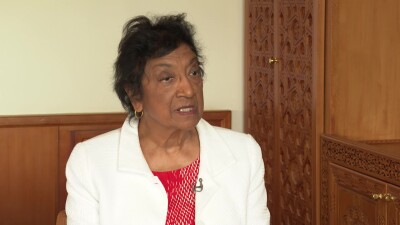
Navi Pillay
From Apartheid to Gaza: Analysing Pillay’s Role in Shaping Genocide Law
Geneva: The retirement of Navi Pillay, Chair of the United Nations Independent International Commission of Inquiry on the Occupied Palestinian Territory, including East Jerusalem, and Israel, marks not merely the end of a personal career but a moment of reckoning for the global human rights system she served for over five decades. Her departure underscores a deeper question that has troubled international justice for years — how effective are the institutions meant to protect the vulnerable when power politics still dictate their limits?
Pillay’s career offers a lens through which to examine that dilemma. From the apartheid courts of South Africa to the tribunals of Rwanda and the chambers of the United Nations, her life’s work has revolved around the world’s attempts — and frequent failures — to turn moral conviction into enforceable justice.
“The Security Council having the veto is deeply frustrating,” she admitted in one of her final interviews. “Their job is to ensure peace, and yet conflicts and killings are taking place without any intervention. It’s a flawed system. But it’s still the best we have today.” Her words echo a sentiment shared by many within the UN system who have struggled to reconcile principle with power.
That frustration has been particularly visible in her final assignment — leading the Commission of Inquiry on the Occupied Palestinian Territory. Her final role brought her once again to the front lines of global controversy.
The Commission’s recent report found that the State of Israel bore responsibility for four genocidal acts in Gaza, carried out with the intent to destroy Palestinians living there. “We also found that the Israeli President, Prime Minister, and former Defence Minister have incited the commission of genocide,” she stated. According to the Commission’s findings, Israeli officials had “demonstrated a clear and precise intent to establish permanent military control over Gaza and to change its demographic composition. The objectives of ethnic cleansing and settlement remain firmly in place.” On the war in Gaza, Pillay stressed: “The statements made by the top politicians do amount to incitement to genocide.”
Predictably, such findings have drawn strong reactions from governments and political figures, some of whom accused her of bias — charges she flatly rejects. “I would prefer that our critics tell us which piece of that evidence is false, and why,” she said. “Much of this information came from people inside Israel. Tell us which factor is wrong.”
The exchange reflects a familiar tension in international law — between evidence and narrative, legality and legitimacy. The Commission’s work, like many before it, has struggled against the absence of enforcement mechanisms in the UN system. Investigations may document atrocities, but prosecutions often depend on the will of powerful states.
This imbalance has defined global human rights since the founding of the United Nations. Pillay’s reflections draw attention to how far civil society, rather than governments, has driven change. “When the UN started, it was just a club for the States,” she said. “Everything we have today for human rights protection didn’t happen just because the States woke up one day. It comes from the pressure of civil society. That’s why I value these institutions.”
Her point speaks to a larger truth — that international norms have evolved not from the generosity of governments but from sustained public demand. From the anti-apartheid movement that once isolated South Africa to the campaigns for accountability in Rwanda and the Balkans, collective pressure has repeatedly forced the global system to confront its own inertia.
Pillay’s early experiences in apartheid South Africa illustrate this dynamic. Few lives have embodied the global struggle for human dignity as completely as Navi Pillay’s. From a childhood spent in the segregated townships of apartheid South Africa to the chambers of the United Nations, her journey has been one of persistence, moral courage, and faith in the power of justice to change lives. Now, after more than five decades of defending the vulnerable and confronting power, as Pillay steps down as Chair of the United Nations Independent International Commission of Inquiry on the Occupied Palestinian Territory, including East Jerusalem, and Israel, her path to this point began far from the world’s diplomatic capitals. “We grew up very poor,” she recalled. “My father was a bus driver, and then seven children — the usual seven children. I tell the story because most people assume that in my country, if you are Indian, you’re better off than the African people. But all of us were poor, and we struggled together.” She paused before adding, “It’s worth it — one’s reward is worth it when you have helped someone who’s helpless.”
From those early hardships, Pillay drew both empathy and resolve. Her work in those years taught her the value of collective action. As a young lawyer, she became the first to open the country’s first non-white female-run practice, defending political prisoners and activists who had no access to justice. “We are very grateful for the collective action taken by the whole world to end apartheid,” she later reflected. “I didn’t think apartheid would end in my lifetime. So, what happened? We had the collective support of people all over the world, even children.”
That conviction — that solidarity can bend the arc of history — became the foundation of her international career. As a judge at the International Criminal Tribunal for Rwanda (ICTR), she helped establish new legal precedents for justice after genocide. “Working in the Rwanda tribunal was extremely difficult,” she remembered. “It was a rural area. When we first went there, there was no bank or supermarket, no postal addresses. I complained and complained until I started listening to the witnesses. And what am I complaining about when they’ve been through so much suffering?”
At the ICTR, Pillay presided over landmark cases, including the first in international law to recognise rape as an act of genocide — a ruling that transformed global understanding of gender-based violence during conflict. The precedent expanded the scope of international law to include gender-based crimes within definitions of war and genocide.
Her work in Rwanda led to her appointment as a judge on the International Criminal Court and later, in 2008, as the United Nations High Commissioner for Human Rights. In Geneva, she championed the inclusion of civil society and victims’ voices in shaping international human rights standards.
Yet the progress she helped achieve also highlighted enduring contradictions. The tribunals for Rwanda and Yugoslavia, though historic, depended heavily on political consensus and selective funding. The International Criminal Court, too, has faced accusations of imbalance — pursuing cases in Africa while avoiding politically sensitive investigations elsewhere. Pillay’s tenure as High Commissioner for Human Rights exposed her to similar pressures, where advocacy for victims often collided with geopolitical caution.
Her career thus traces the uneasy journey of the human rights movement itself — from moral aspiration to institutional bureaucracy, from the language of solidarity to the calculations of statecraft. The question that remains, as she exits, is whether the system she served can act decisively without the sanction of power.
Pillay’s story may have begun in Durban, but its message belongs to the wider world. It is a reminder that the struggle for justice cannot rest on institutions alone. Laws, commissions, and courts matter — but so does the collective conscience that sustains them. As she once put it, “It’s worth it — one’s reward is worth it when you have helped someone who’s helpless.”
Throughout her long and often controversial career, Pillay has maintained a consistent stance — that human rights are indivisible, and that silence in the face of injustice is never an option. From the dusty courtrooms of Durban to the marble halls of Geneva, she has spoken truth to power with quiet conviction, driven by a belief that justice, however slow, remains humanity’s last hope.
Her departure from the United Nations marks the end of an extraordinary chapter in the global human rights movement — and the close of a personal journey that began with a bus driver’s daughter who refused to accept the limits imposed by history.
Her departure may close a distinguished chapter, but the unfinished work she leaves behind continues to test the credibility of global governance itself. In an era when conflicts rage and accountability remains elusive, the question Navi Pillay has embodied throughout her life endures: can the world’s institutions defend human dignity against the weight of power?
— global bihari bureau