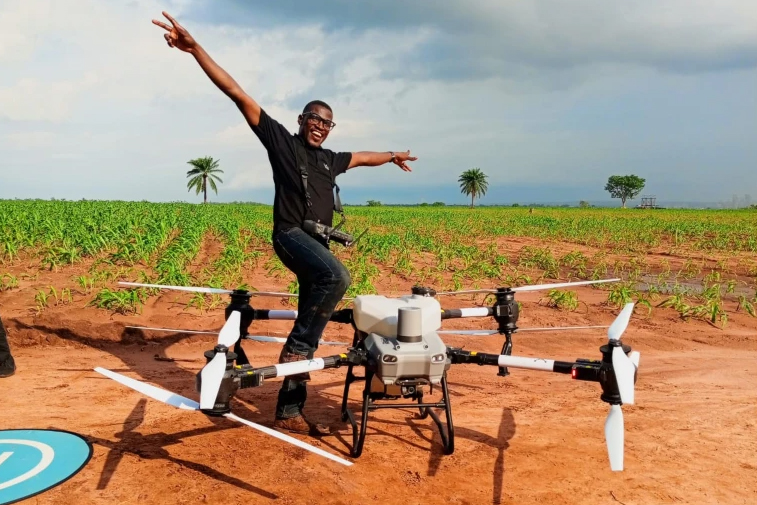
In Nigeria, The Flying Farmer, Femi Adekoya, is using agricultural drones to transform how crops are managed. © Femi Adekoya.
How Africa Is Redefining Farm Mechanisation: Five Stories
Rome/Accra/Abuja: A new wave of innovation is redefining agricultural mechanisation across Africa, turning machines into tools of empowerment for farmers rather than symbols of failed development experiments. With a focus on sustainability, inclusivity and local design, countries across the continent are adopting technologies that reduce drudgery, raise productivity and create new opportunities for women and young people, according to the Food and Agriculture Organization of the United Nations (FAO).
Early mechanisation drives in Africa during the 1960s and 1970s were launched with high hopes but delivered limited results. Large tractors and imported machinery were often mismatched to local realities of small plots, narrow tracks and poor rural roads. Farmers also faced limited access to spare parts and repair services, and many programmes collapsed when equipment broke down or when maintenance and operating costs became unaffordable.
Today, FAO says a different approach is taking hold, one centred on locally adapted technologies and community-driven innovation. Working with governments, universities and farming communities, the UN agency is promoting machines that fit the African context while supporting skilled employment for women and youth.
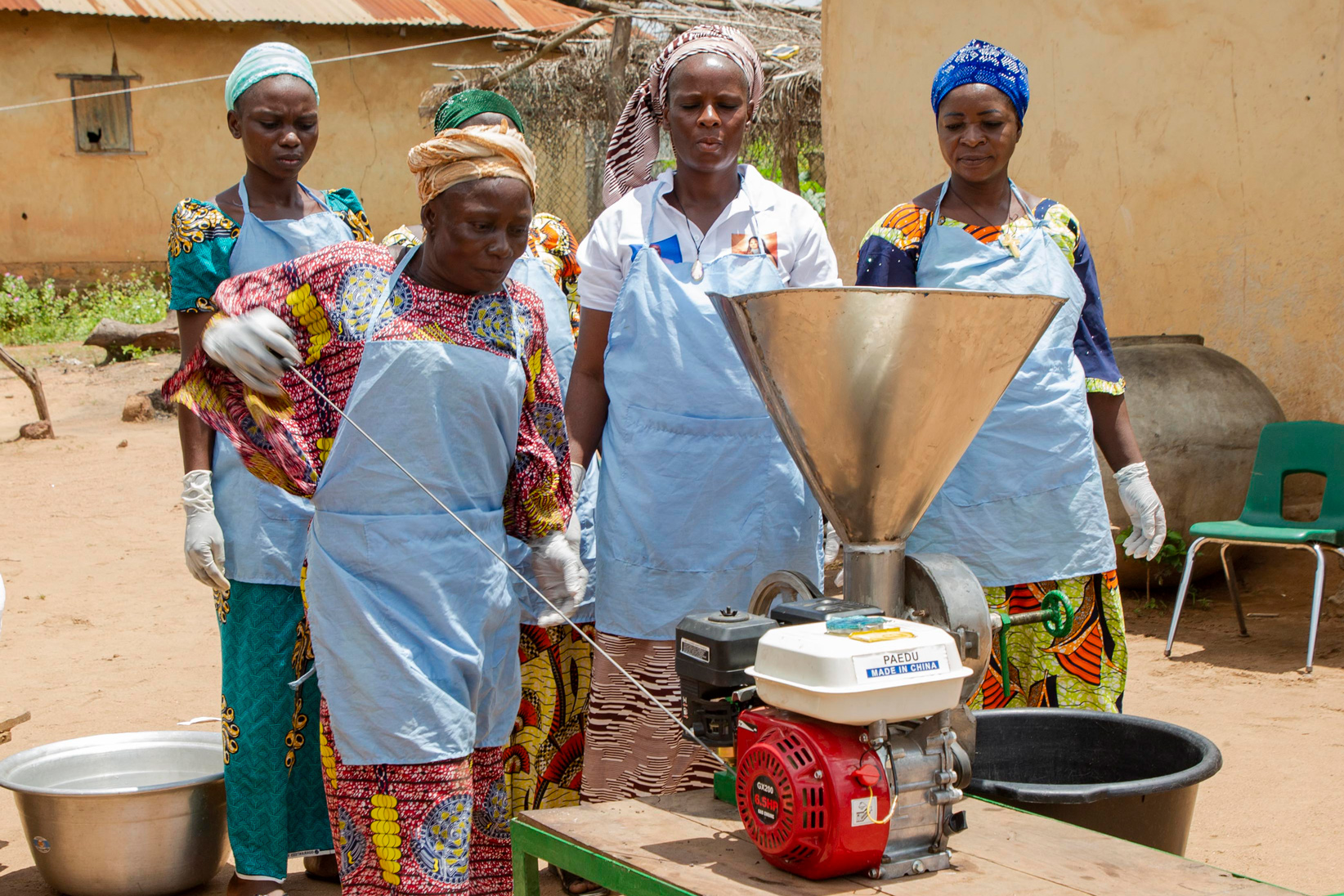
In Ghana, mechanisation is transforming the processing of fonio, a nutritious ancient grain that has traditionally required days of labour by hand. A collaboration between FAO, the Ministry of Food and Agriculture and FAO Regional Goodwill Ambassador for Africa, Chef Fatmata Binta, has introduced machines that mill and dehull fonio in a fraction of the time. Previously, the tiny grains were threshed, washed and dried on the ground, where sand and impurities often mixed in, forcing consumers to wash them again before cooking. New drying techniques that keep grain off the ground, together with mechanised processing, have improved food safety and quality, enabling women farmers to earn higher prices in the market.
In Nigeria, farming has taken to the skies. Farmer and entrepreneur Femi Adekoya, known as “The Flying Farmer,” uses agricultural drones to manage crops on small and medium-sized farms. The drones support crop monitoring and field mapping, helping farmers identify pest outbreaks, nutrient deficiencies and water stress at an early stage. They are also used for precision spraying of pesticides and liquid fertilisers, reducing chemical use, lowering costs and improving safety. Beyond operating drones himself, Adekoya trains other young agripreneurs in drone operation, maintenance and data interpretation, creating service-based rural businesses. His work has been highlighted by FAO at regional and international events as an example of how modern, technology-driven agriculture can generate employment for youth.
In the United Republic of Tanzania, engineers at Sokoine University of Agriculture have developed a farming robot that moves systematically between crop rows and applies inputs with accuracy and efficiency. In partnership with the private sector, the university is also producing the Mobi Power tractor, a compact, multi-functional machine designed for ploughing, planting, spraying, mowing and transport. Its small size allows it to navigate narrow paths and irregular plots common to smallholder farms, while local production ensures affordable maintenance and repairs. FAO promotes such context-specific and inclusive solutions through policy guidance, Farmer Field Schools, agricultural roadshows and knowledge-sharing platforms.
Rwanda has become a centre of rural innovation through a national initiative emerging from FAO’s Global Innovation Challenge on Sustainable Agricultural Mechanisation. Through Farmer Field Schools, smallholder farmers are gaining access to tools such as mobile solar dryers for grain and tubers, cassava chippers and mechanised threshers that cut manual labour, save time and reduce post-harvest losses. With FAO funding and technical support, youth are being trained as machine operators, technicians and service entrepreneurs. By combining practical training with business mentoring, the programme is fostering a generation of rural innovators who view mechanisation not as a threat to jobs but as a source of better and more skilled employment.
In Benin, mechanisation is easing the heavy physical burden borne by women, who form the backbone of agricultural labour across the continent. A project implemented by FAO and financed by Germany’s Agency for International Cooperation (GIZ) has introduced small-scale machines for rice, cassava and soybean processing to 15 cooperatives. Back-breaking manual work has been replaced by tools such as rice dehuskers and parboilers and cassava chippers that crush peeled roots into mash for drying and further processing into gari or flour. With greater output in less time and higher-quality products, women have been able to establish profitable processing enterprises and supply local markets more effectively.
FAO says these experiences show that mechanisation can succeed when it responds directly to farmers’ needs and local conditions. By providing neutral spaces for exchange and showcasing locally developed solutions, the organisation is helping accelerate learning and support the scaling up of sustainable agricultural mechanisation across Africa, turning machine power into a driver of empowerment rather than exclusion.
Source: The FAO News and Media Office, Rome.
– global bihari bureau