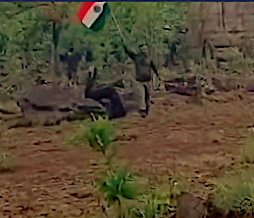
New Delhi: In the biggest-ever operation against Naxalism in the country, security forces killed 31 Naxalites, including 16 female cadres, in a 21-day operation from April 21 to May 11, 2025, at Karreguttalu Hill (KGH) on the Chhattisgarh–Telangana border, without any casualties among the forces.
Union Home Minister and Minister of Cooperation Amit Shah announced today in New Delhi that the Karreguttalu Hill, once the Unified Headquarters of the Naxal groups – the People’s Liberation Guerrilla Army (PLGA) Battalion 1, Dandakaranya Special Zonal Committee (DKSZC), Telangana State Committee (TSC), and Central Regional Company (CRC) – now “proudly hoists the tricolour, symbolising the end of red terror in the region”. Shah reiterated that India is steadfast in eliminating Naxalism by March 31, 2026, stating, “The entire country is proud of our brave personnel who faced Naxalites with valour.”
The operation, named ‘Operation Black Forest’, stands as the largest anti-Naxal campaign to date, executed by the Central Reserve Police Force (CRPF), Special Task Force (STF), and District Reserve Guards (DRG). Shah lauded the personnel for their bravery in extreme 45-degree Celsius temperatures and rugged, hilly terrain, completing the campaign in just 21 days. Across 21 encounters, forces recovered 35 weapons, 450 improvised explosive devices (IEDs), 818 barrel grenade launcher (BGL) shells, 899 bundles of Codex detonators, a substantial quantity of explosive materials, 12,000 kilograms of food supplies, medicines, and daily-use items. They destroyed 214 Naxal hideouts and bunkers, including four technical units producing BGL shells, IEDs, homemade weapons, and other deadly armaments, significantly weakening Naxal infrastructure.
The Karreguttalu Hill, a 60-kilometre-long, 5-to-20-kilometre-wide region spanning Bijapur in Chhattisgarh and Mulugu in Telangana, was a formidable Naxal stronghold, considered impregnable due to its challenging terrain, including hundreds of caves and ambush points. Over the past two and a half years, approximately 300-350 armed Naxal cadres, including the PLGA’s Technical Department (TD Unit), used KGH for training, strategy development, and weapon production. Of the 31 Naxalites neutralised, 28 were identified, carrying a combined reward of Rs. 1 crore 72 lakh, likely from the banned PLGA Battalion, CRC Company, or TSC. Analysis indicates several senior Naxal cadres were killed or seriously injured, though the difficult terrain has hindered the recovery of all bodies.
The operation’s success hinged on seamless coordination among state and central agencies, reflecting the government’s “whole-of-government” approach. A multi-agency special team, comprising Chhattisgarh Police and Central Armed Police Forces (CAPFs), collected, collated, and analysed technical, human, and field intelligence from various agencies. Real-time analysis relayed to field commanders enabled forces to locate Naxal operatives, hideouts, and arms caches, while preventing casualties from IEDs on multiple occasions. This intelligence-driven approach facilitated the recovery of significant explosive materials, disrupting Naxal operations.
In a joint press conference in Bijapur, CRPF Director General Gyanendra Pratap Singh, Chhattisgarh Director General of Police Arun Dev Gautam, and Additional Director General (ADG) for Anti-Naxal Operations detailed the campaign’s scope. They highlighted the recovery of 31 uniformed Naxalite bodies and the destruction of key infrastructure, underscoring the operation’s unprecedented scale. The campaign aimed to reduce Naxal armed capabilities, neutralise armed squads, drive Naxal elements from inaccessible areas, and dismantle the brutal PLGA Battalion, a core objective of the operation.
The Karreguttalu Hill’s strategic importance grew after security forces established numerous camps in the Sukma and Bijapur border areas, traditional Naxal strongholds hosting top cadres of the PLGA Battalion, CRC Company, and TSC. These camps bolstered security dominance, prompting Naxalites to form a Unified Command and retreat to KGH over the past two and a half years. Based on precise intelligence inputs, Chhattisgarh Police and CAPFs launched the large-scale joint operation on April 21, 2025, meticulously planned to address KGH’s challenges.
The operation faced significant obstacles, with 18 personnel from the Commando Battalion for Resolute Action (CoBRA), STF, and DRG injured in IED explosions. All injured personnel are now stable and receiving the best possible treatment at various hospitals. Daytime temperatures exceeding 45 degrees Celsius caused dehydration among soldiers, yet their morale remained high, undeterred by KGH’s harsh conditions. Forces were thoroughly briefed on the terrain’s complexities, including hundreds of caves, ambush points, and IED dangers, ensuring operational clarity and minimising confusion.
Logistics were a cornerstone of the campaign, with a large number of forces, equipment, and resources mobilised professionally. The multi-agency team conducted meticulous planning, determining the strength of deployed forces, scheduling continuous mobilisation, and arranging timely replacements. Detailed briefings provided forces with comprehensive information about their operational area, enhancing effectiveness. The intelligence team’s real-time analysis was critical, enabling forces to navigate KGH’s terrain and avoid IED threats, contributing to the operation’s success.
The operation at the Karreguttalu Hill aligns with Shah’s Joint Action Plan, which emphasises filling security gaps through new camps, implementing development schemes in Naxal-affected districts for holistic regional development, and taking “effective” action against hardcore Naxal cadres and their ecosystem. This strategy has inflicted heavy damage on Naxal structures, significantly reducing their influence. In the first four months of 2025, security forces neutralised 197 hardcore Naxalites, building on 928 surrenders in 2024 and 718 in 2025. Naxal-affected districts decreased from 126 in 2014 to 18 in 2025, with the most-affected districts dropping from 35 to 6. Incidents fell from 1,080 across 330 police stIn the biggest-ever operation against Naxalism in the country, security forces killed 31 Naxalites, including 16 female cadres, in a 21-day operation in 76 districts in 2014 to 374 across 151 stations in 42 districts in 2024. Security personnel deaths declined from 88 in 2014 to 19 in 2024, while Naxalites killed in encounters rose from 63 to 2,089. Since 2019, 320 security camps, including 68 night-landing helipads, have been established in Naxal-affected states, and fortified police stations increased from 66 in 2014 to 555 in 2025.
The Karreguttalu Hill operation’s long-term impacts are evident, with large Naxal units fragmented into smaller groups, weakening their operational capacity. Security forces have strengthened their hold on Bijapur’s National Park area and Narayanpur’s Maad region, advancing India’s anti-Naxal strategy. Development schemes have supported local communities, further eroding Naxal influence. This historic operation, a testament to coordinated state-central efforts, has significantly disrupted the Naxal ecosystem, reinforcing India’s commitment to a Naxal-free nation by 2026, the Home Ministry stated.
– global bihari bureau