Arvind Kejriwal
Excise Case Ends at Trial Court After Four Years
Liquor Policy Verdict Reshapes Delhi Politics Again
New Delhi: A Delhi court today acquitted former Delhi Chief Minister Arvind Kejriwal, former deputy chief minister Manish Sisodia, and 21 others in the long-running excise policy corruption case, bringing to a close—at the trial court level—one of the most politically consequential prosecutions in recent Indian history.
The verdict was delivered by the Rouse Avenue Court after extended hearings on whether the prosecution had established sufficient grounds to proceed to trial. Discharging all 23 accused, the court held that the material placed before it did not disclose a prima facie case of criminal conspiracy or corruption. It observed that allegations and assumptions could not substitute for legally admissible proof and that the prosecution had failed to demonstrate criminal intent or personal benefit accruing to the accused from the formulation or implementation of the excise policy.
In its order, the court pointed to weaknesses in the investigation, noting that the case relied heavily on witness statements without adequate corroboration through documentary or financial evidence. It found gaps in the attempt to link policy decisions with any unlawful gain and remarked that the prosecution had not been able to establish a coherent chain connecting decision-making to criminal benefit. The court underlined that administrative or political decisions, however controversial, could not be criminalised in the absence of demonstrable conspiracy and traceable benefit.
Inside the packed courtroom, proceedings unfolded under heavy security and intense media presence. Prosecutors argued that the policy had been manipulated to favour select private entities, while defence counsel countered that the case was built on conjecture and selective interpretation of routine bureaucratic processes. After the discharge order was pronounced, the court cancelled the bail bonds of all the accused.
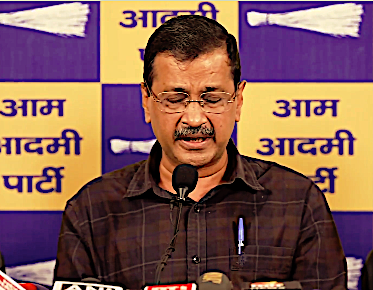
Outside the courtroom, Kejriwal appeared visibly emotional and broke down while addressing reporters, reflecting the strain of nearly two years of legal and political pressure. “I am not corrupt. The court has said that Kejriwal and Manish Sisodia are honest,” he said, adding that the verdict reaffirmed what he and his party had consistently maintained since the case began.
Soon after the judgment, senior leaders of the Aam Aadmi Party issued statements. Sisodia wrote, “Truth alone triumphs. Today, once again, I feel proud of Baba Saheb Ambedkar Ji’s Constitution. Despite all attempts to break us, it has been proven that Arvind Kejriwal and Manish Sisodia are honest.” AAP MP Sanjay Singh said the ruling had exposed what he described as a political conspiracy and that the court had “answered those who misused institutions to harass elected leaders.”
आख़िर में अधर्म और अन्याय हारता है और सच ही जीतता है।
सत्यमेव जयते pic.twitter.com/GZghEdhJf3
— Arvind Kejriwal (@ArvindKejriwal) February 27, 2026
Kejriwal also used his remarks to question the conduct of rival political parties, asking why leaders from other formations had not faced similar legal consequences in comparable cases. His comments indicated that the verdict would now be central to AAP’s effort to reconstruct its political narrative after years of sustained legal scrutiny and electoral setback.
The Bharatiya Janata Party responded cautiously, stating that the legal process was not yet complete and that the verdict would be examined for possible appeal. BJP spokespersons said the discharge was based on insufficiency of evidence at this stage and reiterated that investigative agencies were free to pursue remedies before higher courts. Party leaders also underlined that the political consequences of the case had already been reflected in the electoral verdict delivered by the people of Delhi.
Leaders of the Indian National Congress and other INDIA bloc partners acknowledged the judgment, saying it must be respected as part of the judicial process. Some opposition figures described the ruling as reinforcing the principle that criminal allegations must be supported by strong evidence, while refraining from drawing political conclusions.
The case originated from the Delhi government’s 2021–22 excise policy, which sought to restructure liquor retail through greater private participation. Allegations of irregularities and favouritism led to investigations by the Central Bureau of Investigation and the Enforcement Directorate, triggering arrests of senior AAP leaders and months of custodial and judicial detention. The controversy has spanned nearly four years, from the introduction of the policy in 2021 to the present verdict in 2026.
Kejriwal’s arrest in March 2024, while he was still serving as chief minister, marked a turning point in the case and drew national attention. Over the next year, multiple bail hearings and legal challenges followed, including scrutiny by the Supreme Court of India, which repeatedly stressed adherence to due process while allowing investigations to continue.
The prosecution and its fallout significantly reshaped Delhi’s political landscape. During 2024 and 2025, the excise policy case dominated public discourse, affecting governance and electoral campaigning. In the 2025 Delhi Assembly election, AAP lost power after more than a decade in office, a development widely seen as linked to the prolonged focus on corruption allegations and leadership arrests. The BJP has since argued that the electorate had already delivered its political verdict on the matter.
Today’s judgment reopens that political equation. For AAP, the court’s decision is being presented as legal vindication after years of reputational damage and institutional pressure. For its critics, the outcome does not necessarily signal closure, given the likelihood of appeal and the continuing proceedings linked to the Enforcement Directorate’s money-laundering investigation, which remains legally separate from the CBI case decided by the trial court.
In practical terms, the verdict removes immediate criminal liability in this case for Kejriwal and the other accused, lifting restrictions linked to the trial court proceedings. However, legal uncertainty persists pending any appeal and the outcome of parallel investigations.
Beyond immediate party reactions, the case has left a deeper imprint on national debate. It has sharpened questions about the evidentiary standards required in corruption prosecutions involving policy decisions and the role of investigative agencies in politically sensitive matters. The court’s ruling draws a clear line between administrative choices and criminal culpability, reiterating that proof of conspiracy and illegal gain must be demonstrable and not inferred.
As the courtroom emptied on Thursday afternoon, the verdict underscored the long arc of a case that moved from policy reform to criminal investigation and now to judicial discharge at the trial court stage. Whether it marks a turning point in the political fortunes of Kejriwal and his party, or merely another chapter in an ongoing legal contest, will depend on the next steps taken by investigative agencies and appellate courts.
For now, the decision stands as a defining moment in a saga where law and politics intersected repeatedly—first in shaping the crisis, and now in redefining its consequences.
– global bihari bureau