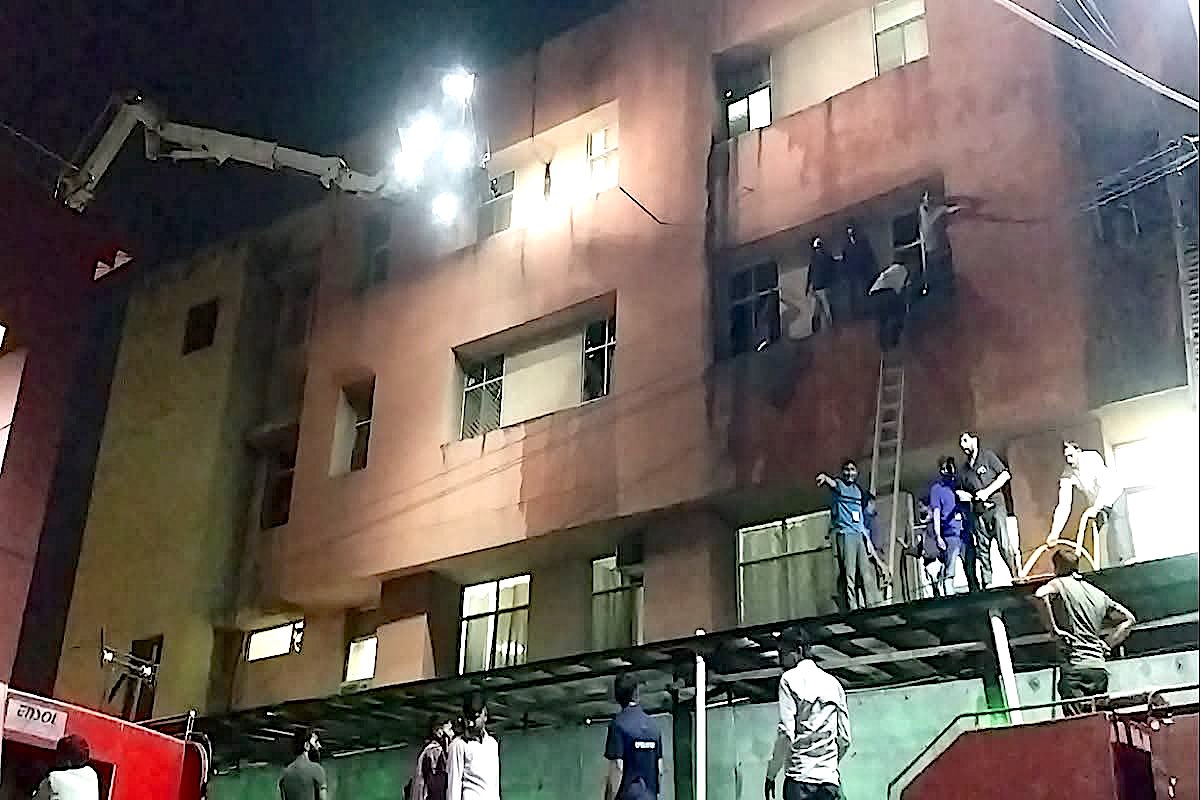
Firefighters trying to douse the fire at the SMS Hospital in Jaipur. Photo source: @bhartiylalchand|X
Deadly Jaipur Fire Sparks Alarm Over Hospital Safety Norms

Jaipur: A devastating fire broke out at the Sawai Man Singh (SMS) Hospital’s Trauma Centre in Jaipur late Sunday night, October 5, 2025, claiming six lives and leaving several others injured, once again exposing deep structural flaws in hospital fire safety systems across India.
The blaze, originating in a storeroom adjoining the Neuro Intensive Care Unit, quickly filled the corridors with thick, toxic smoke. Hospital sources told reporters that the fire began near a storage section containing oxygen tubing and electrical devices, intensifying the blaze. Though firefighters reached promptly, patients on ventilator support in the Intensive Care Unit (ICU) had little chance as the smoke spread rapidly through adjoining wards.
According to hospital authorities, six patients—Pintu (Sikar), Dilip (Jaipur/Andhi), Shrinath (Bharatpur), Rukmini (Bharatpur), Bahadur (Jaipur/Sanganer), and Khurma (Bharatpur)—died of suffocation and burn injuries, while five others are battling for life. Of the eleven patients in the ICU, five were rescued, and hospital reports claim thirteen others were evacuated from nearby wards and shifted to other wings of the hospital. However, several patients were even shifted outdoors on stretchers, eyewitnesses said.
#JaipurHospitalFire #SMSHospital #sms_hospital… pic.twitter.com/vvTzZHzLpa
— JAGDISH LODWAL (@Jagdishmeena554) October 6, 2025
Preliminary inquiries suggest an electrical short circuit in the storeroom triggered the fire, but forensic teams have been deployed to ascertain the exact cause. Firefighters confirmed that the central oxygen pipeline was spared, preventing a potentially larger catastrophe.
However, the spread of smoke proved fatal, despite the flames being largely contained to the storeroom. Officials said the power supply to the affected area was immediately cut off, and the fire was brought under control after more than two hours of operations involving multiple fire tenders. As rescue operations concluded, investigators combed through the charred storeroom, where the sight of burnt equipment and blackened walls stood as a grim reminder of the price paid for systemic neglect.
Questions are already being raised about whether SMS Hospital had complied with prescribed fire safety norms. Though the hospital’s newer blocks reportedly have fire alarm and hydrant systems, older sections like the Trauma Centre have not been fully upgraded in accordance with the National Building Code (NBC) and State Fire Safety guidelines. Some officials alleged that while a firefighting system existed in the building, it was not activated in time. Some family members of the patients claimed that fire alarms failed to ring and an exit gate was locked during the panic, allegations now under investigation as part of the official probe.
The tragic incident in Jaipur is a stark reminder that safety audits in hospitals must not remain a formality, as fire safety compliance in Indian hospitals has been a recurring concern, with the Jaipur incident adding to a grim list of tragedies.
Across India, audits have repeatedly shown widespread non-compliance. In Karnataka, for instance, only 329 of 8,728 hospitals possess valid fire safety approvals. In Uttar Pradesh, a 2024 inspection revealed that only 301 of 906 hospitals in Lucknow had operational fire systems and valid No-Objection Certificates (NOCs). In Tamil Nadu, more than 3,900 hospital audits were conducted last year, and many facilities were found lacking in training and maintenance. Similar gaps were highlighted in Noida, where nearly half the hospitals inspected were non-compliant.
Such data underscore how poor enforcement and ageing infrastructure often combine to create dangerous conditions in healthcare facilities. While rules require periodic fire safety audits, regular drills, maintenance of alarms and extinguishers, and clearly marked evacuation routes, implementation has been patchy. Many hospitals continue to operate with expired NOCs, blocked exits, and nonfunctional hydrants, despite being high-risk environments storing oxygen and other combustible materials.
Also read:
- Supreme Court stays High Court orders; tells AP government to probe Covid hospital fire case
- Was the fire in COVID-19 hospital an offshoot of Gujarat government’s drive to regularize illegal constructions?
The Jaipur tragedy mirrors similar incidents in Jhansi, Lucknow, and other Indian cities, where post-fire inspections have repeatedly exposed alarming lapses in compliance with safety norms.
In Jhansi, the November 2024 blaze at Maharani Laxmi Bai Medical College, which killed ten newborns in the Neonatal Intensive Care Unit (NICU), revealed that the hospital had been denied a fire No Objection Certificate (NOC) earlier that year for failing to maintain basic firefighting systems such as hose reels and functional extinguishers. A state audit in February 2024 had found that most extinguishers were expired, alarm systems were defunct, and wiring in the NICU was exposed. A subsequent electricity safety inspection in June again flagged the absence of circuit breakers, improper earthing, and overloaded power circuits—all of which remained unaddressed until the tragedy struck.
Following the Jhansi incident, a comprehensive audit of hospitals across Uttar Pradesh brought forth similarly grim findings. Out of 906 hospitals inspected in Lucknow district, only 301 were found to have operational firefighting systems and valid fire NOCs, while over 600 lacked compliance. Notices were served to 80 hospitals for gross violations of safety standards, some of which included major government facilities. In another audit of 727 hospitals conducted earlier in the year, just 202 had valid fire NOCs, while the rest either failed to apply or had not met basic safety parameters. Inspectors found blocked fire exits, untrained staff, nonfunctional alarms, and extinguishers that had not been refilled for years.
Electricity safety departments and fire officers across several states have documented the same pattern—warnings issued after inspections are often ignored, and even hospitals that receive official deficiency notices continue operations without corrective measures.
This recurring non-compliance persists despite multiple advisories from the Union Health Ministry and the National Disaster Management Authority (NDMA), both of which have repeatedly emphasised the need for annual fire audits, staff training, and strict enforcement of the National Building Code’s fire safety provisions.
In response to the Jaipur fire, Chief Minister Bhajanlal Sharma visited the site early morning today, expressing grief and ordering a six-member inquiry committee headed by Iqbal Khan, Commissioner of the Medical Education Department, with members drawn from the Public Works Department, the Rajasthan Medical Education Society, the Fire Department, and SMS Medical College. The panel is tasked with reviewing the sequence of events, the adequacy of hospital fire-prevention measures, and any lapses in emergency response, including whether administrative negligence or failure to adhere to fire safety protocols contributed to the loss of lives.
Chief Minister Sharma said in an official statement that the state government “will leave no stone unturned in ensuring accountability.” He added, “The loss of lives in this tragic incident is deeply saddening. We have ordered a high-level probe and will take strict action against those found negligent.” The State Government also announced financial assistance and full medical support to the families of the deceased and injured, though experts say systemic reform is long overdue.
The Prime Minister, Narendra Modi, in a message of condolence, said the loss of lives due to the fire tragedy “is deeply saddening.” Vice President C. P. Radhakrishnan, too, condoled the loss of lives due to a fire tragedy at a hospital in Jaipur.
Together, these findings reveal a systemic crisis: hospitals in India are governed by well-defined safety laws on paper, yet preparedness on the ground remains dangerously inadequate. Whether in Jhansi, Lucknow, or now Jaipur, fire safety infrastructure often exists only as a procedural requirement, not as an operational safeguard—turning spaces meant for healing into sites of tragedy.
Whether the newly formed State committee’s findings lead to stricter enforcement or fade into another routine report will determine if such tragedies continue to haunt Indian hospitals—or finally compel them to become places of healing rather than sites of preventable disaster.
– global bihari bureau