IISc Bengaluru, IIM Ahmedabad, AIIMS Delhi Lead in Key Categories
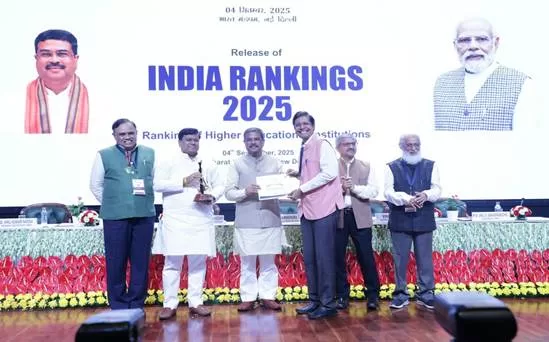
New Delhi: The Indian Institute of Technology (IIT) Madras has retained its top position in the Overall Category of the India Rankings 2025 for the seventh consecutive year, reinforcing its status as a premier institution under the National Institutional Ranking Framework (NIRF). Union Minister of Education Dharmendra Pradhan released the rankings on September 4, 2025, in the presence of Minister of State for Education and Development of North Eastern Region (DoNER) Dr. Sukanta Majumdar, Secretary of Higher Education (HE) Dr. Vineet Joshi, All India Council for Technical Education (AICTE) Chairman Prof. T.G. Sitharam, National Earthquake Technology Forum (NETF), National Assessment and Accreditation Council (NAAC), and National Board of Accreditation (NBA) Chairman Prof. Anil Sahasrabudhe, and NBA Member Secretary Dr. Anil Kumar Nassa, along with vice-chancellors and directors of higher education institutions.
The National Institutional Ranking Framework (NIRF), launched by the Ministry of Education in 2015, evaluates institutions across five parameters: Teaching, Learning & Resources (30% weightage), Research and Professional Practice (30%), Graduation Outcome (20%), Outreach and Inclusivity (10%), and Perception (10%). This year’s rankings, the tenth edition, saw participation from 7,692 unique institutions, with 14,163 applications across categories, a 297.3% increase from 3,565 applications in 2016. Pradhan hailed NIRF as a trusted benchmark aligned with the National Education Policy (NEP) 2020, driving India’s ambition to become a knowledge superpower by 2047. He urged institutions to foster innovation, entrepreneurship, and global competitiveness while adopting data-driven accreditation frameworks.
Dr. Majumdar emphasised NIRF’s role in promoting access, inclusivity, and quality, noting its alignment with NEP 2020’s vision for a globally competitive, future-ready education system. The introduction of new categories, such as Sustainable Development Goals (SDGs) and expanded rank bands, reflects NIRF’s evolution. The framework now covers nine categories—Overall, Universities, Colleges, Research Institutions, Innovation, State Public Universities, Open Universities, Skill Universities, and Sustainable Development Goals (SDGs)—and eight subject domains: Engineering, Management, Pharmacy, Architecture & Planning, Law, Medical, Dental, and Agriculture & Allied Sectors.
Key Highlights of India Rankings 2025
- Overall Category: Indian Institute of Technology (IIT) Madras leads for the seventh year (2019–2025), followed by Indian Institute of Science (IISc) Bengaluru and Indian Institute of Technology (IIT) Bombay. The top 100 includes 24 state public universities, 22 private deemed universities, 19 Indian Institutes of Technology (IITs), and others, showcasing diversity.
- Universities: Indian Institute of Science (IISc) Bengaluru retains the top spot for the tenth consecutive year (2016–2025), followed by Jawaharlal Nehru University (JNU) and Manipal Academy of Higher Education (MAHE).
- Colleges: Hindu College, Delhi, overtakes Miranda House to claim first place, with six of the top ten colleges from Delhi, underlining the capital’s dominance.
- Engineering: Indian Institute of Technology (IIT) Madras tops for the tenth year (2016–2025), with Indian Institute of Technology (IIT) Delhi and Indian Institute of Technology (IIT) Bombay in second and third.
- Management: Indian Institute of Management (IIM) Ahmedabad leads for the sixth consecutive year (2020–2025), followed by Indian Institute of Management (IIM) Bangalore and Indian Institute of Management (IIM) Kozhikode.
- Medical: All India Institute of Medical Sciences (AIIMS), New Delhi, holds the top rank for the eighth year (2018–2025) and secures eighth in the Overall category.
- Pharmacy: Jamia Hamdard, New Delhi, regains the top spot, followed by Birla Institute of Technology & Science (BITS), Pilani.
- Dental: All India Institute of Medical Sciences (AIIMS), New Delhi, takes first place, displacing Saveetha Institute of Medical and Technical Sciences (SIMATS), Chennai.
- Law: National Law School of India University (NLSIU), Bengaluru, retains its top position for the eighth year (2018–2025).
- Architecture & Planning: Indian Institute of Technology (IIT) Roorkee leads for the fifth year (2021–2025).
- Agriculture & Allied Sectors: Indian Agricultural Research Institute (IARI), New Delhi, tops for the third year (2023–2025).
- State Public Universities: Jadavpur University, Kolkata, leads the category introduced in 2024.
- Open Universities: Indira Gandhi National Open University (IGNOU), New Delhi, tops for the second year (2024–2025).
- Skill Universities: Symbiosis Skills and Professional University (SSPU), Pune, leads for the second year (2024–2025).
- Innovation: Indian Institute of Technology (IIT) Madras tops the category.
- Sustainable Development Goals (SDGs): Indian Institute of Technology (IIT) Madras leads the newly introduced category, followed by Indian Agricultural Research Institute (IARI) and Jamia Millia Islamia (JMI).
####Participation and Methodology
The 2025 rankings saw a 217% increase in unique applicants (7,692 from 2,426 in 2016), with 4,045 applications in the Overall category, 1,584 in Engineering, and 4,030 in Colleges. Data was sourced from institutions and third-party platforms like Scopus (Elsevier Science), Web of Science (Clarivate Analytics), and Derwent Innovation for publications, citations, and patents, ensuring transparency. Rankings are based on 19 sub-parameters across the five broad categories, with top 100 institutions ranked in major categories and additional rank bands (e.g., 101–150, 151–200) for broader coverage.
Pradhan called for institutions to align with Prime Minister Narendra Modi’s vision of a Viksit (developed) and Atmanirbhar (self-reliant) Bharat by 2047, emphasising their role in driving ‘Samriddhi’ (prosperity). Dr. Majumdar highlighted the SHINE vision—Sustainability, Holistic growth, Innovation, National pride, and Excellence—underscoring NIRF’s focus on equity, research quality, and sustainable development.
The rankings, accessible at https://www.nirfindia.org/2025/Ranking.html, reflect India’s higher education ecosystem’s resilience and aspirations.
– global bihari bureau