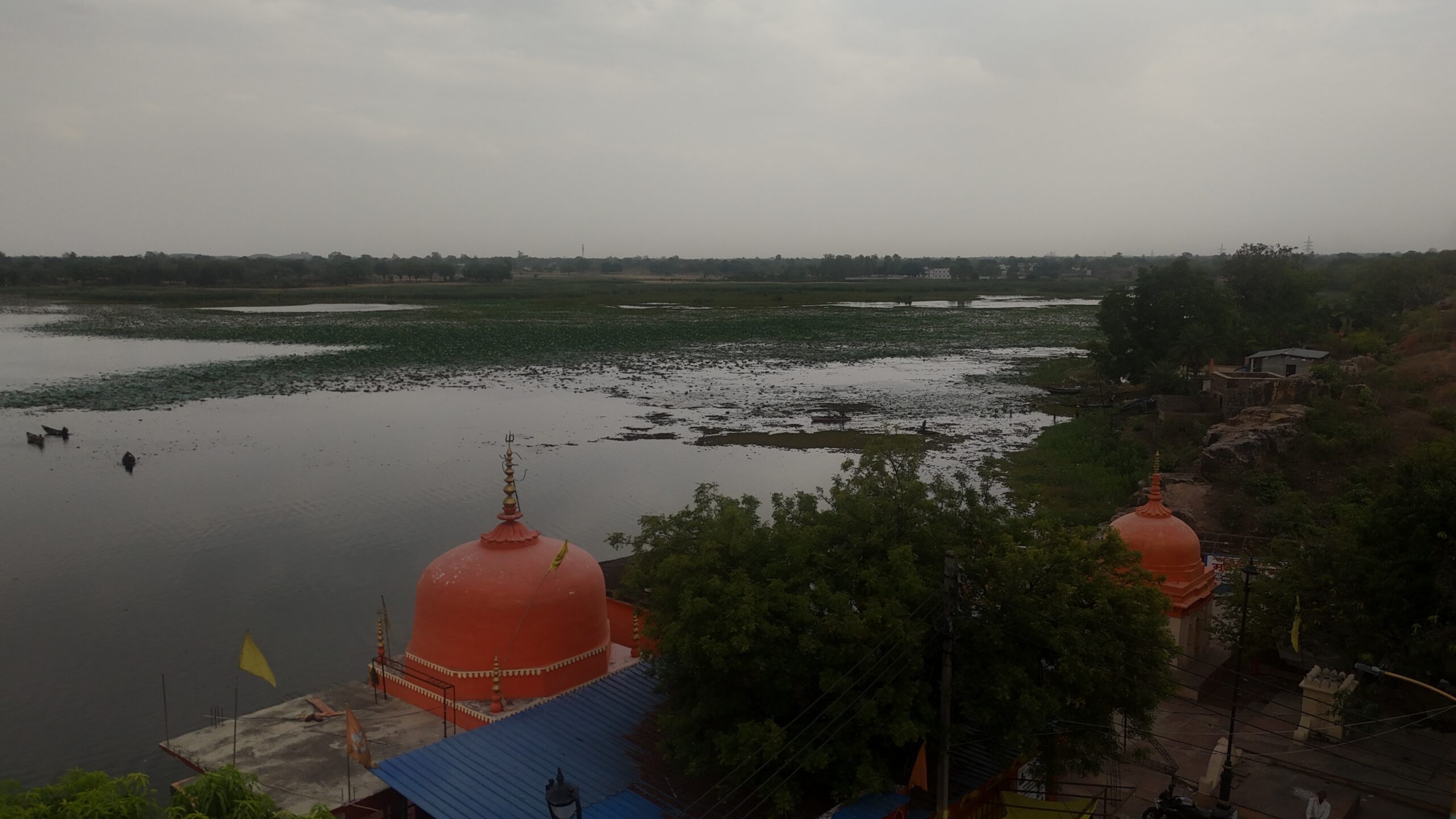
The Mansarovar Lake in Talbehat, Lalitpur.
 By Sanjay Singh*
On the serene banks of Mansarovar Lake in Talbehat, Lalitpur, where water endures as a rare blessing amidst Bundelkhand’s parched landscapes, a transformative event is unfolding from 5 June to 11 June 2025. Jal Katha, a seven-day storytelling discourse organised by the Saheli Foundation, is not merely a gathering but a spiritual and ecological awakening to confront the region’s dire water crisis.
Timed to launch on World Environment Day, Jal Katha, set near the historic Hazariya Mahadev Temple, draws its soul from the Jal Sahelis—water warriors who have become Bundelkhand’s heartbeat of hope. This movement is steeped in India’s spiritual traditions, where water, or Apah Tattva, is revered as divine consciousness in the Rigveda and Shrimad Bhagavatam.
Rivers like the Ganga are worshipped as mothers, and the Chandela kings of Bundelkhand built intricate ponds and stepwells that sustained communities for centuries. Yet, modernisation has reduced water to a commodity, leaving 60% of these structures defunct or degraded (Archaeological Survey of India, 2021).

Jal Katha seeks to restore this sacred bond. In a grand pavilion hosting 3,000 devotees, Sadhvi Sarita Giri, a saadhak from Ma Tripur Sundari in Naimisharanya and president of Sarita Dham Trust, will lead the discourse from the Vyas Peeth, weaving tales of water’s sanctity. “This discourse will reach the world, helping people understand the importance of water,” she declares. Gujarat’s revered storyteller, Mahendra Bapu, known for championing environmental conservation through Bapu Dharma, will narrate the Hanuman Katha, embedding messages about preserving water, forests, and land. Other environmentally conscious saints will join, amplifying the spiritual call to action.
Each morning, Pandit Akshay Dubey Ji will perform a Varun Yagya, honouring Lord Varuna, the deity of water, to spiritually purify Mansarovar’s now-polluted waters and underscore society’s responsibility to nature.
Mansarovar Lake, spread over 200 acres and known locally as “India’s sea,” is a living testament to ancient wisdom. Dug in the 16th century by Raja Mardan Singh to end a famine, as advised by a visiting royal, it has never run dry, even in Bundelkhand’s harshest summers. Named after Raja Bharat Shah’s fort, the Tal ki Behat lake remains a cultural and ecological anchor, its waters once so pure, they were drunk by the locals. Today, pollution from worship materials and waste threatens its legacy, a microcosm of the broader crisis.
Shramdaan, a cornerstone of Jal Katha, will see Jal Sahelis, locals, and community members unite to clean Mansarovar Lake, restoring its lost glory. Crowdfunding during the event will support this revival and the rejuvenation of ancient Chandela-era ponds, ensuring their utility for future generations.
Afternoon symposiums will bring together experts, social workers, and community representatives to discuss water conservation, sanitation, environmental balance, and public participation. Children will perform plays, puppet shows, and Kathak dances on water themes, fostering water literacy among the young.
A special exhibition pavilion will transform the event into a hub of awareness, featuring stalls from government departments—Rural Development, Health, Swachh Bharat Mission, Jal Jeevan Mission, Agriculture, Horticulture, Forest, and Social Welfare—showcasing schemes and resources. NGOs and local self-help groups will display innovations in water and sanitation, making the pavilion an educational, interactive space for all ages.
The Jal Sahelis’ impact reverberates beyond Talbehat. In February 2025, 368 of these women, draped in blue saris and scarves, embarked on an over 300-kilometre Jal Yatra across five drought-ravaged districts: Niwari, Jhansi, Lalitpur, Tikamgarh, and Chhatarpur. Carrying earthen pots filled with water from seven Bundelkhand rivers—symbolising their pledge to preserve this sacred resource—they rallied over 2,500 people, including former Madhya Pradesh Chief Minister and Union Minister Shivraj Singh Chauhan. From the Betwa River in Orchha to the Jatashankar Temple in Chhatarpur, their march was a clarion call for action. Through Jal Chaupals—village water dialogues—they shared stories of depleted wells, assessed rivers and traditional structures, and mapped over 100 dried ponds and small rivers. This sparked the “100 days of shramdaan, 100 days of water conservation” campaign, where communities, inspired by the Sahelis’ resolve, clean, deepen, and fortify water bodies with bori bandhan, reviving the region’s hydrological heritage.
The Jal Yatra, described as a “never-done-before” effort, has earned praise from Prime Minister Narendra Modi in his Mann Ki Baat, spotlighting their work in Chhatarpur, such as building ponds and using silt for farming. Uttar Pradesh Chief Minister Yogi Adityanath has also honoured their contributions. Their stories featured at the 2025 Mahakumbh in Prayagraj, post-Makar Sankranti Snan, inspiring a national dialogue on water conservation. Aligned with the Jal Jeevan Mission and Har Ghar Nal Yojana, their efforts have reduced the burden on women who once trekked 5–10 kilometres daily for water, a task exacerbated by Bundelkhand’s rocky terrain and low soil permeability (UNICEF, 2023).
Yet, the challenges are daunting. With 18% of the world’s population but only 4% of its freshwater resources, India faces a stark reality: per capita water availability has plummeted from 5,177 cubic metres in 1951 to 1,545 in 2020, classifying the nation as water-stressed (UNESCO, 2022; Central Water Commission, 2021). Projections warn that by 2050, this could fall below 1,000 cubic metres, heralding severe scarcity (NITI Aayog, 2018). In Bundelkhand, spanning 14 districts across Uttar Pradesh and Madhya Pradesh, the crisis is acute. Groundwater levels are dropping 1–2 metres annually in 70% of the region’s blocks, 30% of India’s perennial rivers are turning seasonal, and 70% of surface water is contaminated, with rivers like the Yamuna carrying unsafe levels of faecal coliform (Central Ground Water Board, 2022; IITM Pune, 2022; Central Pollution Control Board, 2023). Climate change has slashed rainfall by 10–15% in Bundelkhand since 1990, intensifying droughts (IMD, 2023).
India extracts 251 cubic kilometres of groundwater annually, the world’s highest, with Bundelkhand’s aquifers depleting at 1.5 metres per year in critical zones. Pollution and climate-driven rainfall shifts, down 10–15% since 1990, compound the crisis. Jal Katha’s vision is ambitious: in Phase 1, it aims to host 100 storytelling events across 50 water-stressed districts like Bundelkhand, Rajasthan, and Gujarat, training 500 community leaders and kathavachaks to spread conservation messages and restore 1,000 traditional water bodies. Phase 2 envisions a national Jal Katha festival with music, dance, and storytelling, supported by a Jal Katha app for sharing tips and tracking progress. Phase 3 seeks to embed the initiative in education and cultural programmes, advocate for water metering policies, and share the model globally with other water-stressed nations.
In Talbehat, where Raja Mardan Singh’s lake stands as a symbol of resilience, the Jal Sahelis and Jal Katha are proving that water is not merely a resource but a sacred gift. By blending India’s cultural wisdom with modern action, they are rewriting the narrative of scarcity into one of hope, community, and reverence. As Sadhvi Sarita Giri proclaims, this is a movement to “reawaken the spiritual consciousness that once inspired society to live in harmony with nature.” In a land where rivers are mothers and ponds are lifelines, Jal Katha is a testament that even in the driest places, change can flow.
*Water conservationist and Secretary of Parmarth, the organisation behind the Jal Saheli model.