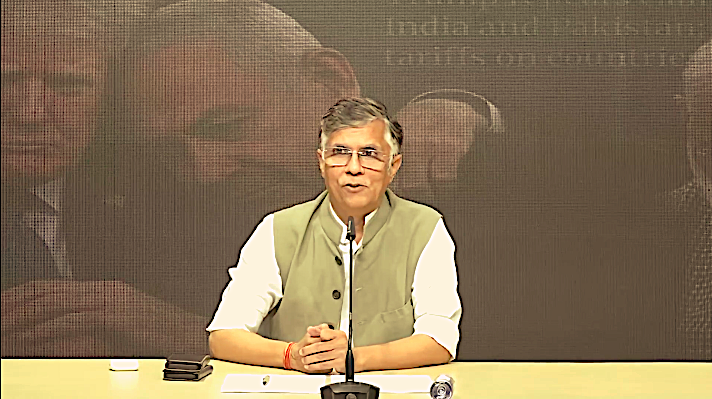
Pawan Khera, who is chairman, Media & Publicity (Communication Deptt), AICC, addresses a press conference at the Congress headquarters in New Delhi today.
Khera Slams ‘Submissive’ Foreign Policy
AICC Flags Economic Toll of West Asia Crisis
New Delhi: As the West Asia crisis begins to test not just India’s foreign policy bandwidth but also its economic resilience, the All India Congress Committee today mounted a sharp and politically loaded critique of the Union government, with senior leader Pawan Khera alleging that what he described as a “submissive” and “uncertain” diplomatic posture had left India exposed to both strategic vulnerability and domestic economic stress.
Addressing a press briefing at the AICC headquarters, Khera, who is chairman, Media & Publicity (Communication Deptt), AICC, claimed that the Prime Minister Narendra Modi’s response to the crisis reflected a pattern of deference, making a jibe that permission to speak in the Lok Sabha on the issue had come only after 23 days. Using a metaphorical reference, he suggested that India, which aspired to be a “Vishwa Guru,” was instead behaving like a “follower,” and directly accused Prime Minister Narendra Modi of succumbing to the diktat of Donald Trump and Benjamin Netanyahu, alleging that key decisions were aligned with US and Israeli positions. In the course of his remarks, Khera repeatedly invoked a political metaphor of “Saheb, Bibi aur Ghulam,” and also referred to “Epstein,” suggesting external influence behind key decisions.
The sharpness of the attack reflects a deeper strategic divergence over India’s global posture. While the opposition has framed the issue as one of eroding strategic autonomy and moral clarity, the government’s approach under Narendra Modi has been characterised by calibrated positioning—maintaining ties with multiple actors, including the United States, Israel, Iran and Gulf countries, without overtly taking sides. This reflects an evolution in India’s foreign policy towards multi-alignment and strategic flexibility rather than explicit bloc-based positioning.
In that sense, the debate extends beyond immediate political exchanges to a broader question about India’s role in a shifting global order: whether it should function as a normative voice willing to articulate clear positions grounded in international law—even at potential cost—or as a pragmatic balancer that preserves manoeuvrability by avoiding explicit alignment, even if that creates perceptions of ambiguity. India’s dependence on West Asian energy supplies, the presence of a large diaspora in Gulf countries, and its expanding defence and economic partnerships with multiple global powers complicate these choices.
Also read: Modi Assures Nation Amid West Asia Crisis
The Indian National Congress appear to be betting that, in a politically charged environment marked by inflationary pressures and supply disruptions, a combination of clarity and criticism will translate into political credibility. The government, on the other hand, appears to be relying on caution and flexibility as instruments of stability, seeking to navigate competing geopolitical interests without jeopardising core economic and strategic priorities.
Khera maintained that the Congress was not advocating alignment with Iran but was instead calling for adherence to a rules-based international order. He said India should have clearly condemned what he described as an illegal war under established global norms, including those of the United Nations, and criticised the Prime Minister for not expressing even “two words of condolence” over the reported killing of Iran’s Supreme Leader, Ayatollah Ali Khamenei. According to him, such omissions reflected a lack of moral and strategic clarity, and he also referred to incidents including the reported killing of 168 schoolgirls, arguing that India had failed to voice concern.
He brought the Prime Minister’s foreign visits into focus to question both timing and outcomes. Referring to Prime Minister Narendra Modi’s visit to Japan, Pawan Khera said that within 24 hours of the trip, the Japanese Prime Minister—Shigeru Ishiba—had resigned, and used the episode to question the quality of intelligence inputs and briefings available to the Indian leadership. On the Israel visit, he alleged that within 48 hours, Israel, along with the United States, carried out what he termed an “illegal attack” on a long-standing Indian partner, arguing that India appeared diplomatically unprepared. He also criticised what he described as the optics of the visit, including the conferment of a “newly created” medal, suggesting that symbolic gestures were being prioritised over tangible national interests.
Linking foreign policy decisions to domestic consequences, Khera alleged that the fallout of the West Asia crisis had begun to affect households and businesses across the country. He claimed that nearly 50 per cent of Indian homes were facing LPG-related difficulties and cited reports of supply distortions, adding that cylinders were reportedly being sold in the black market at around ₹5,000. He further alleged that industrial diesel prices had risen by ₹22 and premium petrol by ₹2, while broader fuel price increases were being held back due to ongoing elections and would rise thereafter, despite the government having collected ₹28 lakh crore in fuel-related levies over the past 12 years. He also linked price restraint to the absence of simultaneous elections, arguing that costs would have risen earlier under a “One Nation, One Election” scenario.
He described widening economic stress across sectors, stating that industries ranging from Morbi’s tile manufacturing to hospitality and MSMEs were under strain due to fuel shortages and supply chain disruptions. He cited figures indicating that 60,000 metric tonnes of basmati rice exports were stranded, alongside disruptions in trade involving spices, fruits such as bananas and grapes, and jewellery. He added that 37 ships, 1,109 seafarers, and goods worth ₹10,000 crore were currently stuck, while stock market losses had reached ₹48 lakh crore within 23 days.
Khera also highlighted the strategic implications of disruptions in the Strait of Hormuz, noting that a significant portion of India’s energy supplies passed through the route and alleging that 85 per cent of gas flows had been affected. He argued that India’s earlier arrangement of importing Iranian oil in rupees had insulated it from foreign exchange pressures—an advantage he said had now eroded. He claimed that emerging trade arrangements involving multiple countries might require transactions in Chinese yuan, which he described as detrimental to India’s economic autonomy.
Raising concerns about cascading effects, he warned that continued LPG shortages could disrupt supply chains, including milk packaging, potentially leading to shortages within days. He pointed to conflicting claims on gas reserves—74 days as per official statements and 25 days according to other sources—as evidence of a lack of clarity and strategic planning. Fertiliser supplies, he said, had also been hit, with about 25 per cent sourced from Gulf countries and nearly 40 per cent of urea and phosphate imports routed through the Strait of Hormuz disrupted.
Khera also raised strategic concerns, referring to incidents such as the reported targeting of the IRIS Dena in the Indian Ocean and the presence of a nuclear submarine in the region, and questioned the government’s silence on such developments. He contrasted India’s response with that of Sri Lanka, which he said had demonstrated the courage to refuse foreign military access, arguing that India had failed to assert itself despite being a larger power.
He questioned whether the government had adequately considered the implications for Indian workers in Gulf countries, whose remittances are a key economic factor, and criticised what he described as a failure to prioritise their concerns. He also referred to India’s current role as chair of BRICS, asking whether the government would show the leadership expected of it in initiating dialogue to de-escalate tensions.
On the macroeconomic front, he warned of rising inflation across sectors, including aviation and electricity, and linked the removal of airfare caps to potential price increases across airlines such as IndiGo, Akasa Air and Air India. He also criticised the falling rupee, calling the situation a “Modi Made Disaster,” and said earlier warnings by Rahul Gandhi regarding economic vulnerabilities had not been heeded.
Responding to questions, Khera raised issues related to fertiliser imports, diesel supplies to Bangladesh, and what he described as inconsistencies in the government’s political messaging on the issue. He also flagged the potential impact on welfare schemes such as PM POSHAN, warning that 11 crore children across more than 10 lakh schools could be affected. He described high-level meetings such as those of the Cabinet Committee on Security as reactive, arguing that they came only after the crisis had escalated.
He further highlighted disruptions in supply chains, warning that if LPG shortages persisted over the next 10 days, milk availability could be affected. He questioned the government’s preparedness to address stranded exports, including basmati rice, and the concerns of traders dealing in spices, fruits and other commodities. He also cited the impact on MSMEs, including thousands in Karnataka linked to sectors such as automotive, garments and footwear, attributing their distress to fuel shortages and rising costs.
Khera also referred to public expressions of solidarity with Iran, noting that even children in Kashmir had contributed small personal belongings such as earrings towards relief efforts, and said the Iranian Embassy had thanked the people of India rather than the government—an observation he used to underline what he described as the enduring civilisational ties between the two countries despite current policy choices.
Khera concluded by demanding clear answers from the government in Parliament on its foreign policy choices, the economic fallout and mitigation measures, while asserting that India must reclaim an independent, rules-based global posture rather than appearing aligned with specific geopolitical interests.
The confrontation also underlines how foreign policy is no longer insulated from domestic political scrutiny, especially when global crises translate into visible economic strain. As Parliament takes up the issue, the contest between an assertive, declaratory approach and a cautious, multi-aligned strategy is likely to sharpen, shaping both policy debate and political narratives in the period ahead.
– global bihari bureau