 By Deepak Parvatiyar*
From Battlefield to Global Crisis: War’s Expanding Toll
Conflict’s Reach Extends From Hospitals to Harvests
Wars are often measured in territory gained or lost, in targets struck or leaders eliminated. This one is increasingly measured in something less visible but far more consequential: the slow, cumulative strain on the systems that sustain everyday life.
Across the Middle East and far beyond it, the conflict has begun to register not as a contained military confrontation but as a layered, transnational crisis—one that is simultaneously disrupting energy flows, constraining food systems, degrading public health capacity, and unsettling global mobility. And yet, even as these pressures intensify, the principal actors shaping the conflict are not converging toward restraint. They are, instead, articulating positions that justify its continuation.
That divergence is starkest in their own words.
Israeli Prime Minister Benjamin Netanyahu declared on March 26 that Israel is striking “with full force at the targets of the Iranian terror regime,” confirming the killing of Islamic Revolutionary Guard Corps Navy commander Alireza Tangsiri—“the one who led the closure of the Strait of Hormuz.” He framed the campaign as part of coordinated action “with our friend the United States” to achieve the war’s objectives.
Tehran presents the same moment as one of resistance, not escalation. Foreign Minister Seyed Abbas Araghchi accused Washington of “double standards,” pointing to U.S. backing of Israel’s Gaza blockade while condemning Iran’s actions in Hormuz. “International law is not a tool of convenience,” he said. President Masoud Pezeshkian reinforced that posture, publicly thanking Russia and stating that President Vladimir Putin’s messages “inspire us in this war,” suggesting that the conflict is also reshaping regional alignments.
From Moscow, that alignment is explicit. Foreign Minister Sergey Lavrov has condemned U.S. and Israeli actions as violations of international law while rejecting comparisons with Russia’s own war in Ukraine. When asked whether the same legal standards should apply to Moscow, he dismissed the parallel, arguing that the situations are fundamentally different. He has also rejected suggestions that Russia stands to benefit economically from the disruption, despite questions over increased oil flows to Asian markets and their contribution to state revenues.
Washington, meanwhile, occupies a more ambivalent position—combining pressure with limited diplomatic signalling. U.S. Secretary of State Marco Rubio has said indirect exchanges with Iran, conducted through intermediary countries, have produced “some progress.” Yet he has offered no public details, and there has been no verified confirmation from Tehran accepting talks or a pause. Rubio has also argued that the Strait of Hormuz “could be open tomorrow” if Iran ceased threats to shipping, framing the disruption as a violation of international law. At the same time, he has widened the argument—linking the crisis to U.S. support for Ukraine, questioning allied burden-sharing, and calling for greater involvement from Group of Seven (G7) partners in securing global energy routes. On Russia’s role in the Iran crisis, he has been notably restrained, observing that Moscow remains primarily focused on Ukraine.
A War That Is Now Reshaping Global Systems
This clash of narratives is not merely rhetorical. It is shaping the trajectory of a crisis whose consequences are already measurable across multiple systems.
According to the World Health Organization’s first global situation assessment, up to 3.2 million people have been internally displaced in Iran, while more than 1,049,000 people have been displaced in Lebanon, with additional cross-border movements placing pressure on neighbouring states. Health systems are absorbing sustained shock: WHO has verified 21 attacks on health care in Iran, 65 in Lebanon, and 6 in Israel, with figures continuing to evolve as verification catches up with events.
The strain is both immediate and cumulative. Hospitals are treating rising numbers of trauma patients while struggling to maintain routine care for chronic conditions such as diabetes, cardiovascular disease and cancer. Displacement has driven populations into overcrowded shelters, increasing the risk of infectious disease outbreaks. Shortages of medicines, medical supplies and personnel are constraining response capacity.
Also read: Trump Pauses, Iran Pushes, India Watches
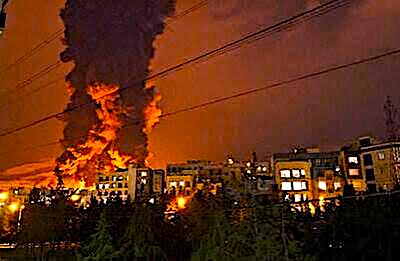
Infrastructure damage is amplifying these vulnerabilities. Strikes affecting water systems and desalination facilities have reduced access to safe drinking water. Attacks on oil and industrial sites are contributing to air pollution, raising concerns about long-term respiratory impacts. Fuel shortages—linked in part to maritime disruption—are beginning to affect hospital operations, ambulance services and supply chains. Mental health pressures are rising sharply, particularly among displaced communities.
At the same time, the conflict is transmitting shock through the global economy with unusual speed.
The Strait of Hormuz—through which approximately 20 million barrels of oil per day (around 35 per cent of global crude supply), about 20 per cent of liquefied natural gas, and up to 30 per cent of globally traded fertilisers normally pass—has seen traffic collapse by more than 90 per cent since early March. Tanker movements have fallen from roughly 130 ships per day to minimal levels, with only limited and controlled transits resuming. War-risk insurance premiums have surged, and shipping routes have been disrupted, driving volatility across energy markets.
War’s Fallout Spreads Far Beyond the Middle East
The Food and Agriculture Organization warns that the implications extend well beyond fuel. Chief Economist Máximo Torero has described the disruption as one of the most severe shocks to global commodity systems in recent years. Fertiliser prices have already risen sharply—by around 19 per cent in parts of the Middle East and up to 28 per cent in Egypt—and could remain 15 to 20 per cent higher globally through the first half of 2026 if disruption persists. That, in turn, threatens agricultural productivity for staple crops such as wheat, rice and maize, with particular risks for import-dependent countries. Secondary effects—including pressure on remittances and the potential for export restrictions—could further amplify the shock.
Yet the picture is not one of uniform breakdown. Adaptation—uneven but significant—is underway.
India has reported stable fuel supplies, supported by diversification across more than 40 supplier countries and strategic reserves often cited as covering around 60 days. Authorities have acted against hoarding, and supply chains have adjusted to new conditions. Civilian mobility is also gradually stabilising: since February 28, approximately 450,000 passengers have returned to India as flight operations resume through a mix of scheduled, non-scheduled and rerouted services.
Across the region, aviation remains constrained but functional. The United Arab Emirates is operating limited non-scheduled flights, with around 80 flights expected in a single day. Saudi Arabia and Oman continue regular operations to India. Qatar’s airspace is partially open, enabling 8–9 non-scheduled flights daily. Kuwait and Bahrain have closed their airspace, but special flights by Jazeera Airways and Gulf Air are operating via Dammam in Saudi Arabia. Travel from Iran is being facilitated through Armenia and Azerbaijan, while routes from Israel are operating via Jordan, with additional transit pathways through Saudi Arabia supporting movement from Kuwait, Bahrain and Iraq.
International response mechanisms are scaling up. The World Health Organization has activated its Incident Management System and released $2 million from its Contingency Fund for Emergencies, while identifying a $37 million funding gap for Lebanon. Emergency coordination is expanding across the Gulf and parts of Europe, though disparities in health system resilience remain pronounced.
What emerges from these intersecting pressures is not a single crisis, but a system under stress.
Military operations, energy flows, food systems, public health capacity and global mobility are no longer operating in parallel—they are interacting, amplifying one another’s vulnerabilities. And at the centre of that interaction lies a political reality that remains unresolved: the principal actors continue to frame the conflict in ways that justify persistence rather than compromise.
The result is a war that no longer respects boundaries—geographic or sectoral. Its consequences are diffusing across the infrastructures that underpin daily life, from hospitals and food supply chains to shipping lanes and flight paths.
Whether those systems stabilise or fracture further will depend less on their inherent resilience than on decisions yet to be taken. For now, the trajectory remains uncertain—and the strain, cumulative.
*Senior journalist