US-Israel Launch Epic Fury on Iran
Trump Urges Iran Regime Overthrow
Minab School Strike Kills Dozens
Iran Retaliates; Gulf on Alert
UN Calls for Restraint in War
New York/Tehran/Jerusalem: Direct military hostilities between the United States, Israel, and Iran escalated into the most serious confrontation in decades after coordinated Israeli and American air and missile strikes struck Iranian territory on Saturday, February 28, followed by retaliatory launches toward Israel and U.S. regional positions. The exchange of attacks rapidly widened in scope, producing repercussions across global energy markets, shipping lanes, civil aviation, diplomacy, and regional security alignments. The United Nations revised its schedule today to accommodate a press encounter with Ambassodor Danny Danon, Permanent Representative of Israel to the United Nations, which was immediately followed by the Security Council meeting to discuss the situation in the Middle East.
Earlier, in a nationally broadcast address, U.S. President Donald Trump announced what he described as the start of “extensive combat operations” against the Islamic Republic of Iran. He framed the action as defensive, arguing that Washington faced an imminent threat from Iran’s missile and nuclear-related programmes and accusing Tehran of sponsoring attacks on American forces and allies across the Middle East. Trump cited past incidents, including the 1979 seizure of the U.S. Embassy in Tehran, the 1983 Beirut barracks bombing, and attacks on U.S. forces in Iraq and at sea, declaring that Iran “must never obtain nuclear weapons.” He said U.S. forces would dismantle Iran’s missile industry, destroy its naval operational capacity, and neutralise proxy groups across the region.
— Donald J. Trump (@realDonaldTrump) February 28, 2026
Trump’s address included an unprecedented appeal directly to Iranian citizens and security forces. He urged members of the Islamic Revolutionary Guard Corps and police to lay down their arms in exchange for immunity and called on civilians to remain indoors as bombing continued. He described the operation as an opportunity for Iranians to “take over your government” and promised decisive American force to ensure what he termed their liberation.
⭕️The IDF completed a broad strike on strategic defense systems of the Iranian regime.
The IDF struck multiple strategic aerial defense systems, including an advanced SA-65 system in the Kermanshah area of western Iran. pic.twitter.com/p3UI3aB50y
— Israel Defense Forces (@IDF) February 28, 2026
Israeli officials confirmed that the operation had been launched jointly with the United States under the banner of Operation Roaring Lion. Prime Minister Benjamin Netanyahu said Israel and the United States acted to remove what he called an existential threat posed by Iran’s missile and nuclear infrastructure. He accused Tehran of financing and directing militant groups on Israel’s borders and said the campaign was intended to create conditions for internal change in Iran. The Israel Defense Forces (IDF) reported striking hundreds of targets in western Iran, including advanced air defence systems near Kermanshah and missile launch units preparing to fire toward Israel. Israeli authorities said nationwide sirens were activated following Iranian launches and that air defence systems intercepted multiple projectiles.
Pentagon officials said U.S. strikes were carried out to protect American forces and allies from what they described as an imminent attack and to prevent Iran from restoring nuclear and long-range missile capabilities. Washington reiterated that Iran had been designated a state sponsor of wrongful detention and warned American citizens to leave the country immediately.
That designation was formally announced in a press statement by U.S. Secretary of State Marco Rubio, who said Iran had been named a “State Sponsor of Wrongful Detention” under U.S. law. Rubio cited the 1979 hostage crisis as the foundation of what he called a decades-long pattern of detaining Americans and other foreign nationals as political leverage. He referred to President Trump’s executive order to protect U.S. nationals from wrongful detention abroad and to the Countering Wrongful Detention Act of 2025, which authorised the designation. Rubio warned that if Iran did not end the practice, Washington would consider additional measures, including possible geographic restrictions on the use of U.S. passports for travel to, through, or from Iran. He reiterated that no American should travel to Iran and urged those currently there to leave immediately. Rubio was scheduled to travel to Israel from March 2-3, 2026, to discuss “a range of regional priorities, including Iran, Lebanon, and ongoing efforts to implement President Trump’s 20-Point Peace Plan for Gaza”.
Iran’s government rejected the U.S. and Israeli narrative and described the campaign as a flagrant act of aggression. In a statement, the Foreign Ministry said Iranian cities, defence infrastructure, and civilian sites had been attacked in violation of the United Nations Charter. Tehran asserted its inherent right to self-defence under Article 51 and called for an emergency meeting of the United Nations Security Council.
Foreign Minister Seyed Abbas Araghchi held urgent consultations with counterparts in Russia, Turkey, Pakistan, Saudi Arabia, the United Arab Emirates, Qatar, Kuwait, Bahrain, and Iraq. He described the strikes as crimes against international peace and security. He warned that any territory or facility used to support U.S. or Israeli operations would be regarded as a legitimate target. Russia’s foreign minister supported convening the Security Council and condemned the attacks, while Turkey and Pakistan issued statements urging an immediate cessation of hostilities and restraint by all sides.
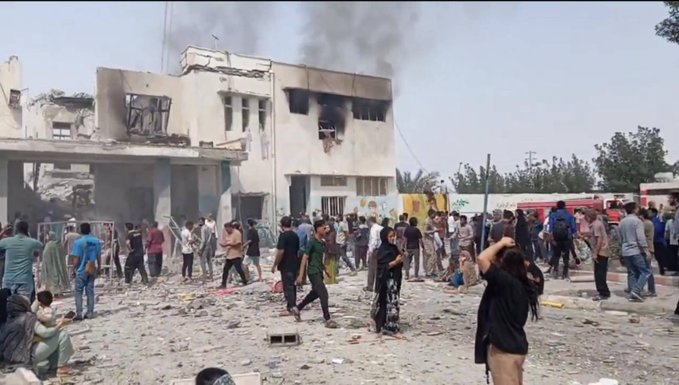
Iranian officials said missile strikes hit several cities, including Tehran, Isfahan, Kermanshah, and the southern port city of Minab. The Foreign Ministry and senior officials claimed that a girls’ primary school in Minab was struck in daylight, killing at least 51 schoolchildren. Iranian state television broadcast images of damaged residential blocks and emergency crews searching rubble. The Iranian Red Crescent reported mass-casualty response operations in multiple provinces, and hospitals in Tehran and southern Iran were placed on emergency footing.
Casualty figures remain sharply disputed. Iran’s Health Ministry said at least 286 people had been killed and more than 1,400 wounded since the outbreak of hostilities, including civilians. Israeli authorities reported 47 deaths and more than 300 injuries from Iranian missile attacks on Tel Aviv and Haifa. The United States acknowledged that several service members were injured at bases in Qatar and Kuwait but did not release full casualty numbers.
Iran’s attacks are designed to terrorize civilians and destroy neighborhoods. This is what we operate against. pic.twitter.com/sL73DqWtGk
— Israel Defense Forces (@IDF) February 28, 2026
A Reuters report citing two regional diplomatic sources and one Western intelligence official said that Iran’s Defence Minister Amir Nasirzadeh and a senior Islamic Revolutionary Guard Corps commander, Major General Mohammad Pakpour, were believed to have been killed in an Israeli strike near Tehran. Iranian authorities neither confirmed nor denied the report, accusing foreign media of psychological warfare and stating only that “high-ranking officers” were among those killed. No independent visual confirmation has been provided.
🎥WATCH: Soldiers of the Iranian terror regime were struck while arming missile launchers aimed toward Israel. pic.twitter.com/nG64x2fnuU
— Israel Defense Forces (@IDF) February 28, 2026
Speculation has also surrounded the fate of Iran’s top leadership. Supreme Leader Ayatollah Ali Khamenei has not appeared publicly since the outbreak of hostilities. Iranian state television said he was operating from a secure location and remained in full command. The presidency said the president continued to chair emergency security meetings in Tehran.
Due to the escalation with Iran, Israel’s National Security Council called on Israeli citizens abroad to take increased precautions at all destinations around the world, cautioning that the escalation with Iran raises the probability of the Iranian regime attempting to conduct attacks abroad against Israeli/Jewish targets. Given experience, other terrorist elements and local initiatives (including individual attackers) may be motivated to harm Israelis abroad, it warned.
The conflict has also disrupted civil aviation and maritime traffic. Airspace over Iran, Israel, and large parts of the Gulf was closed or heavily restricted, forcing major airlines to divert or cancel flights between Europe and Asia. Maritime authorities reported that oil tankers and commercial shipping altered routes away from the Strait of Hormuz amid fears of escalation. Insurance premiums for Gulf transit surged, and crude oil prices jumped sharply in early trading.
Governments across the Gulf issued statements after Iranian missiles crossed regional airspace. Qatar said debris fell near uninhabited areas close to Al Udeid Air Base, injuring several U.S. personnel but causing no civilian deaths. Kuwait confirmed heightened military alert status and reported no casualties. The United Arab Emirates said its air defences were activated but that no direct strikes hit civilian targets and no deaths were recorded. All three governments called for restraint while reaffirming commitments to protect their sovereignty. Saudi Arabia’s Crown Prince Mohammed bin Salman expressed “full solidarity with Kuwait, the United Arab Emirates, and Qatar, condemning the Iranian attacks, and emphasising that the security of these countries is an integral part of the Kingdom’s security, with the mobilisation of all capabilities to support them and preserve their sovereignty and stability. “Saudi Arabia will take all necessary measures to defend its territories, and it extends its full support to brotherly countries to preserve their sovereignty, security, and stability,” he told the French President Emmanuel Macron.
Iran-aligned groups in Lebanon, Iraq, and Yemen issued warnings of possible retaliation if attacks continued. Hezbollah accused Israel and the United States of pushing the region toward war, while Iraqi militias vowed to target U.S. interests if Iranian territory continued to be struck.
The United Nations Secretary-General António Guterres called for immediate restraint and warned that the world could not afford a wider regional war. He urged all parties to respect international law and protect civilians. The Security Council convened an emergency session marked by sharp divisions between Western members and Russia and China.
Analysts note that the escalation unfolded amid political and strategic pressures in Washington and Tel Aviv, but caution that no direct evidence has been presented to establish causality. Some observers point out that the U.S. administration had recently faced domestic political setbacks, including legal constraints imposed by the Supreme Court on its tariff policy, and argue that heightened focus on external security threats often coincides with periods of internal political strain. Others counter that the military action was consistent with long-standing U.S. and Israeli threat assessments regarding Iran’s missile and nuclear activities and should be viewed within that continuity rather than as a response to short-term political developments.
Regarding Israel’s role, analysts emphasise that Israeli leaders have repeatedly articulated a doctrine of pre-emption toward what they describe as existential threats. From this perspective, the strikes are presented by Israeli officials as a continuation of earlier operations aimed at preventing Iran from expanding its military capabilities. Iranian officials, however, describe the same actions as unprovoked aggression and part of a broader strategy of containment and coercion. Independent analysts note that both narratives reflect entrenched positions shaped by decades of confrontation rather than a sudden shift in policy.
Meanwhile, official Iranian discourse increasingly framed the conflict as part of a longer strategic confrontation rather than a limited exchange. Articles published on the Supreme Leader’s official website argued that the war would not be confined to missile and air power but would rely heavily on the ground forces of both the regular army and the Islamic Revolutionary Guard Corps. These writings described a doctrine of “offensive defence,” asserting that Iran would secure its borders in the south, southeast, and west while also preparing for operations beyond its frontiers if required. Recent military exercises in southern Iran and on islands in the Persian Gulf were portrayed by Iranian media as rehearsals for such scenarios, suggesting that Tehran anticipates a prolonged, multi-domain confrontation rather than a brief phase of hostilities.
Analytical commentary published on the same platform stressed that shipping lanes, energy flows, and oil markets would inevitably become central to any sustained conflict, even if they were not deliberately targeted. The analysis argued that U.S. bases across the Gulf, Iraq, and Syria could draw host countries into the confrontation and that escalation would be unlikely to remain geographically contained. It warned that wider disruption could trigger a global oil crisis and cause extensive damage across the region, including in Israel itself. These assessments broadly aligned with concerns expressed by international energy and security analysts about the vulnerability of maritime routes through the Strait of Hormuz.
In a major speech delivered earlier in Tabriz, Khamenei described the United States as a declining power and asserted that even the strongest military could be struck in ways that would prevent it from recovering. He rejected American pressure over Iran’s missile and nuclear programs as illegitimate interference in sovereign rights and linked recent internal unrest to what he described as foreign-backed destabilisation efforts. Iranian state media has since cited this address as an ideological justification for resistance in the current conflict. Western officials, by contrast, dismissed these claims and maintained that their actions were intended to deter further attacks and prevent what they characterise as destabilising Iranian activities in the region.
The timing of the escalation, occurring within hours of the departure of Indian Prime Minister Narendra Modi from Israel, has also drawn commentary. Some regional observers suggest the coincidence underscores the sensitivity of diplomatic optics and the desire by Israel to avoid complicating a high-profile bilateral visit. Others caution that such temporal proximity does not in itself demonstrate coordination or deliberate sequencing and may reflect operational timelines unrelated to diplomatic travel. No official confirmation has been provided linking the two events.
Overall, independent analysts caution that the present confrontation reflects accumulated tensions rather than a single triggering event. Competing narratives of self-defence on one side and unlawful aggression on the other are expected to harden further as military and diplomatic channels narrow. While both sides continue to assert that they do not seek a wider war, the scale of deployments, the disruption of air and sea routes, and the involvement of multiple regional actors underline the risk that miscalculation rather than deliberate strategy could determine the next phase of the crisis.
With casualties mounting, oil markets volatile, and diplomatic channels under strain, governments worldwide are bracing for the possibility that the confrontation between Iran, Israel, and the United States could evolve into a prolonged multi-front conflict whose consequences would extend far beyond the Middle East and reshape global security and energy stability.
– global bihari bureau