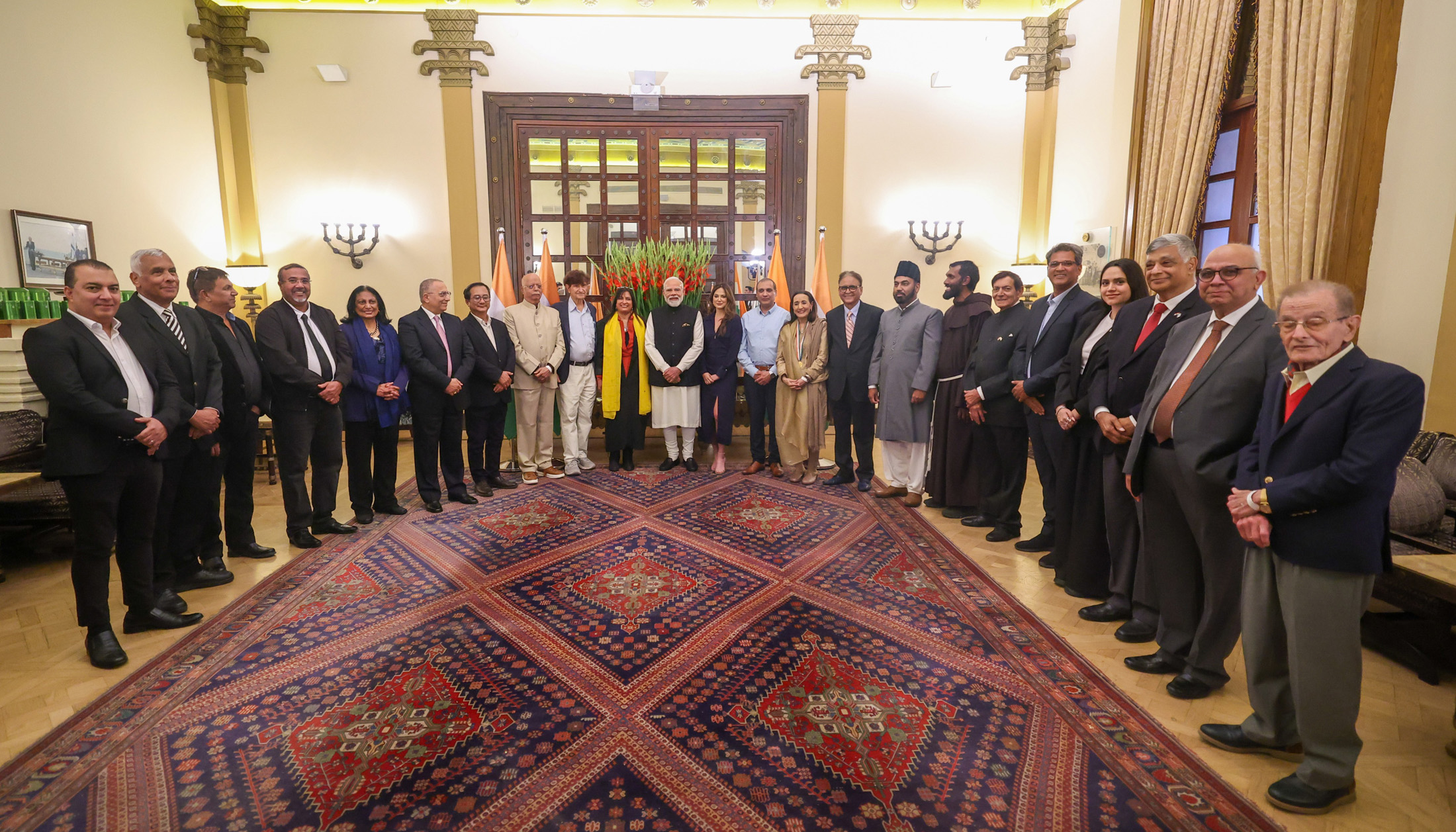
Prime Minister Narendra Modi interacts with Prominent Members of Indian Jewish Community, in Israel on February 26, 2026.
India, Israel Chart New Path in AI, Defence and Education
Rare Earth to Nalanda: India–Israel Seal Broad Pact
Jerusalem: Beginning with cooperation on critical minerals and rare earths and the revival of ancient scholarly links through Nalanda, India and Israel today announced a broad framework of agreements and initiatives elevating their bilateral engagement under a “Special Strategic Partnership for Peace, Innovation and Prosperity,” covering technology, defence, labour mobility, agriculture, education, health, environment and regional connectivity.
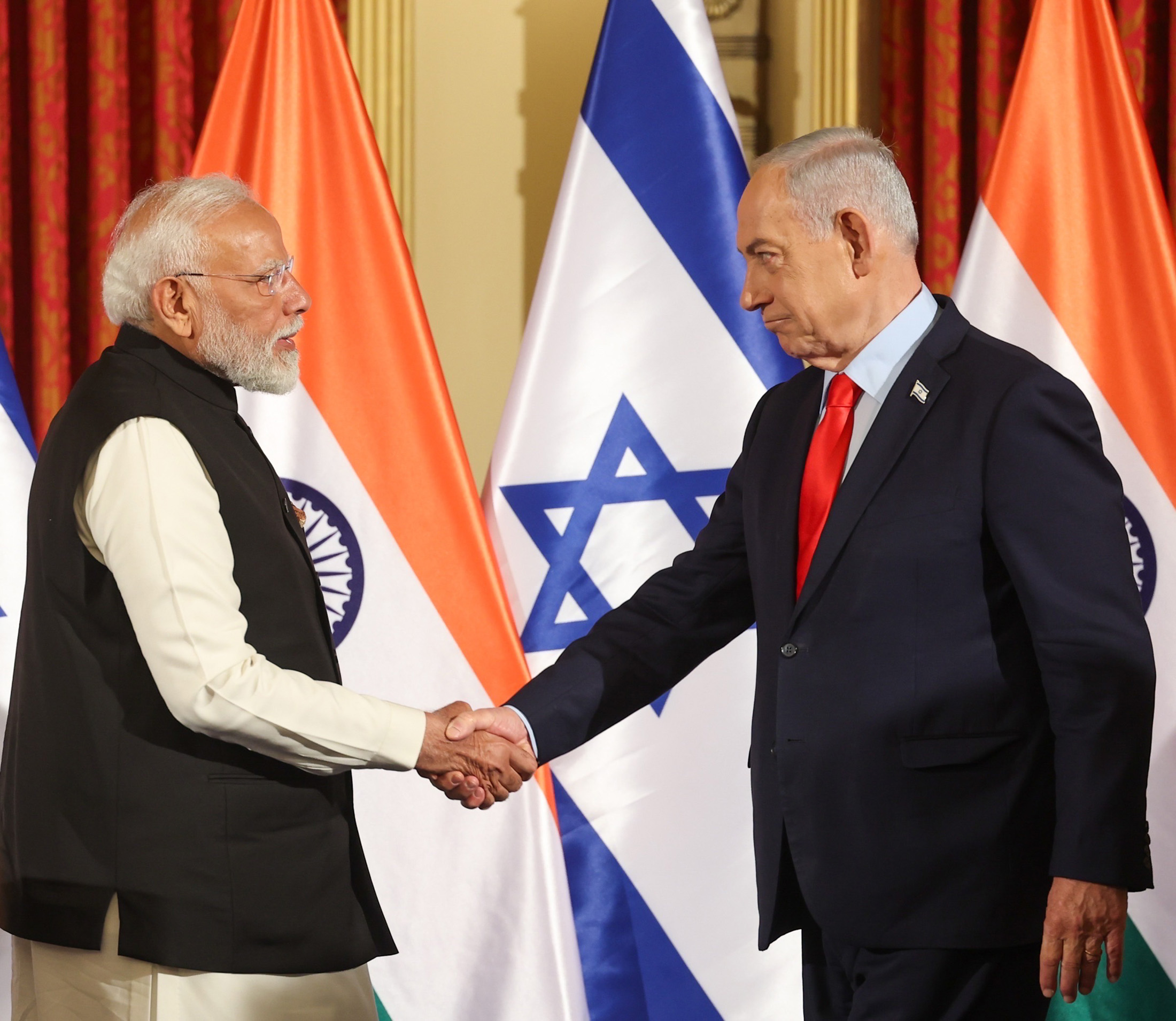
The decisions were reflected in a Joint Statement, ten formal announcements and a series of Memoranda of Understanding exchanged following meetings between Prime Minister Narendra Modi and Israeli Prime Minister Benjamin Netanyahu.
At the core of the outcomes was cooperation in geophysical exploration linked to critical minerals and rare earth elements. A Memorandum of Understanding between India’s Ministry of Mines and Israel’s Ministry of Energy and Infrastructure provides for collaboration in mineral exploration using advanced geophysical and artificial intelligence tools, data sharing, investment promotion and sustainable development of mineral resources. This cooperation was placed within a broader Critical and Emerging Technologies framework led by the two National Security Advisors.
Among the ten major announcements were the elevation of the relationship to a Special Strategic Partnership; upgrading of the Joint Commission on Science and Technology to the ministerial level; launch of a Critical and Emerging Technologies initiative; establishment of a Financial Dialogue; creation of a Tech-Gateway Initiative; introduction of 20 joint fellowships in agricultural research; increase in financial contributions to joint research calls; agreement on a quota of up to 50,000 Indian workers over five years; establishment of an India–Israel Academic Cooperation Forum; and formation of an India–Israel Parliamentary Friendship Group.
In emerging technologies, the two sides signed a Declaration of Intent on Horizon Scanning as a strategic foresight mechanism to identify future risks and opportunities through joint research, capacity building and AI-driven tools. A dedicated Memorandum of Understanding on artificial intelligence focused on ethical AI development, civilian applications, academic cooperation and public–private partnerships. A Letter of Intent was also concluded to establish an Indo–Israel Cyber Centre of Excellence in India to demonstrate best practices in cybersecurity, digital resilience and emerging technologies.
Cybersecurity cooperation was further outlined through a multi-year strategic programme including human capacity building, applied research, security-by-design principles and regular joint tabletop exercises. The leaders welcomed the inaugural India–Israel Cyber Policy Dialogue held in March 2025 and the conduct of Financial-CSIRT simulations and financial-cyber intelligence cooperation.
In defence and security, the leaders welcomed the Memorandum of Understanding on Defence Cooperation signed in November 2025 and agreed on a roadmap for joint development, joint production and technology transfer. They reaffirmed cooperation in space, noting ongoing engagement between the Israel Space Agency and the Indian Space Research Organisation, and encouraged joint ventures and innovation partnerships.
Trade and investment frameworks were reinforced through the presentation of the report of the 4th India–Israel CEO Forum held in Israel in November 2025 and an agreement between the Israeli Institute of Commercial Arbitration and the Indian Council of Arbitration to strengthen arbitration and mediation cooperation.
The Prime Ministers welcomed the signing of the India–Israel Bilateral Investment Agreement in September 2025 and the launch of negotiations for a Free Trade Agreement. The first round of FTA talks, held from February 23 to 26, 2026, covered goods and services, rules of origin, sanitary and phytosanitary measures, technical barriers to trade, customs procedures, intellectual property rights and digital trade. The next round of negotiations will be held in Israel in May 2026. Bilateral merchandise trade currently stands at about USD 3.62 billion, with potential identified in machinery, chemicals, textiles, agriculture, medical devices and advanced technologies.
In the digital and financial domain, NPCI International Payments Limited and MASAV of Israel signed a Memorandum of Understanding to explore linkages between India’s Unified Payments Interface and Israel’s payment systems to enable cross-border remittances and real-time digital transactions. Financial sector cooperation was strengthened through an agreement between India’s International Financial Services Centres Authority and the Israel Securities Authority to exchange information and collaborate in fintech and regtech.
Labour mobility formed a key people-to-people dimension of the partnership. Three implementation protocols were signed for the employment of Indian workers in the commerce and services sector, the manufacturing sector and the restaurant sector. These build on the 2023 framework that already facilitates Indian workers in construction and caregiving. Manufacturing sectors identified include textiles, metals, electronics, chemicals, plastics, rubber, wood and paper, while services include retail, cleaning, logistics, warehousing, food processing and recycling. Both leaders agreed that up to 50,000 additional Indian workers may arrive in Israel over the next five years, with emphasis on safety, security and legal rights.
Agriculture cooperation was expanded through a Memorandum of Understanding between the Indian Council of Agricultural Research and MASHAV, establishing the India–Israel Innovation Centre for Agriculture to develop next-generation technologies in precision farming, satellite-based irrigation, integrated pest management, germplasm exchange, post-harvest solutions and capacity building. The leaders welcomed the launch of 20 joint fellowships for Indian researchers at Israel’s Volcani Agriculture Research Organization and reviewed the progress of 35 existing Centres of Excellence and eight more under joint operationalisation. They also agreed to scale these centres to 100 and implement a Villages of Excellence programme.
Cooperation in fisheries and aquaculture was formalised through an agreement covering sustainable practices, disease management, mariculture and seaweed cultivation, with provisions for research, trade and training and the establishment of a Joint Centre of Excellence.
Health and science cooperation included plans to convene the first Joint Working Group on Health in early 2026, with a focus on digital health, biotechnology and advanced pharmaceuticals. Civil nuclear energy cooperation was identified as an additional area of engagement.
Environmental cooperation was broadened to include water conservation, wastewater reuse, desalination, water utility reforms, river cleaning, including the Ganga, biodiversity protection, prevention of environmental pollution and promotion of a circular economy alongside climate action.
A separate agreement on heritage and archaeology was concluded between India’s Ministry of Ports, Shipping and Waterways and the Israel Antiquities Authority’s Underwater Archaeology Unit for the development of the National Maritime Heritage Complex at Lothal in Gujarat, including exhibitions, research, publications and expert exchanges.
Cultural cooperation was formalised through a Cultural Exchange Programme for 2026–2029, providing for exchanges in music, theatre, visual arts and dance through festivals, workshops and professional visits. In education, an academic partnership was established between Nalanda University and Hebrew University of Jerusalem, enabling faculty and student exchanges in Buddhist studies, archaeology, mathematics and international relations. A separate MoU on AI-driven education focused on pedagogy, teacher development, regulatory frameworks, equitable access and integration of AI and data literacy.
On regional and global issues, the leaders reiterated cooperation on counter-terrorism and freedom of navigation and trade and referenced platforms such as IMEC and I2U2 for economic connectivity. The Joint Statement noted support for peace and stability in West Asia, including reference to a proposal by the United States President Donald Trump described as a “Comprehensive Plan to End the Gaza Conflict,” and emphasised engagement with the Global South.
Both Prime Ministers condemned terrorism in all forms, including the October 7, 2023, attack on Israel, the April 22, 2025, attack on Indian tourists in Pahalgam and the November 10, 2025, incident near the Red Fort in New Delhi, and reaffirmed their resolve to combat terrorism.
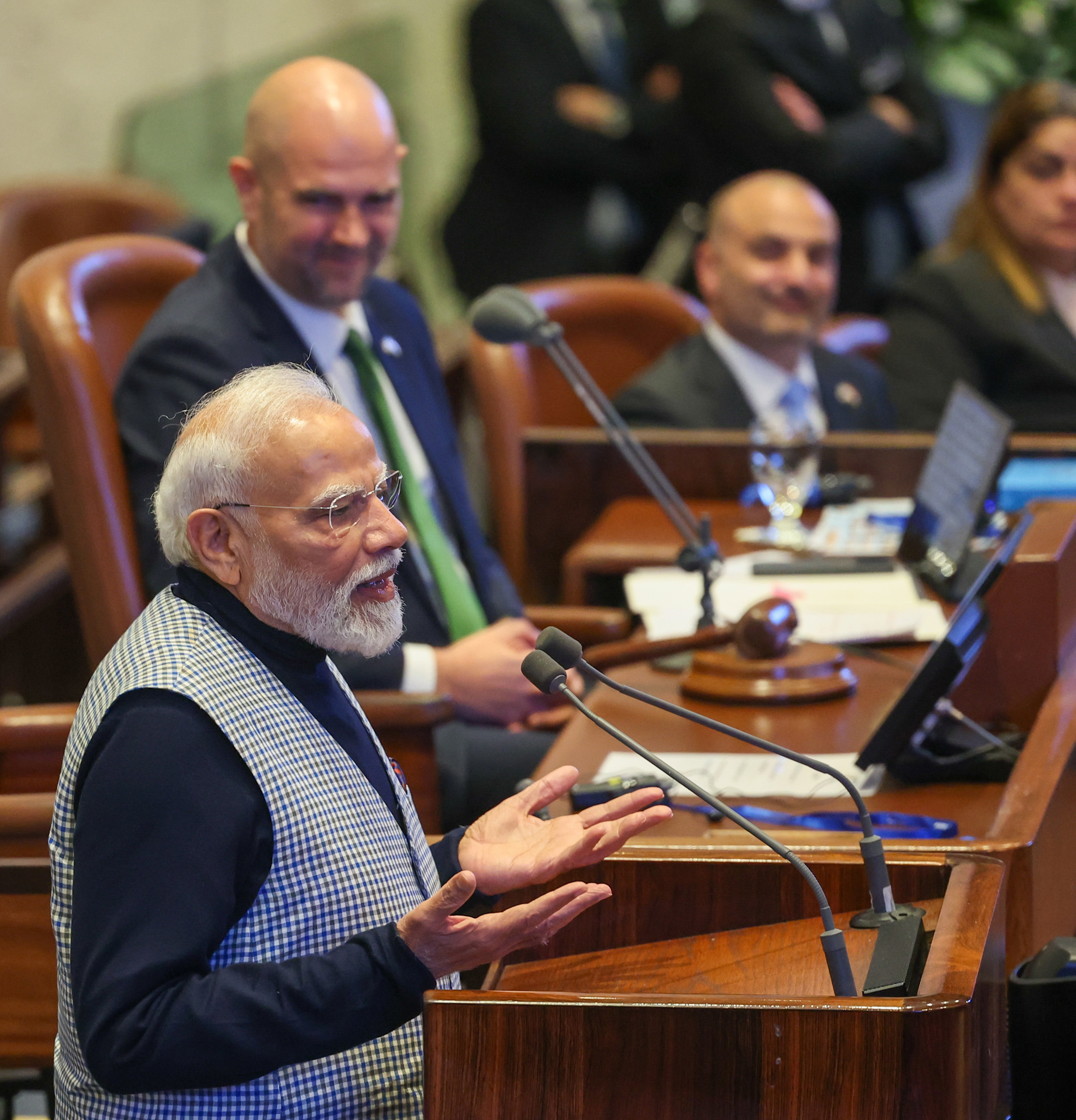
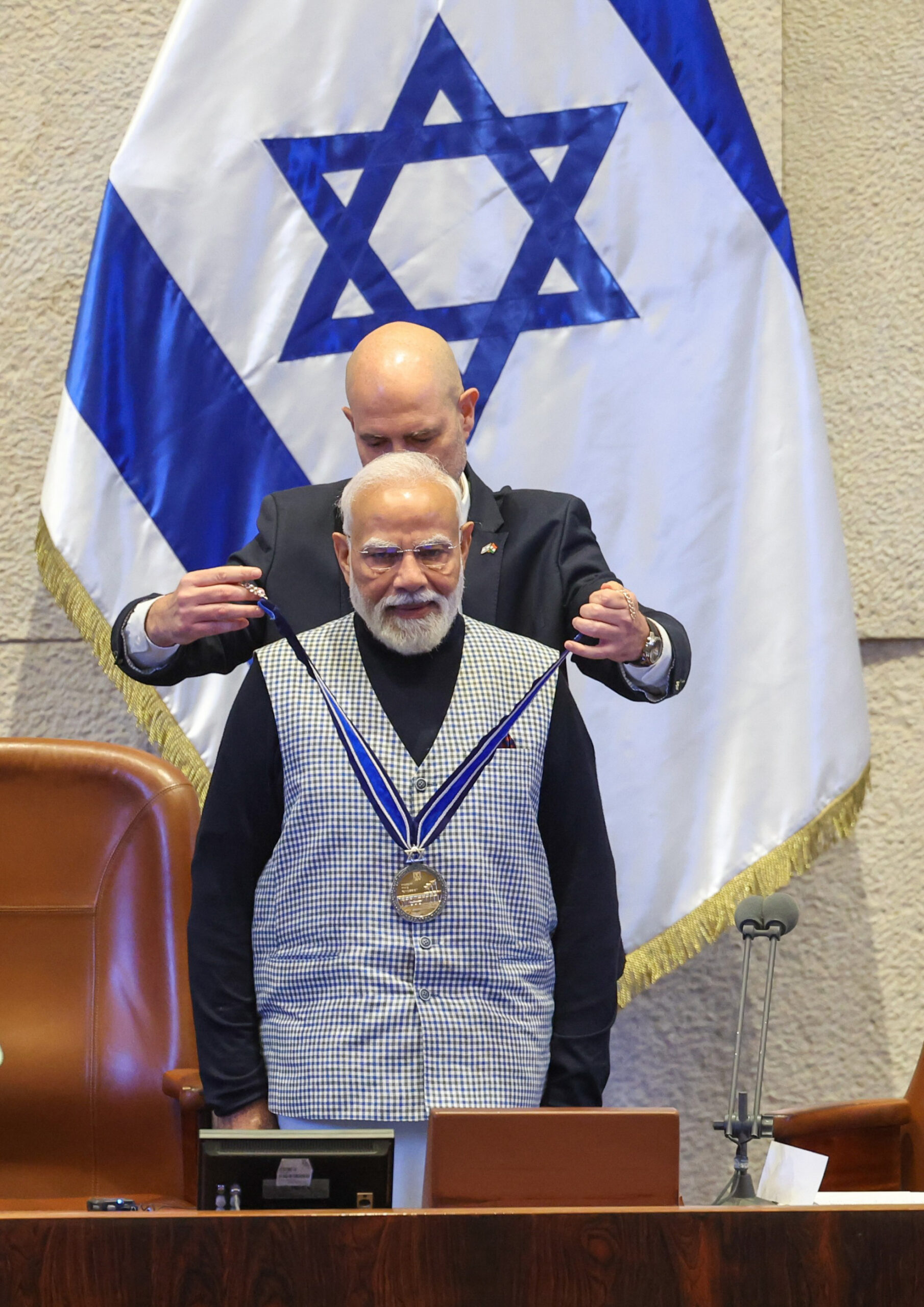
Prime Minister Modi undertook a State Visit to Israel from February 25 to 26 at the invitation of Prime Minister Netanyahu and was accompanied by a high-level delegation of ministers and officials. On arrival at Tel Aviv airport, he was received by Prime Minister Netanyahu and his wife, Sara Netanyahu and accorded a ceremonial welcome. He later addressed the Knesset and was conferred the Speaker of the Knesset Medal.
During Prime Minister Narendra Modi’s appearance at the Knesset, proceedings were briefly marked by a political protest from opposition parties. The walkout followed a dispute over the Speaker’s decision not to invite Israel’s Supreme Court President Isaac Amit to the session in which Israeli Prime Minister Benjamin Netanyahu addressed the chamber ahead of Modi’s speech. Opposition lawmakers exited during Netanyahu’s remarks but returned once Modi entered the hall, with former coalition members temporarily occupying the vacated seats to ensure the chamber was not left empty, according to Israel’s public broadcaster Kan. In coordinated statements, opposition parties Yesh Atid and Yisrael Beytenu said their boycott was directed at the domestic controversy and not at the visiting leader, and that they would return to the plenum to show respect for ties with India. Opposition leader Yair Lapid later greeted Modi inside the chamber and said the protest “had nothing to do” with him, adding that the alliance between the two countries commanded admiration across Israel and that lawmakers on both sides of the aisle looked forward to hearing Modi’s address.
During the visit, Prime Minister Modi visited Yad Vashem, participating in ceremonies at the Hall of Remembrance and the Book of Names Hall, and met President Isaac Herzog in Jerusalem, where they discussed regional issues and planted a tree under the “Ek Ped Maa Ke Naam” initiative. Cultural performances by Indian and Israeli artistes and interactions with the Indian and Jewish diasporas were also part of the programme.
In his press statement, Prime Minister Modi said the elevation of ties reflected the aspirations of the people of both countries and highlighted cooperation in critical and emerging technologies, digital health, defence, agriculture and manpower mobility. He reiterated India’s position that terrorism has no place in the world and expressed support for dialogue and peaceful resolution of conflicts in West Asia.
The visit concluded with the adoption of the Joint Statement and exchange of multiple agreements, with officials indicating that implementation would proceed through existing joint working groups and newly created institutional mechanisms, subject to periodic review at ministerial and senior official levels.
– global bihari bureau