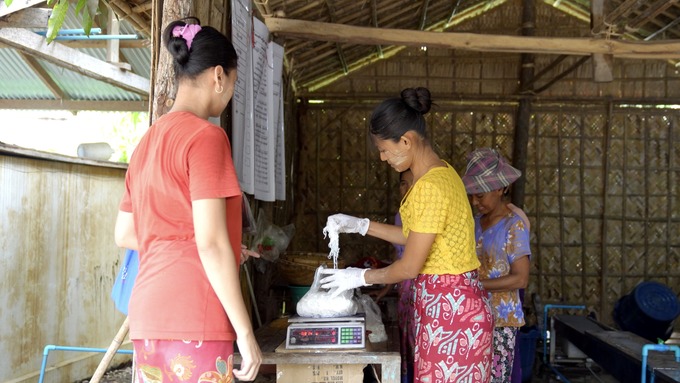
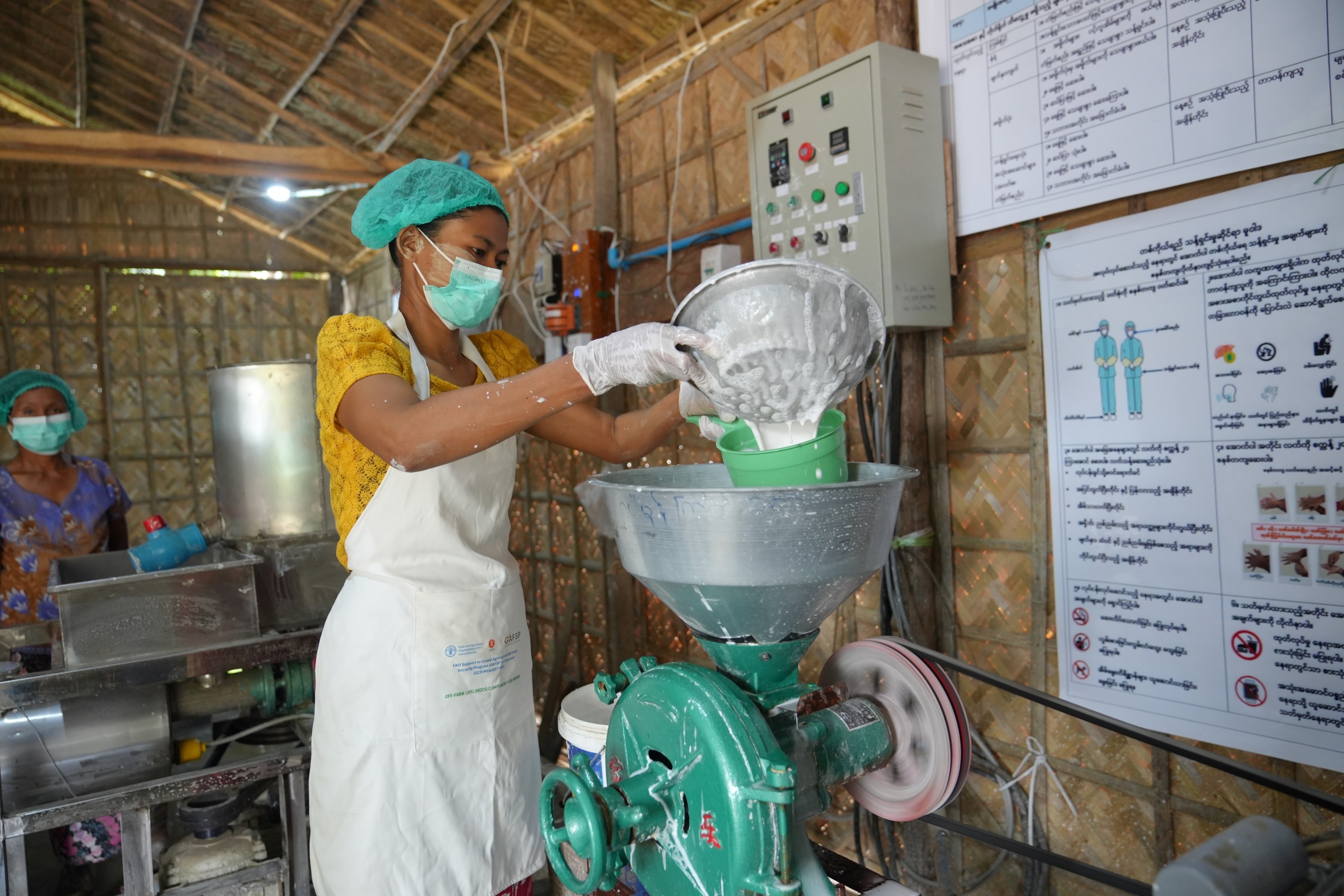
Climate change and political crises meant that farmers like Maw Maw (pictured left/top) could no longer rely on agriculture alone to sustain their livelihoods. She saw rice noodles as a way to bolster her income and bring some stability to her earnings. ©FAO/Htike Koko Aung
From Rice Fields to Noodle Stalls: A Woman’s Path to Stability
On the grounds of a primary school between the towns of Pwintbyu and Salin in Myanmar’s Magway Region, Maw Maw Hmwe operates a modest food stall, serving her well-loved rice noodle salads to a steady stream of students and teachers. What began as a simple daily routine has grown into a source of stability and pride for this mother of eight, who now manages two small businesses and quietly demonstrates resilience in the face of immense challenges.
Maw Maw never imagined herself as an entrepreneur. “I never imagined I could run a business,” she says. “Now I feel confident and independent.” Rice noodles, a staple of Myanmar’s cuisine, offered a promising path forward. From the thick, round strands in the country’s famous fish-based mohinga to the thin, stringy noodles in Shan-style dishes, they appear in meals from dawn to dusk—affordable, familiar, and comforting.
For years, Maw Maw relied on rice farming, supplemented by beans and sesame, to sustain her family. Yet the unpredictability of climate change brought constant uncertainty: one season’s harvest could be lost to floods or droughts. “Some years we have good yields,” she recalls, “but the next year, there is nothing. I worried constantly about how we would survive.” The political crisis of 2021 compounded these struggles, as armed conflict disrupted local economies. Fertiliser, fuel, and seed prices soared, market access dwindled, and low crop prices made it impossible for agriculture alone to support rural households.
Seeking more reliable income, Maw Maw took a decisive step in 2024 by joining a women-led savings and credit group in her community, supported by the Food and Agriculture Organization of the United Nations (FAO). In rural Myanmar, formal loans are often inaccessible to women because of collateral or official documentation requirements, leaving many dependent on high-interest informal lenders. FAO’s initiative bridged this gap, enabling women to pool modest regular savings and access low-interest loans.
Initially hesitant, Maw Maw worried she might not be able to contribute regularly due to her limited income. The group’s management committee explained the system patiently, easing her concerns. Soon, she secured a small loan to purchase better-quality seeds and tools, boosting her harvest. Beyond financial support, the group provided something even more vital: a space for women to meet, exchange ideas, share challenges, and support one another during times of economic strain, fear, and displacement.
Inspired by these connections, Maw Maw and her fellow members transformed their rice fields into an opportunity. Local demand for rice noodles was high, but supply was scarce, often requiring long trips to distant suppliers. By pooling resources, they launched a small production venture called Taw Win Thazin. Through FAO’s Global Agriculture and Food Security Program, the women received a noodle-making machine and hands-on guidance in production techniques, food safety, hygiene, bookkeeping, accounting, and micro-business planning.
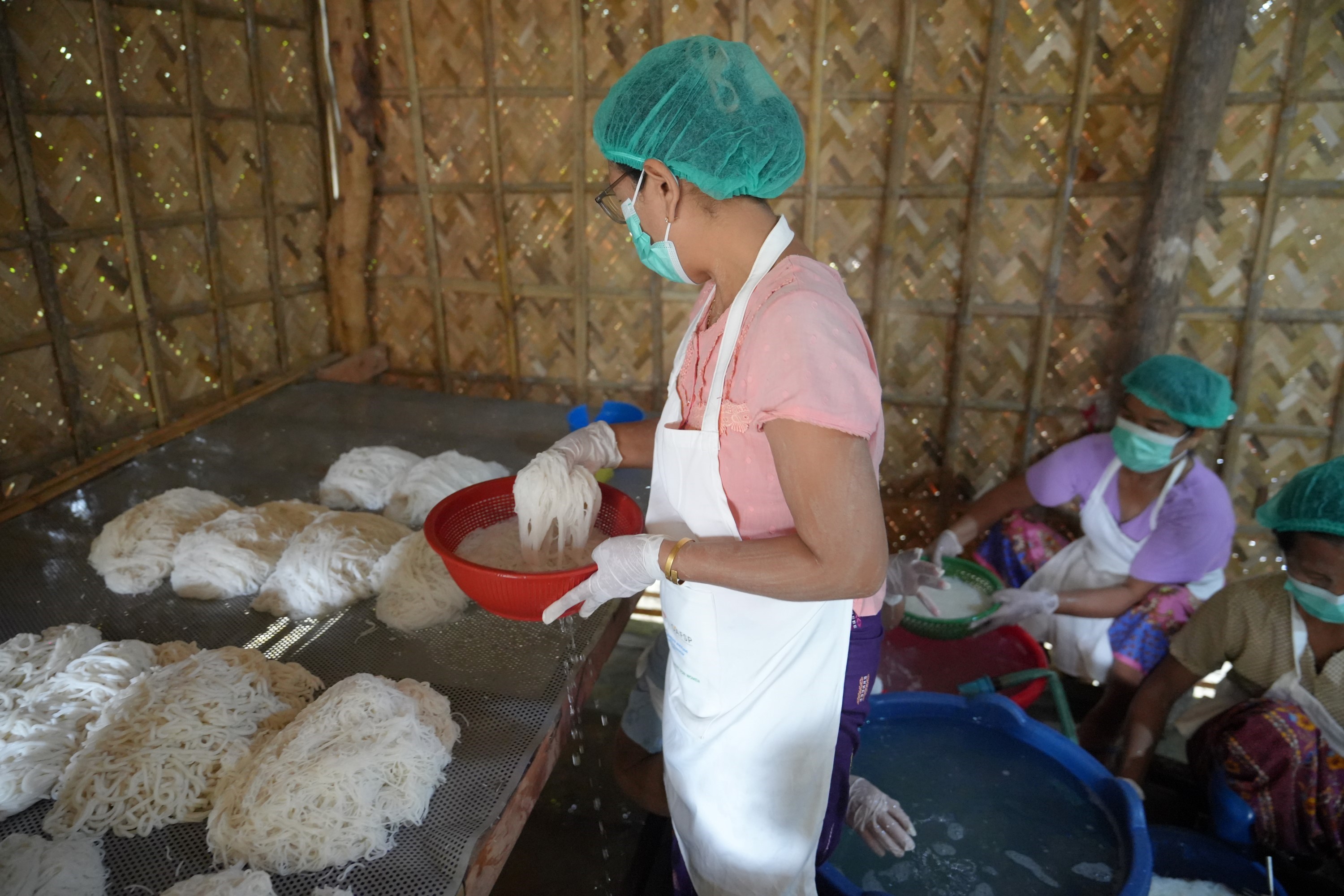
The business quickly gained traction, becoming a reliable source of noodles for the community while generating steady income to support household needs, including school expenses. Buoyed by this success, Maw Maw took a larger loan to open her schoolyard food stall. Today, she proudly uses noodles from Taw Win Thazin in her popular salads, drawing repeat customers daily. The profits allow her to repay loans, meet family needs, and secure a more stable future.
Since 2024, FAO and its partners have supported over 60 women’s savings and credit groups across Myanmar, reaching more than 1,300 women farmers. Over 350 of these women have launched their own agribusinesses, from oilseed processing to traditional groundnut and sesame brittles, while 48 group enterprises like Taw Win Thazin have emerged, offering livelihoods where options were previously limited.
In a nation facing daily uncertainty, these women demonstrate remarkable resilience. Rural women like Maw Maw carry enormous responsibilities—working in fields, processing food, raising livestock, managing households, and caring for children—yet their contributions often remain unseen. Access to finance and training empowers them to make decisions that strengthen families and uplift entire communities.
This story is part of a global celebration of women farmers, producers, fishers, pastoralists, traders, scientists, and entrepreneurs alike. The International Year of the Woman Farmer 2026, championed by the United Nations and supported by FAO alongside partners such as IFAD and WFP, recognises their essential contributions to food security, economic vitality, nutrition, and resilient livelihoods. Despite heavier workloads, precarious conditions, and unequal access to resources, these women persist. The Year calls for renewed commitment—through policies, investments, and collective action—to empower women in all their diversity and build a more inclusive, sustainable agrifood system.
Source: The FAO News And Media Office, Rome
– global bihari bureau