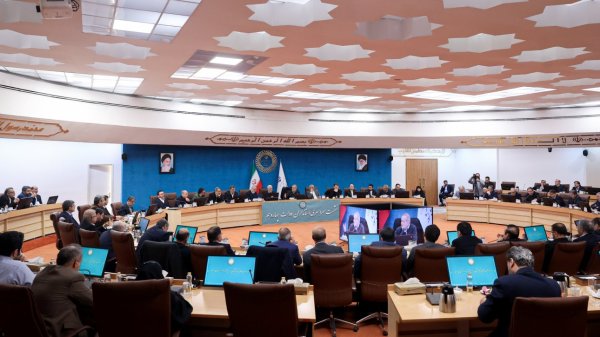
Iran's President Masoud Pezeshkian at a meeting of provincial governors in Tehran on January 27, 2026.
Global Meeting Advances Iran UNSCRs Enforcement
Sanctions Drive Deepen Divide between U.S. and Iran
Prague/Tehran/Washington: “The United States and European countries are not concerned about the Iranian people but are pursuing Iran’s oil, gas, and national wealth,” Iranian President Masoud Pezeshkian said on January 27, 2026, as the United States announced the same day that representatives from 40 countries had gathered in Prague for a symposium to strengthen enforcement of reimposed United Nations Security Council resolutions targeting Iran’s nuclear and military activities.
In a press statement issued in Washington on January 28 (IST), U.S. Principal Deputy Spokesperson Thomas “Tommy” Pigott said the meeting in the Czech capital was designed to advance international implementation of renewed UN obligations following the restoration of six Security Council resolutions in September 2025. The symposium brought together government officials and technical experts to address obstacles faced by UN member states in enforcing sanctions and to expand coordination across regions.
Participants examined a wide range of issues affecting national implementation, including oversight of financial networks, customs and border controls, and monitoring of sensitive technologies and materials. The meeting also secured commitments from several attending countries to receive country- and sector-specific technical security assistance from the United States. Washington said the assistance would help partner governments strengthen their capacity to apply sanctions effectively and close gaps that could otherwise allow prohibited transactions to continue.
Discussions focused on what U.S. officials described as threats posed by Iran’s nuclear programme, ballistic missile development, and conventional arms activities. Delegations emphasised the importance of using all available national legal and enforcement tools to implement the restored resolutions more robustly and consistently. According to the U.S. statement, uneven enforcement across countries risks weakening the overall sanctions framework and enabling networks linked to proliferation to persist.
The symposium also linked sanctions enforcement to broader political and security concerns. U.S. and partner governments cited Iran’s continued proliferation activities and its response to recent domestic protests as factors underscoring the urgency of universal implementation of the UN measures. The meeting highlighted the need for coordinated global action to uphold the restrictive provisions aimed at curbing Iran’s proliferation-related programmes.
The six United Nations Security Council resolutions now being enforced again were originally adopted between 2006 and 2010 in response to Iran’s nuclear activities and its refusal at the time to suspend uranium enrichment. They were reimposed on September 27, 2025, after the Security Council cited what Washington described as Iran’s “significant non-performance” of its nuclear commitments.
Resolution 1696 was the first to demand that Iran suspend uranium enrichment and reprocessing activities and cooperate fully with international inspectors. It marked the point at which Iran’s nuclear programme was formally treated as an issue affecting international peace and security.
Resolution 1737 introduced binding sanctions for the first time. It restricted the transfer of nuclear-related materials and technology to Iran and imposed global asset freezes and travel bans on individuals and entities associated with Iran’s nuclear and missile programmes.
Resolution 1747 expanded the sanctions regime by broadening the list of designated individuals and entities and by introducing an arms embargo that prohibited Iran from exporting weapons. It also urged countries to exercise greater caution in financial dealings with Iranian institutions linked to proliferation concerns.
Resolution 1803 strengthened financial and trade restrictions and encouraged states to inspect cargo travelling to and from Iran when there were reasonable grounds to believe it contained prohibited items. It also expanded oversight of Iranian banks and added further designations to the sanctions list.
Resolution 1835 reaffirmed the earlier measures and expressed continued concern over Iran’s lack of compliance, maintaining political pressure without adding new punitive steps.
Resolution 1929 imposed the most far-reaching restrictions. It prohibited Iran from engaging in activities related to ballistic missiles capable of delivering nuclear weapons, tightened the arms embargo, widened asset freezes and travel bans, and authorised states to seize and dispose of cargo suspected of violating sanctions. It also restricted Iranian investment in sensitive foreign sectors such as uranium mining and missile-related industries.
With their restoration in 2025, these six resolutions once again obligate all UN member states to require Iran to suspend uranium enrichment, heavy water production, and reprocessing activities; to prohibit Iran’s use of ballistic missile technology; to ban Iranian arms imports and exports; and to apply travel bans and asset freezes on designated individuals and entities. They also empower countries to intercept and confiscate prohibited shipments moving to and from Iran.
U.S. officials said the Prague symposium represented an effort to move beyond legal declarations toward practical enforcement. By focusing on technical assistance and coordination, Washington and its partners aim to ensure that sanctions are implemented effectively across financial systems, shipping routes, and regulatory frameworks.
As international efforts intensified on January 27, Iran’s leadership mounted a sharp political response. Speaking at a meeting of provincial governors, President Pezeshkian criticised what he described as the hypocritical stance of the United States and European governments toward developments in Iran under the banner of human rights.
He argued that Western governments were not genuinely concerned about the lives and welfare of ordinary Iranians but were instead pursuing their own interests in Iran’s oil, gas, resources, and national wealth. Pezeshkian said Western countries claim to defend human rights while at the same time supporting what he called the most brutal and inhumane crimes committed by Israel in Gaza.
The Iranian president added that during Iran’s recent unrest, Western governments openly backed rioters and acts of violence. He further emphasised that one of the main areas targeted by Iran’s adversaries was the livelihood of the people, asserting that economic pressure was intended to weaken social stability from within.
Pezeshkian called for greater precision and vigilance by provincial security councils in maintaining public security and monitoring what he termed hostile activities. He said that ensuring public satisfaction and focusing on the needs of citizens would neutralise hostile objectives and strengthen national resilience.
Expressing confidence in Iran’s future, he stated that the country would overcome current challenges through reliance on God and a firm commitment to serving the people. He stressed that if public satisfaction remained the central pillar of government action, no power would be able to push Iranians out of the national arena.
The parallel developments in Prague and Tehran highlighted the deepening divide between the United States and Iran over sanctions, nuclear compliance, and human rights. While Washington and its partners seek stricter and more coordinated global enforcement of UN measures through technical and legal cooperation, Iran’s leadership continues to portray the sanctions campaign as politically motivated and driven by economic interests rather than concern for the Iranian population.
U.S. officials indicated that further international engagements would follow the Prague symposium as part of a broader strategy to reinforce the UN sanctions framework and respond to what they describe as continuing risks posed by Iran’s nuclear and military programmes.
– global bihari bureau