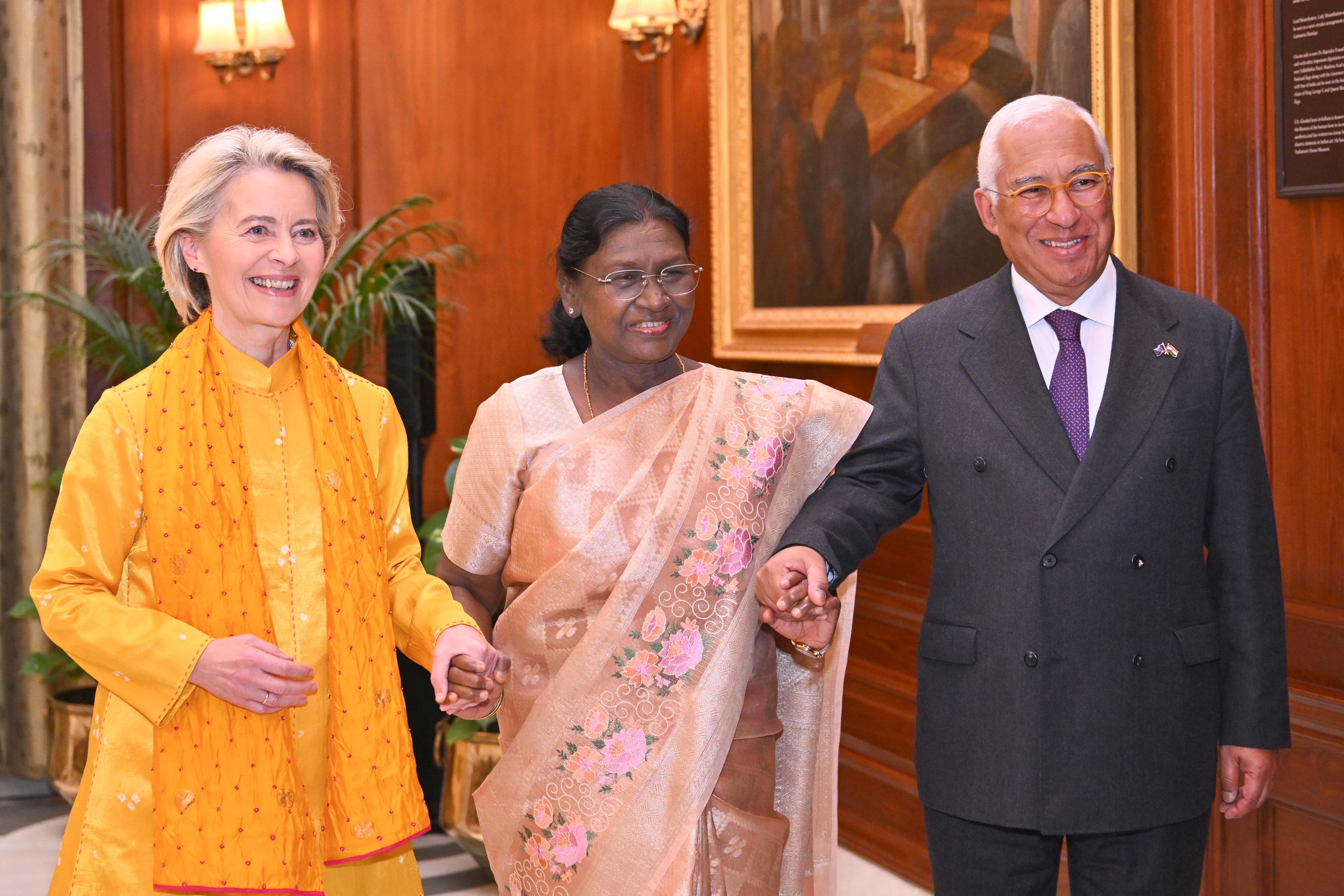
President of India Droupadi Murmu receives António Costa, President of the European Council and Ursula von der Leyen, President of the European Commission at Rashtrapati Bhavan today evening
India–EU Free Trade Pact: Inside the Largest Deal India Has Ever Signed
By any measure — population covered, economic weight, regulatory reach, or geopolitical implications — the India–European Union Free Trade Agreement concluded in January 2026 is not merely another trade pact. It is a structural reset of one of India’s most consequential external relationships.
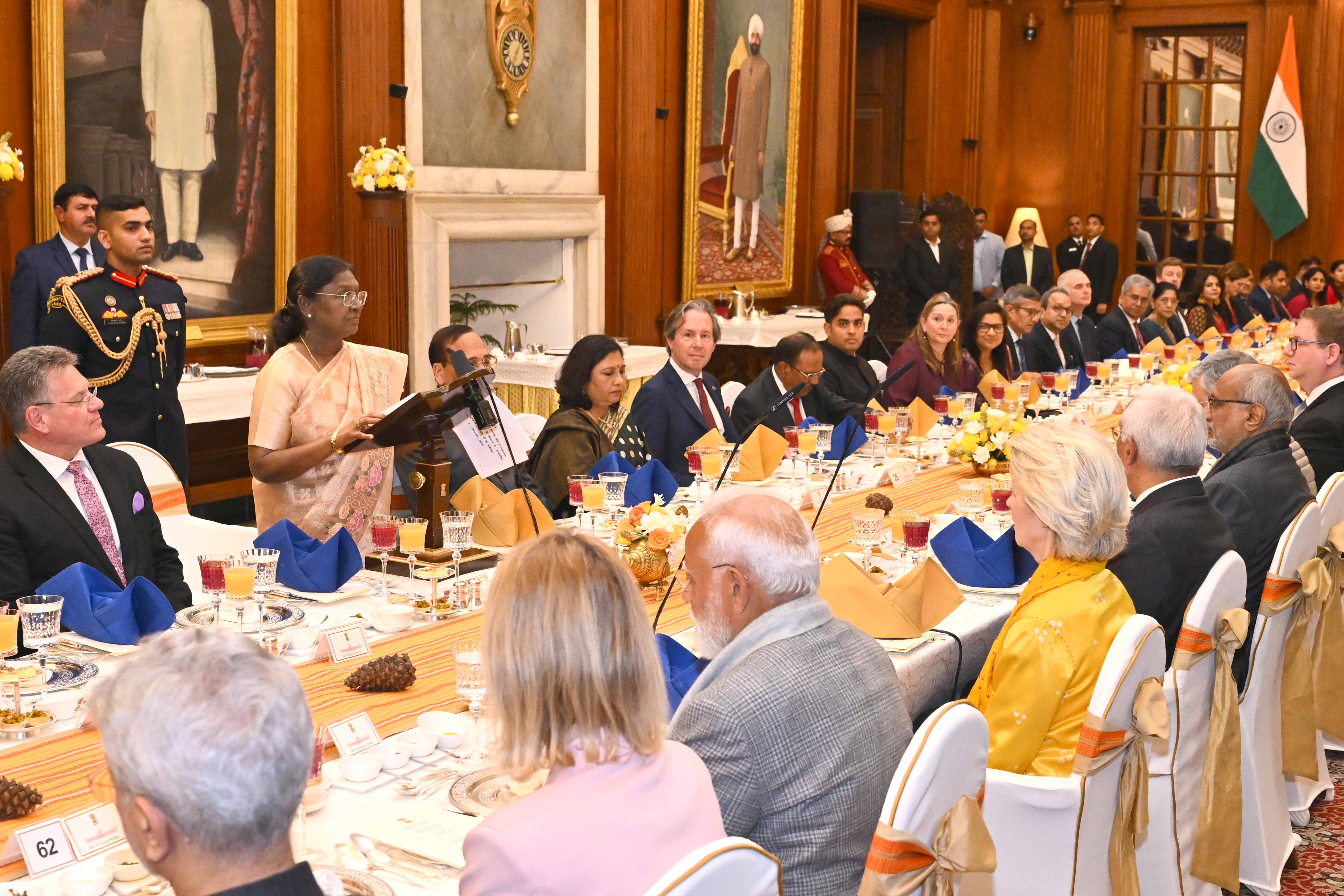
New Delhi: When India and the European Union announced the conclusion of their Free Trade Agreement (FTA) at the 16th India–EU Summit in New Delhi, the symbolism was unmistakable. For the first time, the European Union participated in India’s Republic Day celebrations, with European Council President António Costa and European Commission President Ursula von der Leyen attending as chief guests. That diplomatic choreography was reinforced hours later at Rashtrapati Bhavan, where President Droupadi Murmu hosted the two leaders at a banquet and framed the agreement not only as an economic instrument, but as a reaffirmation of shared democratic values.
India and Europe, President Murmu said, are bound not only by contemporary interests but by deeper commitments to democracy, pluralism and an open market economy — principles that gain urgency amid global uncertainty, conflict, and fragmentation. The agreement, she added, would bring “significant positive changes” to the lives of people on both sides.
A Deal of Unmatched Scale
In purely numerical terms, the agreement is unprecedented. It creates a preferential trade zone covering nearly two billion people, linking the world’s fastest-growing large economy with one of its wealthiest consumer markets. Prime Minister Narendra Modi described it as the largest free trade agreement in India’s history, while European Commission President Ursula von der Leyen went further, calling it “the mother of all deals” — language rarely used in Brussels diplomacy.
At its core, the agreement reshapes access to the European Union market for Indian exporters. More than 99 per cent of India’s exports by trade value, covering approximately 97 per cent of EU tariff lines, will eventually receive preferential or zero-duty access. For India, whose export basket remains heavily weighted toward labour-intensive manufacturing and services, this represents a decisive opening.
How the Tariffs Actually Fall
The architecture of tariff liberalisation is far more granular than headline figures suggest. On the EU side, over 70 per cent of tariff lines covering more than 90 per cent of Indian exports will see immediate duty elimination. Another 20 per cent will be phased to zero over three to five years, while a smaller subset will see calibrated reductions or tariff-rate quotas.
India’s own commitments are similarly staged. Approximately 92 per cent of tariff lines, covering about 97.5 per cent of EU exports to India, are included. Nearly half see immediate elimination, while others follow five-, seven- or ten-year glide paths. Sensitive sectors — notably dairy, cereals, poultry and soymeal — remain protected, reflecting domestic political and livelihood considerations.
Tariff-rate quotas have been carefully deployed in politically sensitive areas such as automobiles, steel, shrimps, poultry products, bakery items, apples, pears, peaches and kiwifruit, ensuring liberalisation without market disruption.
Sector by Sector: Who Gains — and How Much
The gains are uneven but potentially transformative.
Textiles and apparel, long constrained by EU duties, gain near-universal duty-free access into a market valued at nearly ₹23 lakh crore. With India’s EU textile exports already exceeding ₹62,000 crore, manufacturers expect sharp competitiveness gains, particularly for cotton garments and value-added apparel.
In leather and footwear, tariffs as high as 17 per cent are eliminated, opening a European import market of ₹8.7 lakh crore to Indian producers, many of them small and medium enterprises clustered in Tamil Nadu, Uttar Pradesh and West Bengal.
The marine sector, including shrimps and prawns, sees duty reductions from peaks of 26 per cent. Coastal states such as Andhra Pradesh, Gujarat and Kerala stand to gain, with exports linked not only to trade but to India’s broader blue-economy strategy.
Engineering goods, India’s largest manufacturing export segment, gain enhanced access to a European import market estimated at ₹174 lakh crore, while chemicals, plastics, rubber, medical instruments, gems and jewellery, furniture, and mineral-based products all benefit from near-complete tariff elimination.
Services, Mobility and Migration
Trade in goods is only one pillar. The agreement marks one of the EU’s most expansive services commitments to India, covering 144 services subsectors, from information technology and professional services to finance, education and environmental services. India, in turn, has opened 102 subsectors, including telecom, maritime transport and financial services.
Perhaps most politically significant is the mobility framework. The agreement facilitates the temporary movement of business visitors, intra-corporate transferees, contractual service suppliers and independent professionals, while also granting work rights to dependents of intra-corporate transferees. Provisions on social security coordination and student mobility further deepen people-to-people ties — an area India has long prioritised in negotiations with developed economies.
Climate, Carbon and Compliance
One of the most closely watched elements of the agreement concerns climate policy, particularly the European Union’s Carbon Border Adjustment Mechanism (CBAM). The pact incorporates assurances of non-discriminatory treatment, recognition of carbon pricing mechanisms, and cooperation on emissions verification — a critical safeguard for Indian steel, aluminium and cement exporters.
Beyond CBAM, the agreement commits both sides to cooperation on clean energy, climate finance and sustainable technologies. President Murmu explicitly highlighted these areas at Rashtrapati Bhavan, linking trade liberalisation with global climate responsibility.
A Strategic Trade Pivot in an Era of Unilateral Tariffs
An important geopolitical dimension of the India–European Union Free Trade Agreement lies in its timing against a backdrop of rising unilateral tariffs and protectionist pressures, particularly emanating from the United States. Over the past year, the U.S. has imposed punitive duties of up to 50 per cent on certain Indian exports, a move that has disrupted export momentum in labour-intensive sectors and underscored India’s vulnerability to concentrated market risk. In this context, the India–EU FTA offers a strategic counterweight by diversifying market access and reducing dependence on any single export destination. Analysts note that by securing preferential access to one of the world’s largest high-income markets — where duties on European goods will largely fall to zero — India can mitigate some of the adverse effects of U.S. tariff escalation and supply-chain volatility, while European firms view the pact as a way to broaden their trading footprint beyond a trade environment marked by rising U.S. protectionism. The deal is thus interpreted not only as a bilateral commercial accord but also as a pro-trade signal in a fracturing global trade system, enabling both partners to hedge tariff risks and strengthen rules-based commerce amid ongoing U.S. tariff uncertainty.
Technology, Defence and Strategic Trust
Trade is inseparable from strategy in this agreement. The summit concluded alongside a Security and Defence Partnership, opening new opportunities for defence-industrial cooperation. Technology cooperation — spanning semiconductors, digital infrastructure, artificial intelligence and “responsible innovation” — features prominently.
European leaders have framed the agreement as part of a broader effort to diversify supply chains and reduce strategic dependencies, while India views it as validation of its role as a trusted economic and geopolitical partner.
A Geopolitical Signal
In an era marked by trade wars, sanctions and fragmented supply chains, the India–EU FTA sends a deliberate signal. Both sides have positioned the agreement as an affirmation of rules-based trade, multilateralism and peaceful coexistence — language echoed by President Murmu and reinforced in EU statements.
European Council President António Costa described the partnership as strategic and future-oriented, while von der Leyen underscored that cooperation between major democracies can still deliver large-scale outcomes.
What Happens Next
The agreement now moves into ratification, requiring approval by the European Parliament, EU member states, and India’s domestic processes. Implementation will follow in phases, with tariff reductions, regulatory cooperation and mobility provisions unfolding over several years.
If executed as designed, the pact could reshape not only bilateral trade flows but the broader architecture of India’s engagement with advanced economies — embedding Indian producers, professionals and innovators more deeply into European markets, while giving European firms a long-term stake in India’s growth story.
For now, the agreement stands as both an economic instrument and a political statement: that at a time of global instability, India and Europe see each other not merely as markets, but as partners in shaping a more stable, inclusive and rules-based international order.
– global bihari bureau