 By Sudipta Dey
Son’s Loss Fuels Life-Saving Melody
New Delhi: In a city where stories of loss and resilience intertwine, one family’s heartrending tragedy has blossomed into a powerful movement, urging India to confront the silent scourge of drowning that claims countless young lives each year.

Renu Kaul Verma and Sudesh Verma, seasoned journalists whose lives once thrived on the pulse of newsrooms, now carry an unyielding sorrow. On June 23, 2024, their son, Advaitha Verma—just 18, vibrant with promise—drowned in the backwaters of Pawna Lake near Pune, Maharashtra. Advaitha, a business administration student at Symbiosis Institute and a passionate music enthusiast, was the heart of their home, his love for music filling their days with joy. That day, while with friends at the popular tourist spot, he entered the water, and tragedy struck. His desperate cries for help went unanswered, leaving his friends pleading in vain as the lake offered no mercy. His body was recovered hours later, a loss that shattered his family’s world.
- 300,000 people died from drowning globally in 2021. 90% of drowning deaths occur in low- and middle-income countries -World Health Organization (WHO)
- Globally, children and youth (0–29 years) account for 57% of drowning deaths, with 43% under 15 years
- Over 38,000 drowning deaths in India in 2022, accounting for about 7.4% of all injury-related fatalities – National Crime Records Bureau (NCRB)
- WHO estimates suggest India’s drowning deaths could be 34% higher than NCRB figures. Males comprise ~75% of drowning victims globally, with a male-to-female ratio of over 2:1
- In India, males make up 72–84% of drowning victims, with male-to-female ratios of 2.45:1 to 5:1 – NCRB
- In India, the 5–14 age group is at highest risk, with 41.5% of cases under 20 – NCRB 2022 report
The pain was unimaginable, a relentless echo of questions no parent should face: Why him? Why was no one there to save him? Visiting Pawna Lake days later deepened their anguish. A bustling tourist attraction surrounded by shops, restaurants, and hotels drawing crowds and revenue, the lake lacked any safety measures—no lifeguards, no rescue divers, no life jackets, no emergency boats. This was no isolated incident: Pawna has seen multiple drownings, part of India’s grim toll of over 38,000 drowning deaths in 2022, as reported by the National Crime Records Bureau, a figure experts believe is underestimated by up to 34 per cent due to unreported rural cases and flood-related deaths. Globally, the World Health Organization recorded 300,000 drowning deaths in 2021, with a 38 per cent decline in rates since 2000, yet over 90 per cent occur in low- and middle-income countries like India, where children and youth under 29 account for 57 per cent of victims, and males make up about 75 per cent due to greater risk exposure.
For the Vermas, grief was overwhelming. They withdrew from social interaction for nearly a year, consumed by the void left by Advaitha’s absence. “We felt broken, like we’d failed him,” Sudesh shares, his voice heavy with a father’s unspoken sorrow. Yet, from this darkness, a resolve emerged: to ensure no other family endures such loss. “Drowning isn’t fate; it’s a failure of awareness and preparation,” Renu insists, her determination fierce. “Water bodies lure with beauty, but without safety, they’re deadly. Governments profit from tourism—it’s their duty to protect lives.” Sudesh adds, “In cricket, we gear up against a ball’s threat. Why not against water’s dangers? Precautions are lifelines.”
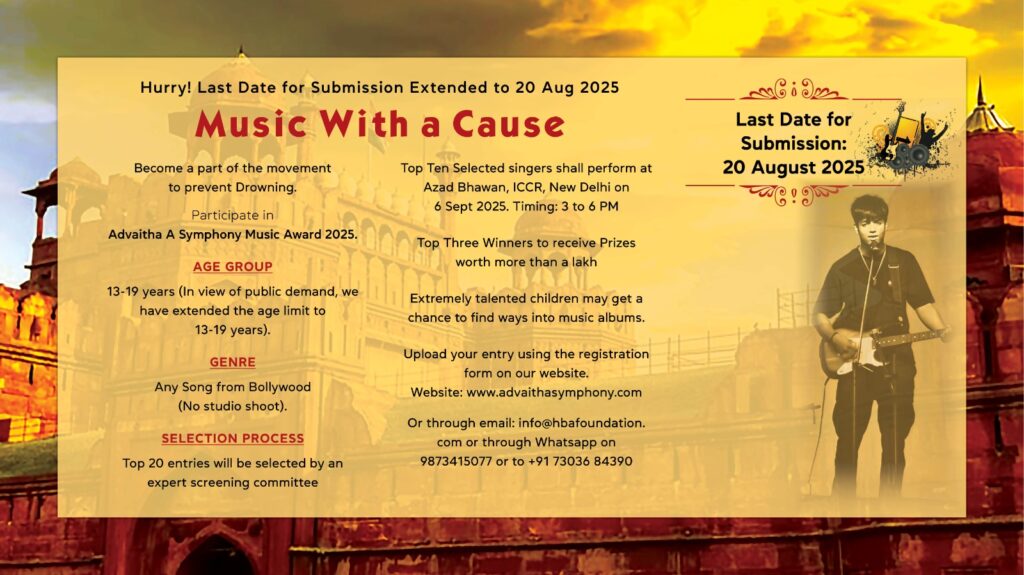
 On July 25, 2025—the United Nations’ World Drowning Prevention Day, themed “Your story can save a life”—the couple launched a nationwide campaign, their pain fueling a plea for change. They founded the Hemant Bala Advaitha (HBA) Foundation, honouring their son and family legacy. Its cornerstone is “Advaitha – The Symphony,” a singing competition debuting September 6 in Delhi, starting in the National Capital Region with plans to expand across India. Inspired by Advaitha’s love for music, it weaves safety messages into melodies to reach the young. “Music was his passion,” Renu says, a tender smile breaking through her grief. “Through it, we tell youth: Your life is precious, irreplaceable. Our theme is ‘Life is Fun, but One.’”
The foundation’s vision extends to marathons uniting communities, lectures in schools and colleges, pamphlet drives, and visits to high-risk water bodies to engage tourists and officials. These efforts join India’s growing but fragmented initiatives—like the Rashtriya Life Saving Society’s training, Kerala’s SwimSafe programme, and Bloomberg Philanthropies’ support in high-burden states—while globally, the WHO pushes for 60 per cent of schoolchildren to swim by 2030. In a nation where water safety knowledge lags, the Vermas’ story fills a vital gap.
“It’s an uphill journey,” Sudesh reflects, hope intertwined with heartache, “but saving even one life honours Advaitha’s memory.” Their shared vulnerability invites us all to listen: Behind every statistic is a family forever changed, and a chance for healing through action.