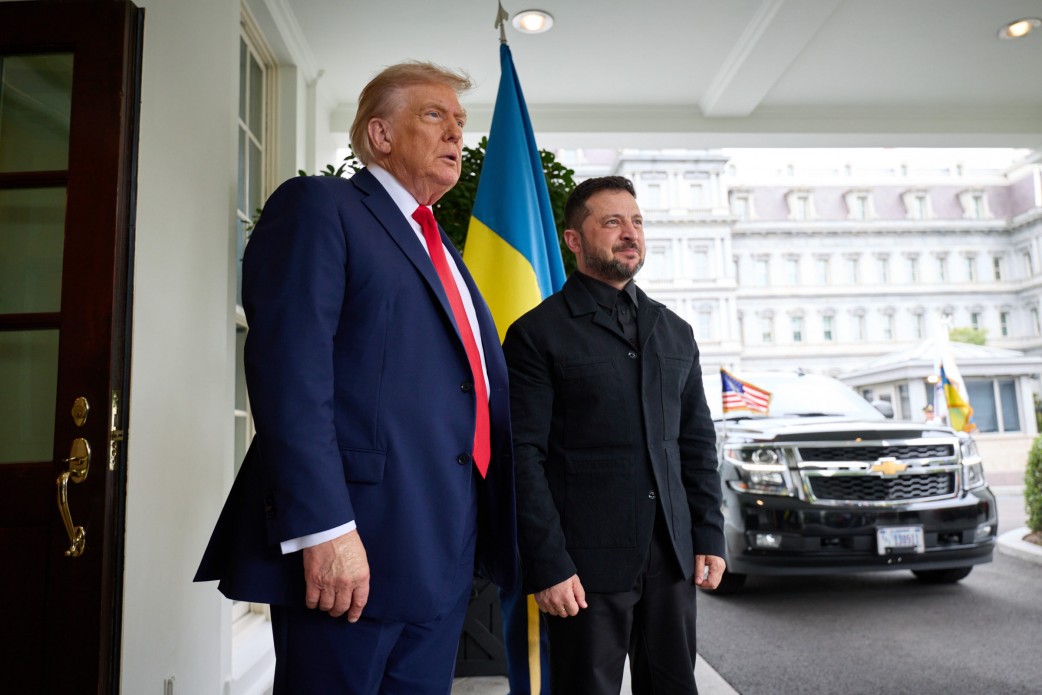
Trump with Zelenskyy in Washington DC
 By Deepak Parvatiyar*
Arms Sales and Talks: U.S. Reshapes Ukraine Aid
A telephone conversation between Russian President Vladimir Putin and United States President Donald Trump, initiated by the latter today, marked a fresh push in diplomatic efforts to resolve the Russia-Ukraine conflict. Russian Presidential Aide Yury Ushakov reported that Putin expressed “heartfelt gratitude” to Trump for the hospitality and organisation of their August 15 summit in Anchorage, Alaska, and progress toward a peaceful resolution.
The call, following Trump’s White House meeting on August 18 with Ukrainian President Volodymyr Zelenskyy and leaders from seven European nations, including representatives from the North Atlantic Treaty Organization (NATO) and the European Union (EU), underscores a U.S. pivot from the open-ended military and financial support of President Joe Biden’s administration to a strategy emphasizing diplomacy, structured arms sales, multilateral security guarantees, and economic arrangements like a minerals deal.
Secretary of State Marco Rubio, in a Fox News interview with Jesse Watters on August 18, called the White House meeting “unprecedented,” stating, “after three years of sort of deadlock and no talks and no change in circumstances, this is the first time where there seems to be some movement.”
Yet, this shift raises concerns about whether the U.S. risks prioritising a swift deal over Ukraine’s full territorial sovereignty, potentially emboldening Russia and straining transatlantic ties.
During the August 19 call, Trump briefed Putin on the White House talks, which included NATO Secretary-General Mark Rutte, EU Commission President Ursula von der Leyen, and leaders from Germany, France, Italy, the United Kingdom, Poland, and Finland. Ushakov noted that both leaders “reaffirmed their commitment to continuing direct talks between Russian and Ukrainian delegations,” discussing the inclusion of higher-ranking officials in these talks. Putin highlighted Trump’s “personal efforts and commitment” to a lasting settlement, describing the conversation as “quite frank and constructive.” This follows the Alaska summit at Joint Base Elmendorf-Richardson, a nearly three-hour discussion that produced no ceasefire but prompted Putin’s agreement to meet Zelenskyy—a step Rubio called a “big deal.” Rubio elaborated,
“The President suggested that Zelenskyy and Putin meet, so we’re working on that now to try to set that up for them to meet somewhere, which, again, would be unprecedented. And then if that goes well, hopefully the next meeting will be a meeting between Presidents Putin, Trump, and Zelenskyy, where we hope to finalise a deal.”
Also read:
- Trump-Zelenskyy Talks Yield No Deal But Trilateral Hopes
- Alaska Summit Fizzles: Can Trump End Ukraine War?
Zelenskyy, speaking in Washington on August 19, reinforced this momentum, stating, “We are ready for any formats at the level of leaders, because only at the level of leaders can we resolve all those complex, painful issues. … I confirmed – and all European leaders supported me – that we are ready for a bilateral meeting with Vladimir Putin, and after that we expect a trilateral meeting.”
The Alaska summit drew criticism for its lack of concrete outcomes and Trump’s warm reception of Putin, including a red carpet and a ride in the presidential limousine, which some European officials saw as sidelining their role. Ukrainian lawmaker Oleksiy Honcharenko warned it gave Putin “more time to grind down Ukraine,” while Democrats like Senator Elizabeth Warren criticised Trump for failing to enforce promised “severe consequences” for Russia. Reports of leaked summit documents found in an Anchorage hotel printer raised further concerns about operational security.
The U.S.’s restructured military support is central to its new approach. Rubio clarified, “We’re no longer giving Ukraine weapons. We’re no longer giving Ukraine money. We are now selling them weapons, and European countries are paying for it through NATO. They are using NATO to buy the weapons and transfer them to Ukraine. That’s another big change from the way this war was approached just under the Biden administration, for example.”
This transactional model, with European allies funding a reported $90 billion in U.S. weapons purchases for Ukraine, reflects Trump’s “America First” ethos to reduce U.S. taxpayer costs while bolstering Ukraine’s military. Zelenskyy, at a joint press conference, expressed optimism, highlighting reciprocal drone sales to the U.S. and emphasising “a lot about weapons and people and training issues and intelligence” in discussions with “big countries, on the United States, on a lot of our friends.” Watters noted, “And the minerals deal is also a nice security guarantee,” to which Rubio responded, “Correct,” suggesting Ukraine’s critical resources, like lithium or rare earths, are part of postwar arrangements.
The U.S. and EU align on providing Ukraine with security guarantees modelled on NATO’s Article 5, though not extending full membership. Rubio emphasised, “any sovereign country in the world has a right to enter into security alliances with other countries. It’s not just NATO. We have such alliances with South Korea. We have it with Japan. … And we will work with our European allies, and non-European countries by the way, to build such a security guarantee.”
This multilateral approach, involving intelligence sharing, military equipment, and potential European troop deployments, aims to deter Russian aggression. European leaders like French President Emmanuel Macron and Italian Prime Minister Giorgia Meloni endorse similar frameworks, though divisions persist, with Slovak Prime Minister Robert Fico advocating a halt to aid for a quicker ceasefire.
Rubio underscored Trump’s drive, stating, “This President hates war and he hates it. He thinks it’s a waste of money and a waste of lives, and he has made it a priority – President Trump has – to bring about peace. If he sees an opportunity to step in and broker a peace, he wants to do it. He’s been successful already six times in six months in achieving that…”
This casts Trump as uniquely positioned to mediate, with Rubio asserting, “President Trump is the only leader in the world … that can talk to both of them and bring them both to a meeting.”
Symbolically, Zelenskyy’s shift from military fatigues to a suit prompted Watters to jest, “Zelenskyy symbolically already making some concessions, because he put on a kind of a suit. So that is progress, Secretary,” to which Rubio replied, “It looked good, right?” Further symbolism emerged when Zelenskyy gifted Trump a golf club from Junior Sergeant Kostiantyn Kartavtsev, a Ukrainian soldier who lost a leg early in Russia’s invasion and used golf for rehabilitation. Zelenskyy noted, “Golf became part of Kostiantyn Kartavtsev’s rehabilitation and helped him regain balance – both physical and emotional,” and showed a video of Kartavtsev urging Trump to help end the war justly. Trump accepted the gift, recorded a thank-you video, and presented Zelenskyy with symbolic keys to the White House.
The push for a negotiated settlement hinges on concessions, as Rubio noted: “In any negotiation to bring about the end of a war … it’s going to require both sides to receive but also to give. … obviously, land or where you draw those lines – where the war stops – is going to be part of that conversation.”
This contrasts with Zelenskyy’s public stance on restoring full sovereignty, though his openness to “any format” of talks suggests pragmatic flexibility. He warned, “If the Russian side does not take it, Ukraine will ask the United States to act accordingly.”
The Alaska summit’s inconclusive outcome and Putin’s focus on “root causes” like Ukraine’s neutrality highlight the challenges. Reports of Russian drone strikes killing seven in Kharkiv on August 18 underscore ongoing violence, amplifying pressure for a deal but also scepticism about Russia’s sincerity.
Critics argue the U.S.’s pivot risks rewarding Russian aggression, particularly after the Alaska summit’s perceived leniency. European unity is tested, with leaders like German Chancellor Friedrich Merz pushing for robust guarantees, while others prioritise de-escalation.
Domestically, Trump’s claim of six conflict resolutions in six months is celebrated by supporters but questioned by opponents for inconsistencies. As Turkish Foreign Minister Hakan Fidan engages Rubio and the EU debates a 19th sanctions package, the proposed Putin-Zelenskyy talks loom large. Rubio’s cautious optimism—“we’re not there yet, but that’s what we’re aiming towards”—and Ushakov’s praise for Trump’s efforts reflect a delicate balance between peace and principle, with Trump’s mediation either a diplomatic triumph or a high-stakes gamble reshaping Ukraine’s future and transatlantic ties.
*Senior journalist