Photo source: @RahulGandhi|X
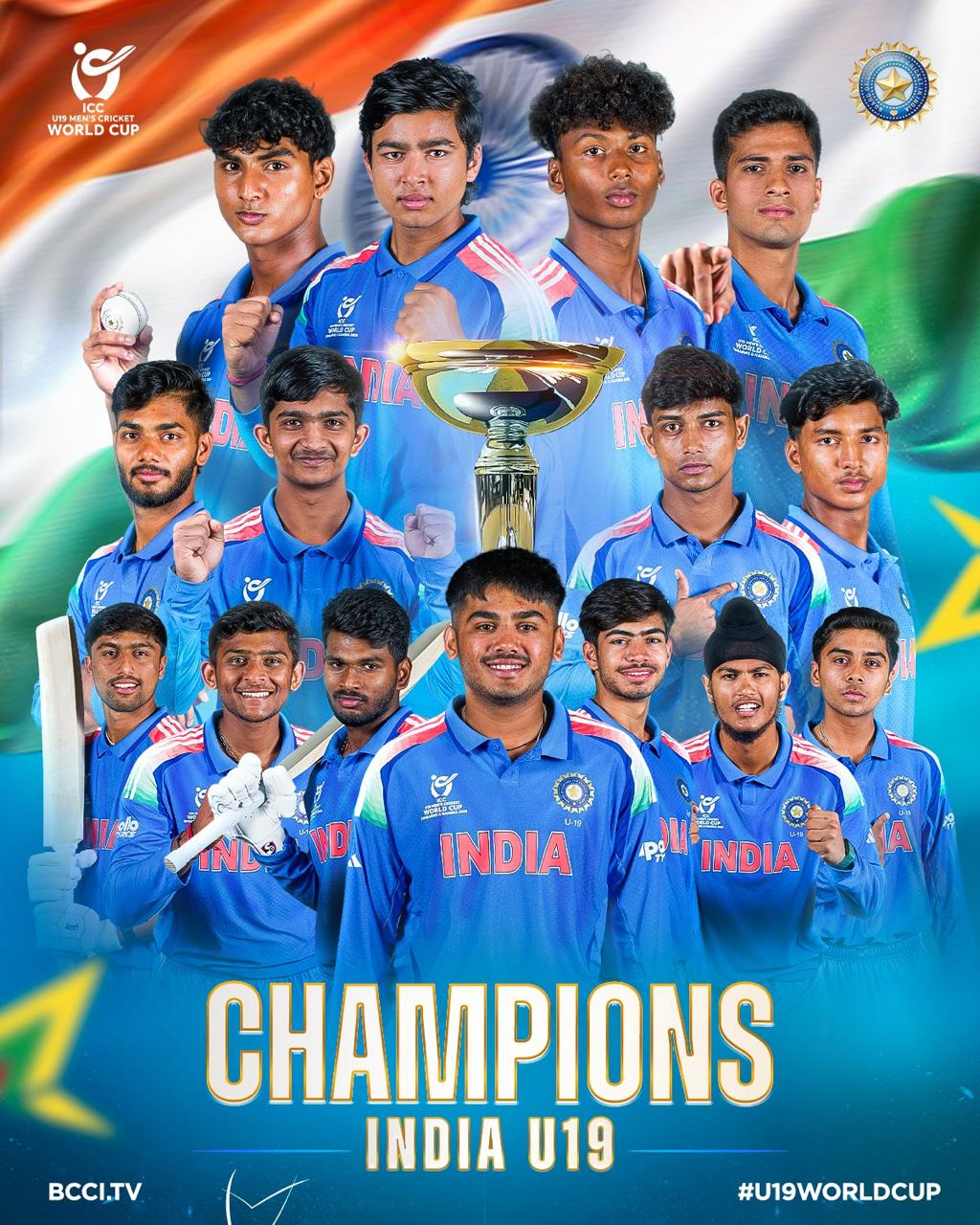
Suryavanshi Blitz Powers India to World Cup Glory
Blue Colts Reign: Record Sixth U19 Crown for India
Harare: India stamped their authority on Under-19 cricket once again, clinching a record sixth ICC Under-19 Men’s Cricket World Cup title with a commanding 100-run victory over England at the Harare Sports Club on Friday. The margin was decisive, the performance comprehensive, and the message unmistakable: India’s youth system continues to set the global benchmark.
The final unfolded as a contest shaped early by an extraordinary batting display. After winning the toss and choosing to bat, India were briefly checked when England struck in the opening overs to dismiss semi-final centurion Aaron George. That breakthrough, however, proved fleeting. What followed was an extended passage of dominance led by Vaibhav Suryavanshi, whose innings redefined the scale of possibility in an Under-19 final.
Batting with fearless intent and remarkable clarity, Suryavanshi seized control almost immediately. Alongside captain Ayush Mhatre, he powered India through the powerplay and beyond, bringing up 100 in 13.2 overs and 150 in 17.1 overs. Mhatre’s 53 off 51 balls anchored the stand, allowing the scoring rate to surge without destabilising the innings. When the Indian captain fell at 162 for 2, England sensed an opening, but the window closed just as quickly.
Suryavanshi continued unrestrained. His strokeplay blended clean hitting with placement, punishing width and length alike. By the time he was dismissed in the 26th over for a breathtaking 175 off 80 balls, India had already raced to 251, effectively pushing the final beyond England’s reach. The innings, featuring 15 fours and 15 sixes, stood as the highest individual score in an Under-19 World Cup final and one of the most dominant knocks in the tournament’s history.
India ensured the momentum did not ebb after his departure. Vedant Trivedi (32 off 36) and Vihaan Malhotra (30 off 36) carried the innings past 300, maintaining tempo without unnecessary risk. Abhigyan Kundu’s 40 off 31 balls injected urgency at the death, while R.S. Ambrish (18) and Kanishk Chouhan’s unbeaten 37 off 20 deliveries provided the finishing flourish. India closed on a formidable 411 for 9, the highest total ever recorded in an Under-19 World Cup final, setting England a daunting target of 412.
England’s chase demanded sustained aggression from the outset. After losing an early wicket to Ambrish, Ben Mayes and Ben Dawkins responded with purpose, adding 74 runs for the second wicket. Mayes’ 45 off 28 balls briefly lifted English hopes, while Dawkins held firm through the middle phase. Captain Thomas Rew added impetus with a brisk 31 off 18 deliveries, keeping the required rate within theoretical reach.
The defining moment arrived midway through the chase. A disciplined spell from India’s bowlers triggered a dramatic collapse, with England losing four wickets in the space of two overs, slipping from 174 for 3 to 177 for 7. The sudden loss of momentum exposed the unforgiving nature of the target and swung the final decisively.
England, however, refused to capitulate. Caleb Falconer mounted a stirring counter-attack, combining power with resolve. Alongside James Minto, he added 92 runs, restoring resistance and pride. Falconer went on to compile a valiant 115 off 67 balls, striking nine fours and seven sixes, a century that stood out as England’s finest moment on the day. Once he fell to Kanishk Chouhan, the chase lost its last pillar, and England were eventually bowled out for 311 in 40.2 overs.
India’s bowling figures reflected control rather than chaos. R.S. Ambrish emerged as the most effective, claiming three wickets, while Chouhan struck at key moments to halt England’s late surge. The attack worked cohesively, using variations and field placements to prevent partnerships from settling once the collapse began.
In post-match reflections, India’s leadership highlighted composure and preparation as the cornerstones of the campaign, noting that the final execution mirrored the discipline shown throughout the tournament. Suryavanshi’s performance was acknowledged by teammates and coaches alike as an expression of freedom backed by trust in the dressing room. England’s camp, meanwhile, pointed to the mid-innings collapse as the decisive phase, while also drawing pride from Falconer’s resilience under extreme pressure.
Beyond the final, India’s title run was marked by consistency and balance. They progressed through the tournament unbeaten, combining batting depth with timely bowling breakthroughs. Their ability to accelerate in decisive phases, particularly at the death, separated them from the rest of the field. The sixth title further extends India’s record as the most successful nation in Under-19 World Cup history, reinforcing the effectiveness of a pathway that continues to produce players ready for elite competition.
For England, the defeat was heavy but not without lessons. Their journey to the final showcased resilience and tactical discipline, and their willingness to challenge a daunting target in the final reflected character, even if execution fell short.
Ultimately, the 2026 Under-19 World Cup final will be remembered for the scale of India’s dominance and the emergence of a performance that defined the tournament. Vaibhav Suryavanshi’s 175 was its most vivid image, but the trophy was secured by a collective that combined fearlessness with structure. As India lifted the cup once again, the victory stood not merely as another title, but as a reaffirmation of a system that continues to shape the future of world cricket.
– global bihari bureau