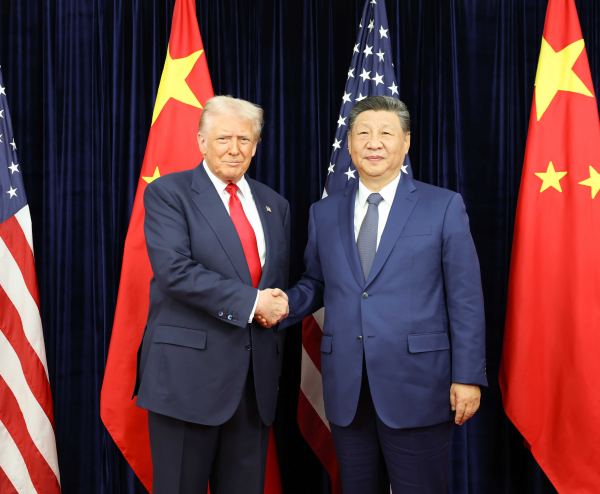
Donald Trump and Xi Jinping in Busan today.
Handshake Today, Homework Tomorrow
Busan: Six years, four months, and one day after their last handshake in Osaka on June 29, 2019, Donald J. Trump and Xi Jinping met for ninety minutes in the secure Narae Maru reception hall at Gimhae International Airport, a pit stop wedged between the Asia-Pacific Economic Cooperation forum’s plenary sessions and Air Force One’s refuelling.
What emerged was less a breakthrough than a calibrated exhale: tariffs sliced from 57 per cent to 47 per cent, rare-earth export curbs deferred for one year, and Chinese state buyers authorised to scoop up “massive” (Trump) or “substantial” (Beijing) volumes of American soybeans, sorghum, and other crops. Markets exhaled with them—Shanghai up 1.8 per cent, Chicago December soybeans up 3.2 per cent, Australian rare-earth miners up 6–9 per cent—yet the fine print remained locked in the black boxes of “follow-up steps” and “competent authorities,” the same diplomatic escrow that has entombed every U.S.–China understanding since the Phase One deal of January 2020.
Beijing’s official readout, released at 14:53 local time, is a masterclass in controlled cadence. Xi frames the relationship as a “giant ship” that must stay the course through “winds, waves and challenges,” a metaphor that simultaneously flatters joint stewardship and absolves either captain of blame for past storms. He touts China’s 5.2 per cent growth in the first three quarters of 2025 and 4 per cent goods-trade expansion as “not an easy accomplishment,” then pivots to the Fourth Plenary Session of the 20th Central Committee’s five-year plan, insisting Beijing seeks only to “manage China’s own affairs well” and share opportunities. The subtext is unmistakable: China is not the aggressor; it is the resilient ocean, not the provocateur. Trade frictions, Xi allows, have yielded “insights,” but the commercial bond must remain the “anchor and driving force,” not a “stumbling block.” The prescription: think big, avoid retaliation, shorten the problem list, lengthen the cooperation list—classic Xi dialectics, heavy on principle, light on particulars.
Trump, quoted verbatim in the same document, sounds like a man who has just closed a Mar-a-Lago real-estate package. China is “a great country,” Xi is a “well respected great leader”, and “my good friend for many years.” The relationship has “always” been “fantastic” and will be “even better.” Together, the two nations will “get many great things done for the world and have many years of success.” The 2026 hosting rotation—China for Asia-Pacific Economic Cooperation, the United States for the Group of Twenty—is invoked by both as proof of synchronised calendars. Reciprocal visits are locked in: Trump “early next year,” Xi invited to the United States, venue to be decided.
Rare Earths? Rare Truths
Then comes the Beijing press briefing, where Foreign Ministry spokesperson Guo Jiakun turns deflection into performance art. On Trump’s April 2026 China visit? “Refer to the readout.” On which rare-earth controls are paused—April’s or October’s? “Refer to the readout.” On soybean volumes? Silence. On nuclear-powered submarines at Hanwha’s Philadelphia yard? China “hopes” Seoul and Washington respect non-proliferation and regional stability. On Trump’s claim that China could match the U.S. nuclear arsenal in five years? Washington should honour the Comprehensive Nuclear-Test-Ban Treaty moratorium. On a rumoured Group of Seven critical minerals alliance? Stop writing “self-made rules” that disrupt global trade. On potential U.S.–Russia denuclearisation talks with China, later invited? “China’s position is consistent and clear.” Every answer is a mirror, reflecting the question back without a single new facet.
Also read: China Deflects, U.S. Waits Ahead of Trump–Xi Talks
This is the exact choreography forecasted three days ago in the October 27 dispatch from Busan’s pre-summit hush. The Kuala Lumpur framework—fifth-round talks on October 25–26 between Treasury Secretary Scott Bessent and Vice Premier He Lifeng—had outlined the same deliverables: reversal of the soybean boycott, a one-year deferral of rare-earth imports, and a tariff truce past November 10. The analysis predicted leader-level consummation in Busan and warned that Beijing’s “silken deflection” would survive the handshake, buying short-term sanctuary at the cost of long-term trust. Both calls landed clean. TikTok’s rumoured ownership transfer, floated in Madrid’s September sketch, vanished without a trace—proof that not every Kuala Lumpur thread was pulled through. South China Sea rammings, Taiwan’s October 25 “Restoration Day” decree, the dual USS Nimitz aircraft splashes—each flagged as potential anchors—never left the tarmac. Security was surgically excised from the economic transaction, confirming the forecast that soybeans would eclipse shoals.
Busan Thaw: Tariffs Melt, Details Freeze
Yet the sharper edge lies in what the deflection now shields. The tariff cut is real but asymmetrical: the United States drops ten points across the board, including halving the 20 per cent fentanyl levy; China merely pauses export licensing it had already weaponised. Soybean purchases are authorised but unquantified—state traders can calibrate volumes to domestic feed demand and global price arbitrage, preserving leverage. Rare-earth relief is dated to one year, not a rollback, leaving Beijing free to reimpose controls in November 2026, precisely when U.S. midterms fade and China’s next five-year plan hardens. The “giant ship” sails forward, but Beijing still holds the rudder on timing, volume, and verification.
Working-level teams now inherit the hardest miles: translating Xi’s metaphors and Trump’s superlatives into spreadsheets with columns for metric tons, delivery schedules, and third-party audits. Past ghosts—Geneva’s May vagueness, Madrid’s September stall—hover. The Phase One deal’s $200 billion purchase target was met on paper only after heroic accounting; today’s “massive” pledge risks the same fate. Diplomats in both capitals, speaking on background, call this a “structured timeout,” not a reset. Markets price sentiment, not certainty; the 420-point Dow futures pop and 1.8 per cent Shanghai close are bets on mood, not mechanics.
The broader canvas remains unchanged. Germany’s aborted Beijing visit, European Union overcapacity probes, the rumoured Group of Seven minerals bloc—all noted pre-summit as Western pincers—stay unaddressed, suggesting Beijing calculates that bilateral sweeteners can blunt multilateral pressure. Guo’s rebuke of the Group of Seven’s “self-made rules” is a preemptive strike, casting any supply-chain diversification as market sabotage. Nuclear submarines in Philadelphia and Trump’s nuclear-testing rhetoric elicit only pro forma hopes for treaty compliance, preserving Beijing’s narrative of external provocation without spending political capital.
In the end, Busan delivered exactly what the October 27 Global Bihari analysis ordered: a leader-stamped de-escalation narrow enough to fit a tweet, broad enough to move futures, and opaque enough to keep both domestic galleries clapping. The giant ship has altered course by ten degrees; whether it holds steady or veers back into the storm depends on spreadsheets still being drafted in offices far from the cameras.
– global bihari bureau