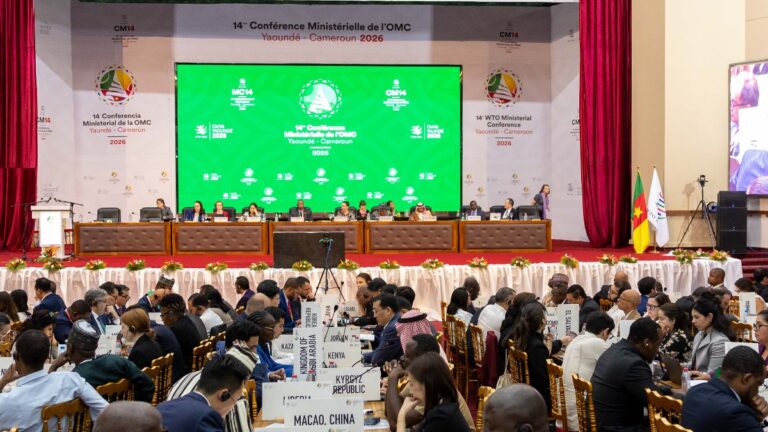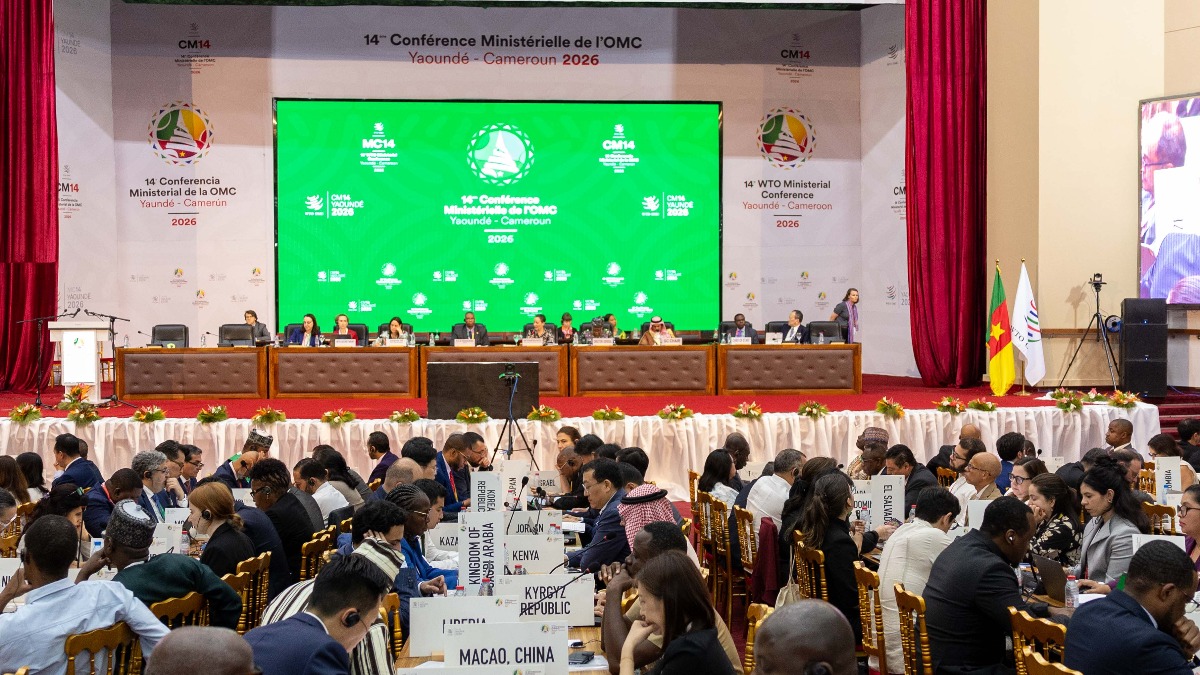
Ministers exchange views on key WTO topics, consider paths forward at MC14.
WTO Meet Reflects Deep Global Splits
India Holds Line as WTO Talks Defer Outcomes
Yaoundé: The WTO Fourteenth Ministerial Conference concluded without resolving any of the core negotiating mandates carried forward from the WTO Thirteenth Ministerial Conference, reflecting deep divisions among members on agriculture, fisheries, digital trade and institutional reform. The failure to reach outcomes was driven by competing priorities between developed economies seeking expanded rule-making and stricter disciplines, and developing countries led by India that insisted on preserving policy space, addressing legacy imbalances and protecting livelihood concerns. Within this fragmented negotiating landscape, India played a central role in shaping the contours of debate, preventing outcomes it viewed as inequitable while pushing for a development-oriented framework across key issues.
The conference, held from March 26 to 29 in Yaoundé, Cameroon, brought together ministers to address key agenda items including fisheries subsidies, agriculture, e-commerce, investment facilitation and dispute settlement reform. While discussions provided political direction for future work, the ministerial did not deliver final agreements on any of the major negotiating tracks. Instead, members agreed to carry forward work programmes in Geneva, with a draft ministerial decision on fisheries subsidies emerging as the principal outcome to guide Phase II negotiations on overcapacity and overfishing.
The outcomes at MC14 are best understood in the context of unfinished business carried forward from MC13, where members had set timelines and expectations across key pillars but stopped short of full resolution. At MC13, issues such as a permanent solution on public stockholding for food security, disciplines on domestic support in agriculture, completion of Phase II negotiations on fisheries subsidies, restoration of a fully functional dispute settlement system, clarity on the e-commerce moratorium, and the status of the Investment Facilitation for Development framework remained unresolved. MC14 did not close these gaps. Instead, it extended discussions across all major tracks, producing direction without finality and reinforcing a pattern of continued negotiation without resolution.
A key factor underlying these outcomes was the divergence in negotiating priorities among major trading members. Developed economies, including the European Union and the United States, continued to press for expansion of rule-making into areas such as digital trade, investment facilitation and sustainability-linked disciplines, while also supporting stronger and more uniform subsidy disciplines in fisheries. These positions were often linked to concerns over market distortions and the need to update global trade rules to reflect contemporary economic realities. Developed members, however, also argued that stronger disciplines, particularly in areas such as fisheries subsidies and digital trade, are necessary to address structural distortions in global markets and emerging sustainability challenges. In this context, several estimates cited in policy discussions indicate that harmful fisheries subsidies globally continue to amount to tens of billions of dollars annually, contributing to overcapacity and depletion of marine resources across regions. Several of these countries maintained that large and growing fishing capacities across multiple regions, including in parts of the developing world, contribute to pressure on marine resources, requiring more comprehensive and enforceable rules. Similarly, in digital trade, proponents of expanded rule-making emphasised the need for predictability, cross-border data flows and reduced transaction costs to sustain global economic integration, arguing that prolonged policy uncertainty could fragment digital markets. However, such approaches encountered resistance from developing members who viewed them as potentially constraining policy space without adequately addressing longstanding asymmetries in existing agreements.
At the same time, large emerging economies and coalitions of developing countries, including India, China and South Africa, emphasised the need to prioritise unresolved mandates, particularly in agriculture and development. These countries argued that issues such as public stockholding for food security and domestic support imbalances remain foundational to the credibility of the multilateral system. Their stance reflected broader concerns that advancing new issues without resolving legacy commitments could further widen structural inequities within the WTO framework.
Differences also emerged within the developing world, particularly between countries with significant industrial capacity and least developed countries (LDCs) and small economies. Several LDCs and coastal nations expressed support for stronger disciplines on fisheries subsidies to address resource depletion, while simultaneously seeking safeguards and flexibilities to protect subsistence fishing. This created a layered negotiation dynamic in which positions were not strictly binary but varied across issue areas, complicating consensus-building. In this context, several delegations from African and small island economies indicated during discussions that sustainability and livelihood concerns must advance together, reflecting a broader negotiating position that stricter disciplines should not disproportionately affect vulnerable coastal communities dependent on subsistence fishing.
On fisheries, countries with large distant-water fishing fleets, including some advanced economies and major fishing nations, were seen to support tighter global disciplines applicable across members, whereas countries with predominantly artisanal fishing sectors, such as India and several African and Asian economies, argued for differentiated treatment. This divergence over the scope and application of subsidy disciplines contributed to the inability to finalise Phase II negotiations, despite agreement on the need to address overcapacity and overfishing. At the same time, some members and policy analysts cautioned that the distinction between industrial and small-scale fishing, while important, may not fully capture the evolving realities of global fisheries, where capacity expansion in certain developing economies has also contributed to stock depletion. These perspectives emphasised that sustainability concerns require a broad-based approach, even as flexibilities are designed to protect vulnerable communities, highlighting the complexity of balancing environmental imperatives with development priorities.
The debate over the Investment Facilitation for Development Agreement further illustrated systemic divisions. A large group of members supported its incorporation into the WTO as a plurilateral agreement, viewing it as a mechanism to attract investment and signal predictability. However, other members, including India and some developing countries, raised concerns that such approaches could bypass consensus-based decision-making and dilute the multilateral character of the institution. This disagreement prevented movement towards formal incorporation despite broad participation.
Similarly, the e-commerce moratorium exposed differing economic interests between digitally advanced economies and countries seeking to preserve tariff policy space. While many developed members supported continuation or expansion of the moratorium, several developing countries, including India, called for a reassessment of its implications, particularly in terms of revenue foregone and constraints on digital industrial policy. Countries supporting continuation of the moratorium also pointed to its role in enabling the growth of the global digital economy by reducing trade frictions and supporting innovation, particularly for services and small enterprises operating across borders. They argued that the absence of a stable framework could lead to fragmented regulatory approaches and increased compliance costs, potentially affecting both developed and developing economies integrated into digital value chains. The absence of convergence on this issue reflected broader disagreements on how digital trade should be governed within the WTO framework.
On dispute settlement reform, differences persisted over both the design and sequencing of reforms. While there was general agreement on the need to restore a functional system, members differed on issues such as the scope of appellate review, institutional structure and safeguards against overreach. These divergences, coupled with the broader geopolitical context, contributed to the continued impasse despite repeated affirmations of commitment.
In agriculture, widely regarded as a central priority for several developing countries including India, MC13 had failed to deliver outcomes on public stockholding, special safeguard mechanisms and broader domestic support reforms. MC14 saw continued deliberations on these issues, including food security concerns and export restrictions, but without convergence or decision. The lack of progress on agriculture reinforced concerns among developing members regarding the sequencing of negotiations and the need to address unfinished mandates.
On fisheries subsidies, MC13 had left unresolved the most contentious aspects relating to overcapacity and overfishing under Phase II negotiations. At MC14, members advanced a draft ministerial decision that sets the framework for continued engagement but did not reach a negotiated outcome. The e-commerce moratorium, temporarily extended at MC13, remained under discussion at MC14 without agreement on its duration or future structure. Likewise, the proposed Investment Facilitation for Development Agreement continued to draw divergent views on its incorporation into the WTO framework.
Against this backdrop, MC14 reflected a continuation rather than a conclusion of the negotiating cycle, with outcomes characterised by procedural advancement and reaffirmation of positions rather than substantive breakthroughs. The conference highlighted persistent divergences between developed and developing members, particularly on issues involving development asymmetries, digital trade and sustainability-linked disciplines, indicating that consensus remains limited on structurally sensitive areas of the WTO agenda.
The outcome at the WTO Fourteenth Ministerial Conference also reflected a broader shift in the functioning of the World Trade Organization, where the institution continues to serve as the principal forum for multilateral engagement but with a reduced capacity to deliver negotiated outcomes. Despite the absence of final agreements, participation by major economies, including the United States, European Union, India and China, indicated that the WTO retains its centrality in global trade governance. At the same time, the continued deferral of decisions across successive ministerial conferences pointed to structural constraints within the consensus-based system, particularly in a global environment marked by divergent economic priorities and geopolitical fragmentation.
This evolving dynamic suggests a redefinition rather than a decline of the WTO’s relevance. The institution is increasingly functioning as a platform for managing differences, maintaining existing rules and preventing unilateral escalation, even as its role in producing new multilateral agreements becomes more limited. In this context, India’s engagement at MC14 illustrated how the WTO framework continues to provide space for developing countries to influence outcomes by shaping negotiating parameters and withholding consensus on proposals perceived as imbalanced. The parallel expansion of bilateral and plurilateral initiatives alongside WTO processes further reflected an emerging multi-track trade architecture, in which multilateral negotiations persist but are complemented by alternative pathways for advancing trade and economic cooperation.
At the same time, some analysts interpret the repeated deferral of core negotiating outcomes across successive ministerial conferences as indicative of deeper structural challenges within the multilateral trading system. From this perspective, the inability to conclude agreements on longstanding mandates such as agriculture or dispute settlement reform raises questions about the WTO’s effectiveness as a rule-making body. This view holds that while the institution continues to provide a platform for engagement, its credibility may increasingly depend on its capacity to deliver concrete outcomes, particularly on issues that have remained unresolved over multiple negotiating cycles.
At the WTO Fourteenth Ministerial Conference, India placed equity, development concerns and livelihood protection at the centre of negotiations, while contributing to ministerial guidance that will shape the next phase of global trade talks, particularly on fisheries subsidies, reform of the multilateral system and unresolved mandates on agriculture and development.
India’s intervention on fisheries subsidies, led by Commerce and Industry Minister Piyush Goyal, underscored a distinction between large industrial fishing nations and countries with predominantly small-scale fishing communities. India argued that the global challenge of overcapacity and overfishing arises from heavily subsidised industrial fleets rather than from artisanal and traditional fishers in developing countries and least developed countries, a position broadly aligned with several developing economies and least developed countries seeking preservation of policy space, while differing from proposals favouring uniform and stricter subsidy disciplines.
Goyal told ministers that the fisheries sector remains central to India’s food security and rural economy, supporting more than nine million fisher families. He emphasised that India’s fishing practices are largely small-scale, traditional and sustainable, and that the country does not operate distant-water industrial fleets or heavily mechanised fishing systems. India also highlighted that its fisheries subsidies are among the lowest globally, estimated at about USD 15 per fisher family annually, in contrast to significantly higher support levels in advanced economies. In this context, India’s position reflected not only environmental considerations but also domestic economic priorities linked to coastal livelihoods across major fishing states, making fisheries negotiations a sensitive policy area.
Framing its position within global sustainability goals, India argued that Phase II negotiations must incorporate principles of equity, including Special and Differential Treatment for developing countries and least developed countries, as well as Common but Differentiated Responsibilities and the Polluter Pays Principle. It called for a 25-year transition period, stricter disciplines on distant-water fleets, a permanent carve-out for small-scale fishers and subsidy disciplines based on per capita intensity. India also pointed to its domestic conservation measures, including annual fishing bans, as evidence of a long-standing policy commitment to sustainability predating its prominence in global negotiations. It maintained that emerging disciplines should not impose uniform obligations across structurally different fishing economies.
The ministerial session on fisheries subsidies noted that 119 WTO members have accepted the existing agreement, with recent ratifications by Paraguay, Samoa and Saint Vincent and the Grenadines. Members reaffirmed their commitment to continue negotiations to strengthen disciplines, though differences persisted on how to balance sustainability with development needs, particularly between members with large industrial fleets and those representing small-scale fishing communities.
Beyond fisheries, India’s engagement at MC14 reflected a broader emphasis on preserving the foundational principles of the multilateral trading system. In discussions on WTO reform, India reiterated that the process must remain member-driven and consensus-based, with the General Council playing a central role. It stressed that unresolved issues from earlier mandates, particularly in agriculture, should be prioritised before new issues are incorporated into the framework.
On dispute settlement, ministers acknowledged that reform remains a priority but also noted the challenging context surrounding the restoration of a fully functional system, including the continued paralysis of the Appellate Body. India’s interventions emphasised that any reform process must preserve balance, inclusivity and the rights of members within a rules-based framework, while supporting continued engagement once conditions allow for substantive progress.
On the question of the moratorium on customs duties on electronic transmissions and the proposed Investment Facilitation for Development Agreement, India called for clarity and progress on existing commitments, warning that the credibility of the WTO depends on delivering on past decisions. India’s approach to the e-commerce moratorium reflected concerns over revenue implications and policy space for the digital economy, while on the Investment Facilitation framework, it reiterated that new agreements should not bypass multilateral consensus or dilute foundational WTO principles.
In bilateral talks with New Zealand Trade Minister Todd McClay, India reviewed preparations for the upcoming visit of Prime Minister Narendra Modi to New Zealand and assessed progress towards concluding a bilateral free trade agreement. Discussions also covered cooperation in agriculture and sports, including training initiatives for Indian farmers in horticulture. Both sides exchanged views on WTO reform and the need to maintain engagement despite differences on specific issues.
Engagements with other major partners reflected a parallel track of advancing bilateral and plurilateral economic ties alongside multilateral negotiations, indicating a broader strategy of pursuing trade liberalisation through multiple channels amid slow progress at the WTO. In talks with UK Business and Trade Secretary Peter J Kyle, both sides confirmed completion of domestic approval processes for the India–UK Comprehensive Economic and Trade Agreement and discussed its implementation. India emphasised the need for outreach to ensure that the agreement’s benefits reach businesses across regions, while the UK outlined plans for business delegations and regional engagement.
Discussions with Canada’s International Trade Minister Maninder Sidhu focused on expediting negotiations on a Comprehensive Economic Partnership Agreement and expanding cooperation in sectors such as shipbuilding, pharmaceuticals, education and clean energy, including nuclear collaboration. India reiterated its position that WTO reform must preserve consensus-based decision-making and address pending mandates, while both sides agreed to continue constructive engagement despite differences on specific trade issues.
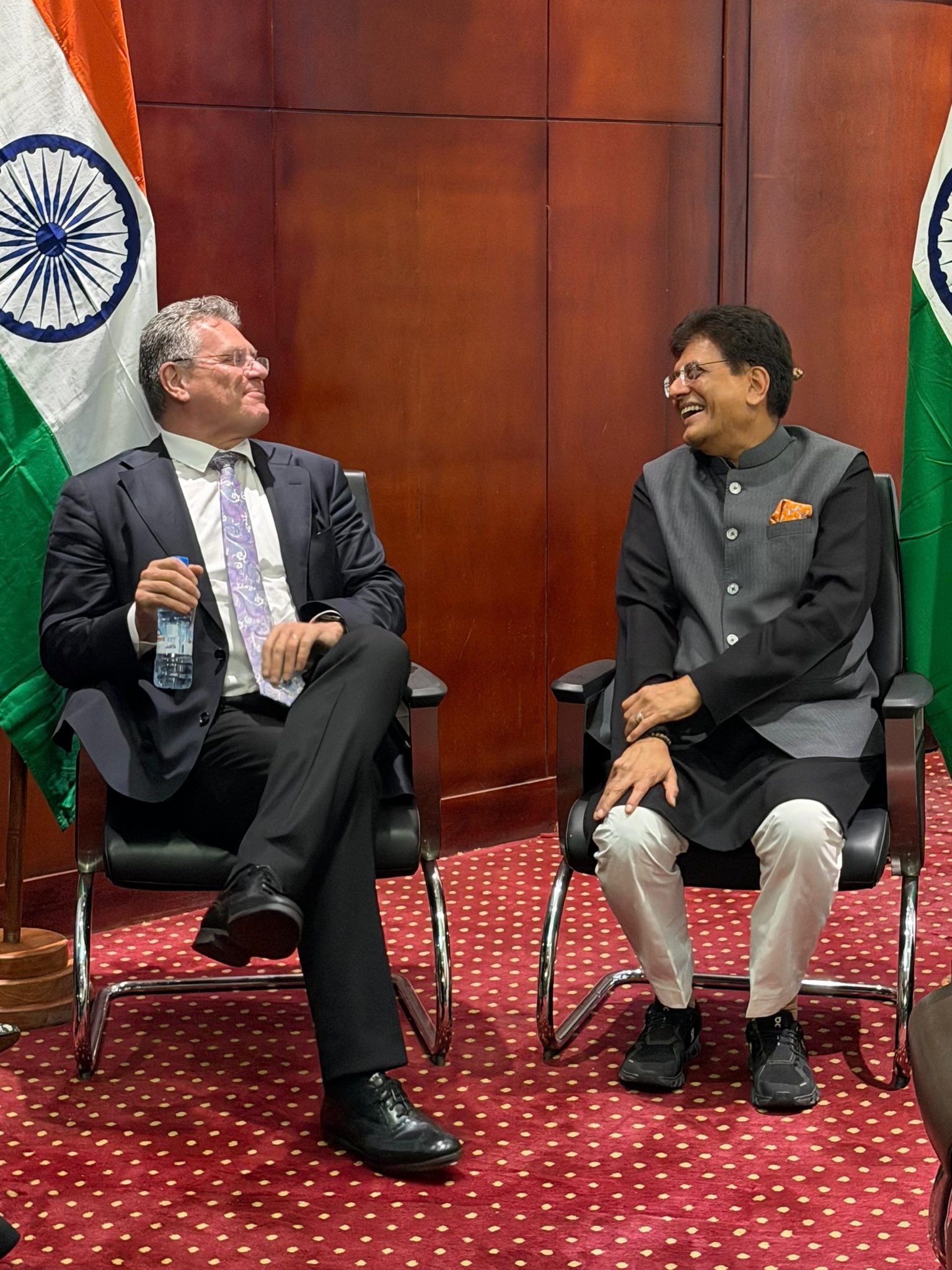
In meetings with EU Trade Commissioner Maroš Šefčovič, both sides reviewed progress on the India–EU free trade agreement and agreed on the need to advance necessary processes for its signing. They also exchanged views on WTO reform, the e-commerce moratorium and the investment facilitation framework, with both sides indicating the importance of maintaining momentum on bilateral economic integration even as multilateral discussions continue.
Across these engagements, India maintained a consistent negotiating approach anchored in development priorities, livelihood concerns and institutional balance within the WTO. The outcomes at MC14 did not resolve major divergences but provided direction for continued negotiations, particularly on fisheries subsidies and reform of the dispute settlement system, where members acknowledged both the urgency of reform and the constraints posed by current global trade dynamics.
In comparative terms, the outcome at MC14 reflected a more restrained and process-oriented trajectory than MC13, where members had secured limited but identifiable outcomes such as temporary extensions and partial institutional movement. MC14 consolidated these trajectories without extending them into new agreements, suggesting that the multilateral system is operating within a narrower bandwidth for consensus. This pattern indicates a shift toward incrementalism, where negotiations continue but outcomes remain deferred across successive ministerial cycles.
The ministerial decision on fisheries subsidies and the continuation of negotiations across other pillars suggest that MC14 functioned as a staging point rather than a conclusion, with future outcomes dependent on the ability of members to reconcile differences on development, sustainability and institutional reform. Within this framework, India’s role reflected an effort to shape negotiating parameters in favour of development-oriented outcomes while maintaining engagement across both multilateral and bilateral tracks.
In that sense, the outcome at the WTO Fourteenth Ministerial Conference ultimately reflects a multilateral trading system negotiating not just its mandates, but its limits, where consensus endures as a principle even as agreement becomes progressively more difficult to achieve.
– global bihari bureau