Real-Time Alerts for Trade Changes
TPA Index Spots Trade Shifts Instantly; Enhances Trade Transparency
Geneva: The World Trade Organization (WTO) and the International Monetary Fund (IMF) economists have developed a Trade Policy Activity (TPA) index that aims to provide early signals of global trade policy changes, based on preliminary tests showing real-time detection capabilities. The tool addresses the critical need to overcome fragmented and delayed trade data, enabling swift responses in the $28 trillion trade market.
Developed by a team including Salvatore Centorrino, Anastasia Diakantoni, Alexander Keck, Michele Ruta, Monika Sztajerowska, and Shang-Jin Wei, the TPA index aggregates data from diverse sources: the WTO’s Trade Monitoring Database, Global Trade Alert reports, official government policy announcements, Maersk’s real-time shipping API tracking container movements, and public posts on the X platform. Spanning over 100 economies and thousands of products, from agricultural goods to high-tech components, it uses a Dynamic Factor Model to produce a 0-100 score, where higher values indicate heightened trade policy activity, such as new tariffs on electronics, export bans on medical supplies, or customs streamlining under the 2017 WTO Trade Facilitation Agreement. Rigorous testing across hundreds of model specifications shows over 90% correlation with established benchmarks like Global Trade Alert, accurately capturing events like Russia’s 2022 wheat export restrictions, which drove global food price increases.
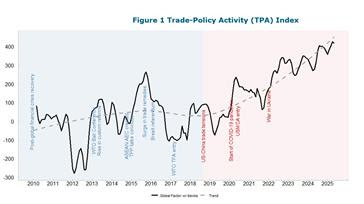
The TPA index categorises measures into trade-facilitating, such as simplified customs procedures reducing clearance times, and trade-restrictive, like tariffs or export bans, while tracking their alignment with objectives: environmental sustainability, such as Paris Agreement commitments to cut carbon emissions; industrial support via subsidies for domestic manufacturing; or national security through export controls on sensitive technologies. Historical trends reveal stable trade policies from 2008 to 2018, followed by a significant surge from 2019 to 2020. Key events include the 2018-2019 US-China tariffs affecting billions in goods like soybeans and consumer electronics, the 2020 COVID-19 export restrictions on masks and vaccines paired with import duty waivers for medical equipment, and the 2022 Ukraine war’s grain and energy export curbs, which triggered global price spikes. The 2017 Trade Facilitation Agreement notably increased facilitating measures, cutting trade costs by improving customs efficiency.
Trade-Policy Activity Index
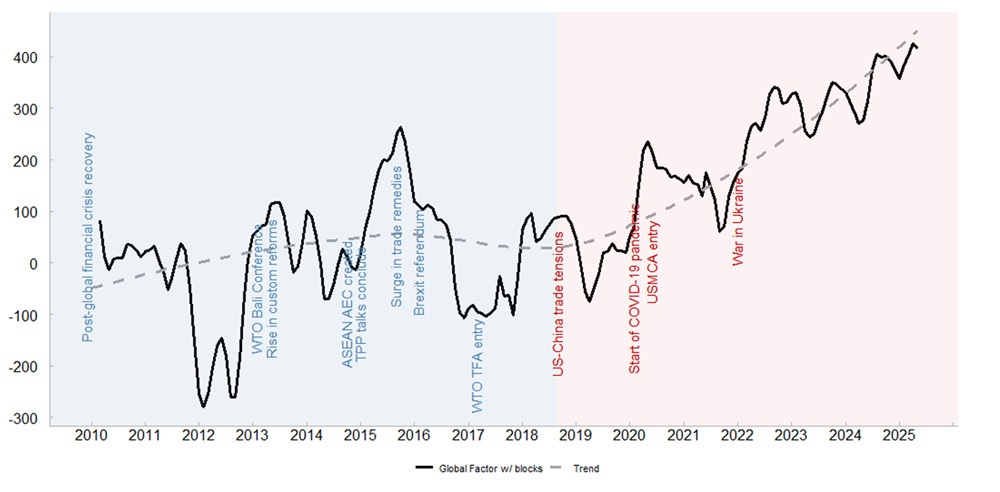
Source: Centorrino, Diakantoni, Keck, Ruta, Sztajerowska and Wei (2025).
Analysis by economic groups highlights divergences. Developing economies, prioritising local supply security, often implement more restrictive measures during crises, such as export bans on essential goods. Advanced economies, conversely, favoured facilitating measures, like import duty reductions, to ensure supply availability. During COVID-19 and the Ukraine war, both measures types surged, with countries simultaneously imposing export curbs on raw materials and easing imports to address shortages of medical supplies or grains. Developing nations exhibited sharper restrictive spikes, particularly in agriculture, but the global trend of heightened policy activity since 2019 persists across all economies, reflecting increased trade volatility.
Traditional trade data, often delayed by 3-6 months, limits policymakers’ ability to respond promptly to disruptions. The TPA index leverages high-frequency “big data”—including satellite imagery of port congestion, Maersk’s Application Programming Interface (API) tracking real-time container flows, online news reports, and X platform posts on policy announcements—to “nowcast” current trends with a 5% error margin. Preliminary tests in September 2025 identified a policy spike, detecting India’s rice export restrictions and Brazil’s soybean quota adjustments within days, underscoring the index’s real-time potential. “The TPA index enhances trade transparency,” said WTO Director-General Ngozi Okonjo-Iweala. IMF Chief Economist Pierre-Olivier Gourinchas added, “It signals economic risks early, informing effective policies.”
The TPA index builds on established WTO-IMF tools like the Tariff Tracker, which monitors tariff changes across 190 economies with monthly updates, detecting 2018 US-China tariff escalations within weeks. The WTO’s Trade Monitoring Reports, published biannually, recorded 182 trade-restrictive and 124 trade-facilitating measures in 2024, using member notifications to provide early alerts on policy shifts. These tools validate the feasibility of timely trade monitoring, reinforcing the TPA’s capacity to deliver precise insights into policy changes across economies and sectors, from agriculture to high-tech industries.
The Role of Facilitating and Other Measures
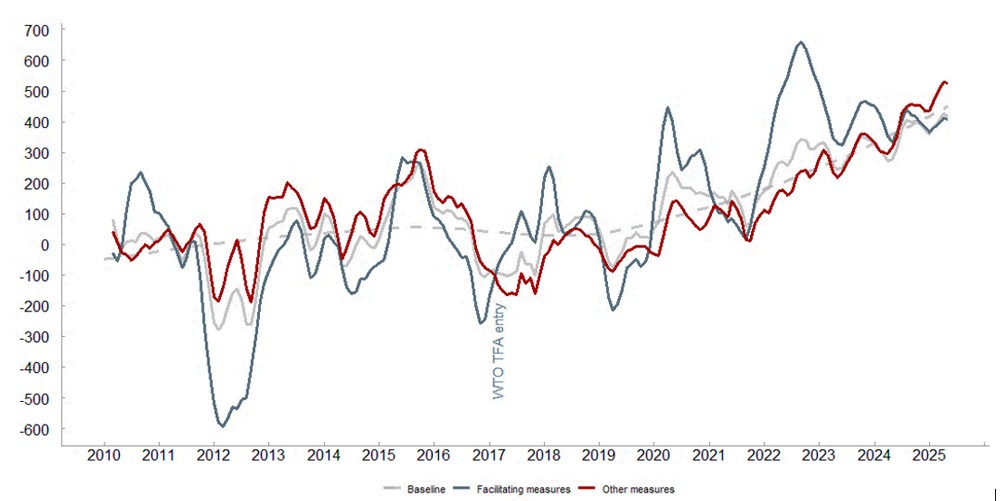
Source: Centorrino, Diakantoni, Keck, Ruta, Sztajerowska and Wei (2025).
The IMF’s 2023 trade review further supports the TPA’s approach, employing high-frequency shipping and economic data to forecast trade impacts, such as a 7.2% global trade growth projection for 2021 post-COVID. By integrating similar data, the TPA index enhances existing surveillance, offering granular insights into sector-specific policies—like agriculture, where rice export bans affect food security, or technology, where chip tariffs disrupt supply chains. This aligns with the WTO’s April 2025 Global Trade Outlook, which identifies trade policy uncertainty as a key barrier to global investment, emphasising the need for tools like the TPA to stabilise markets and foster predictability.
Set for public release by mid-2025 through a free online portal, the TPA index could become a cornerstone of WTO and IMF trade monitoring, with quarterly dashboards promoting dialogue to mitigate trade disputes costing $1.5 trillion annually, according to IMF estimates. Businesses stand to gain: small and medium exporters, making up 70% of global exporters per WTO data, can better navigate tariff changes, while multinationals like Apple can adjust supply chains for components like iPhone chips. Planned extensions include sub-indices for sectors like renewable energy and technology, regional breakdowns to monitor specific trade corridors, AI-driven noise filtering for social media data accuracy, and GDPR-compliant data privacy measures to ensure ethical handling. By aligning trade policies with Paris Agreement goals, such as reducing emissions through green trade measures, the index aims to prevent environmental policies from sparking trade conflicts, fostering fairer and more predictable global markets for billions worldwide.
– global bihari bureau