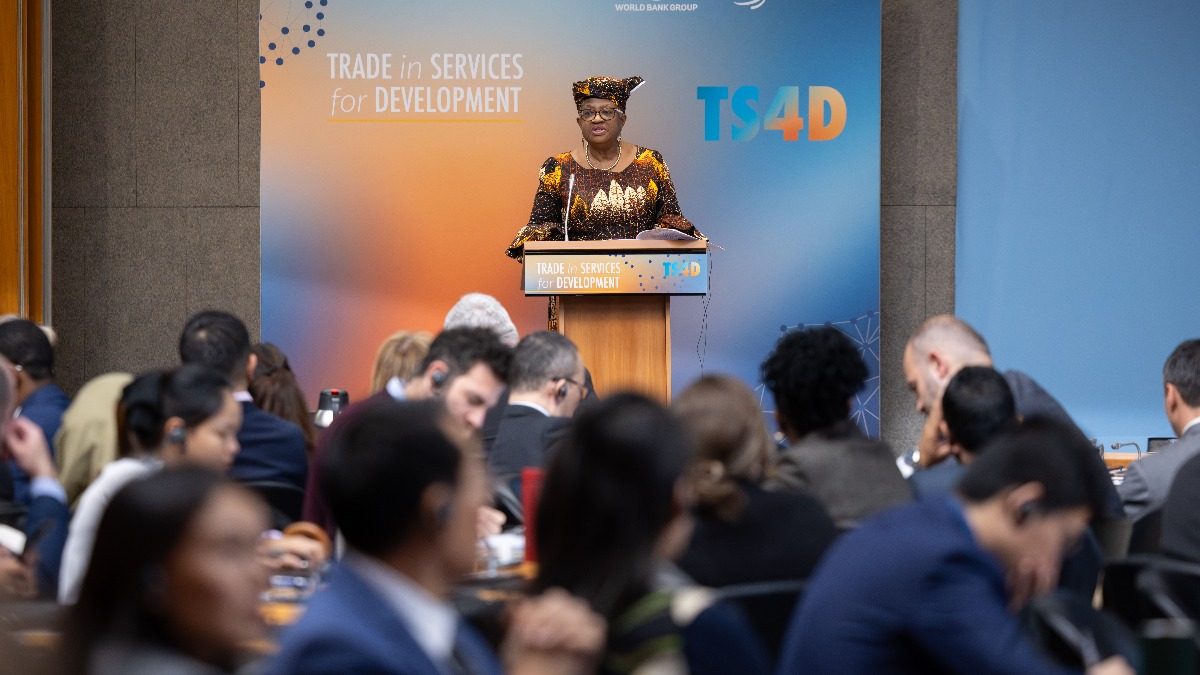
WTO Director-General Ngozi Okonjo-Iweala at the opening of the Trade in Services for Development (TS4D) Conference today.
FDI and digital readiness dictate global trade winners
Developing nations must align capacity with opportunity
Geneva: The global trade landscape is quietly shifting, and for developing economies, the consequences may be profound. Recent data from the World Trade Organization (WTO) reveal a stark divergence in growth between commercial services and merchandise trade. Commercial services are projected to grow by 4.6 per cent in 2025 and 4.4 per cent in 2026 in volume terms, far surpassing merchandise trade, which is expected to expand by only 2.4 per cent in 2025 and slow sharply to 0.5 per cent in 2026. Within this expansion, digitally delivered services, encompassing software, cloud computing, online professional and creative services, are expected to grow even faster, at 6.1 per cent in 2025 and 5.6 per cent in 2026, underscoring the accelerating impact of digital technologies on global commerce.
The numbers highlight a fundamental structural shift. Economies without digital infrastructure, regulatory coherence, or skilled labour capable of producing high-value services risk being left behind, while those with these assets are positioned to capture the lion’s share of growth. Transport and travel services, historically significant components of the service economy, are growing at slower rates. Transport services are projected to increase by roughly 2.5 per cent in 2025 and 1.8 per cent in 2026, reflecting their dependency on physical infrastructure, capital-intensive networks, and global supply chains. Travel services, including tourism, are forecast to grow at 3.1 per cent in 2025 and 4.4 per cent in 2026, signalling recovery from pandemic disruptions but constrained by inflationary pressures, geopolitical uncertainty, and shifting consumer behaviour. Other commercial services, such as consulting, business support, logistics, and communications, are expected to grow by approximately 5.8 per cent. This pattern illustrates that while the overall services sector is expanding, the gains are highly concentrated in digitally enabled and knowledge-intensive segments.
The Trade in Services for Development Conference, convened by the WTO and the World Bank on December 3 and 4, 2025, is structured to present analytical tools and frameworks to help developing economies better participate in services trade. These include the Services Trade Competitiveness Diagnostic Dashboard, which allows governments to map regulatory constraints and supply-side limitations, and the Handbook on Good Regulatory Practices to Facilitate Trade in Services. The conference highlighted collaboration with regional organisations and development banks, disseminating best practices in promoting services exports. While these initiatives provide guidance, they are advisory and do not constitute binding commitments or financial support. The responsibility for converting these insights into tangible growth lies squarely with domestic authorities.
Country-level illustrations demonstrate both opportunity and constraint. Nigeria, for instance, reported that services account for 58 per cent of gross domestic product and over 45 per cent of formal employment, with key strengths in financial, creative, and technology-enabled services. Despite these advantages, regulatory fragmentation and gaps in digital infrastructure threaten to limit Nigeria’s ability to fully harness projected growth. Saudi Arabia presented a regulatory and policy overhaul targeting twenty priority service sectors, including logistics, tourism, financial services, and digital services. Officials reported revising outdated regulations to attract investment and stimulate sectoral growth. Cambodia, where services account for more than 40 per cent of gross domestic product and nearly 40 per cent of the labour force, with women representing approximately 80 per cent of employment in tourism and hospitality, is integrating services into national development planning, prioritising modern digital services, logistics, tourism, and professional business services. These examples reveal a wide spectrum of preparedness: some countries are leveraging capacity and regulatory reform to capture opportunity, while many smaller or less-developed economies remain inadequately positioned to do so.
The concentration of foreign direct investment reinforces this divergence. Seventy-two per cent of global foreign direct investment stock is already located in services, indicating that capital is preferentially flowing to countries with infrastructure, regulatory clarity, and skilled labour. The potential for investment to amplify gains is notable, but unevenly distributed. Modelling presented at the conference suggested that full implementation of the African Continental Free Trade Area could double intra-African exports by 2035, while full adoption of the Regional Comprehensive Economic Partnership among Asia-Pacific members could increase trade by approximately 12 per cent. These projections underscore the importance of regional integration agreements for expanding market access, facilitating harmonised regulations, and attracting investment, but their effectiveness hinges on domestic capacity and execution, which varies widely among developing nations.
Sectoral dynamics reveal further disparities. Digitally deliverable services are expected to generate the bulk of growth. Software development, cloud computing, digital financial services, online education, and creative services offer high returns with relatively low physical infrastructure requirements. In contrast, transport services remain dependent on capital-intensive logistics networks, ports, and aviation infrastructure, constraining expansion. Travel and tourism sectors, though recovering, are sensitive to macroeconomic shocks, including global inflation, currency volatility, and geopolitical tensions. Professional and other commercial services, encompassing consulting, engineering, communication, and business process outsourcing, are moderately growing sectors that require a combination of skill, certification, and regulatory consistency to fully realise potential. The data suggest that the countries equipped to deploy digital infrastructure and skilled labour are likely to consolidate their advantage, whereas those lacking these prerequisites may see slower growth.
Examining the country-level landscape further, Nigeria illustrates both potential and constraints. While the country possesses a sizable services economy and strength in financial and creative sectors, its ability to attract digital foreign direct investment is moderated by regulatory fragmentation, inconsistent enforcement, and limited broadband penetration. Saudi Arabia’s systematic overhaul of regulations across twenty service sectors, combined with a knowledge hub to disseminate experiences to other developing economies, presents a template for managing institutional reform and market readiness. Cambodia demonstrates the importance of integrating services into national development planning, highlighting that inclusive strategies can boost female labour participation and foster diversified economic activity, though the pace of infrastructure and skill development will ultimately determine the extent of gains.
The cumulative effect of these patterns points to a widening gap in global services trade participation. Economies with digital readiness, skilled labour, coherent regulatory systems, and access to regional markets are well-positioned to capitalise on growth. Countries without these assets, reliant on traditional sectors such as transport or tourism, may face stagnation or slow relative growth. The Trade in Services for Development initiative provides analytical frameworks and guidance but cannot substitute for domestic capacity building, investment, or institutional reform.
The forecasts, data, and discussions presented at the conference illustrate that the services trade expansion is not merely quantitative but also structural. The rapid rise of digitally deliverable services creates both measurable opportunity and measurable risk. Countries that fail to invest in infrastructure, skills, and regulatory coherence may find themselves increasingly peripheral in the global economy, while those that succeed in aligning capacity with opportunity are likely to consolidate advantage. The uneven distribution of growth potential reflects an underlying asymmetry in global trade readiness, where digital capacity, regulatory consistency, and institutional competence are as critical as market access in determining who wins and who loses.
In conclusion, the WTO’s verified data and analytical tools reveal a trade landscape increasingly dominated by digitally enabled services, highlighting both promise and peril for developing economies. The trajectory is clear: countries prepared with the necessary digital infrastructure, policy coherence, and human capital are positioned to capture disproportionate gains, while the unprepared risk marginalisation. The Trade in Services for Development initiative provides a roadmap, but realisation of growth depends on domestic execution, investment, and strategic planning. The digital services revolution is ongoing, measurable, and unevenly distributed, and it will reward preparedness, capacity, and governance.
– global bihari bureau