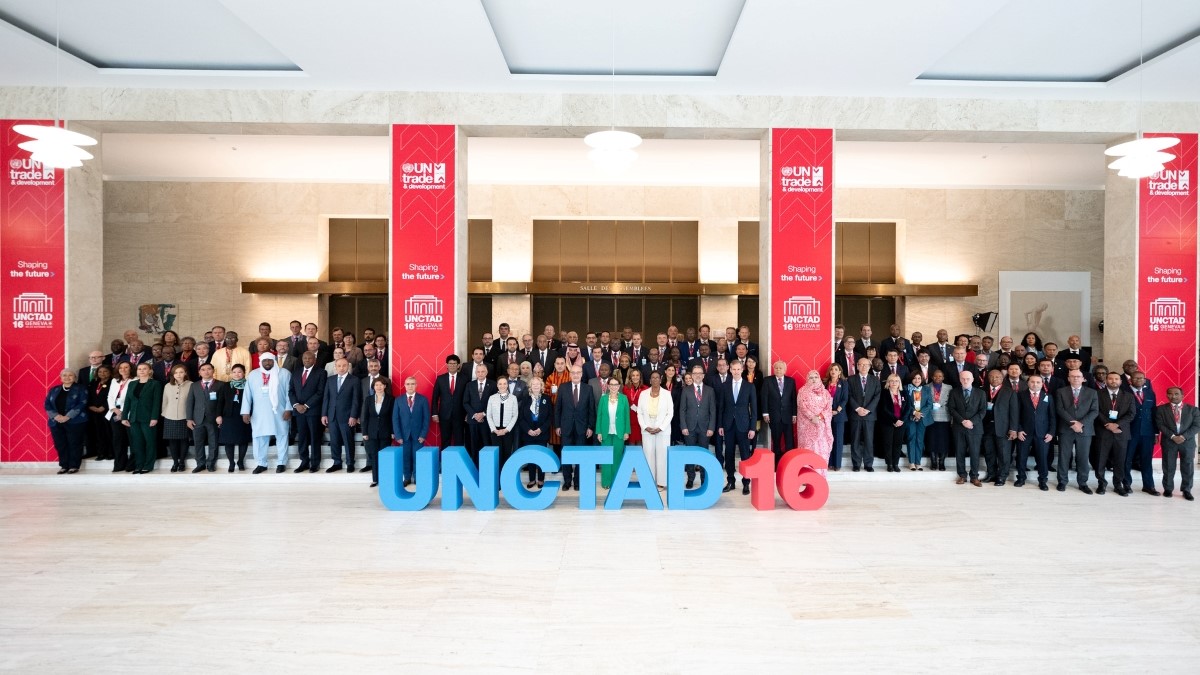
Heads of national delegations at the opening of the 16th United Nations Conference on Trade and Development (UNCTAD16) held in Geneva, Switzerland, on 20 October | © UNCTAD Photo.
UNCTAD16 sets a new four-year trade and growth agenda
Geneva: The 16th United Nations Conference on Trade and Development (UNCTAD16) opened in Geneva today amid growing uncertainty in global trade, with world leaders, policymakers, and experts seeking to chart a collective path toward more resilient and inclusive growth.
Held under the theme “Shaping the future: Driving economic transformation for equitable, inclusive and sustainable development,” the four-day conference from October 20 to 23, 2025, will determine UNCTAD’s priorities and working mandate for the next four years. The quadrennial forum, which serves as the organisation’s highest decision-making body, brings together representatives from all 195 member states to deliberate on key challenges and forge multilateral responses to pressing trade and development issues.
The spirit of multilateralism dominated the opening day, with speakers highlighting UNCTAD’s role in aligning trade and development agendas to the realities of a changing world. Annalena Baerbock, President of the UN General Assembly, emphasised that progress in trade and development was central to the broader renewal of the UN and the multilateral system.
“Trade must uplift rather than divide, empower rather than exclude,” she said, urging governments to ensure that economic growth translates into fairness and opportunity. “A more equitable global economy is essential to demonstrating that multilateralism still works for all.”
The conference opened with the election by acclamation of Federal Councillor Guy Parmelin of Switzerland, the host country, as president of UNCTAD16. Parmelin urged delegates to uphold Geneva’s long tradition of consensus-building, saying: “Let’s remain faithful to the tradition of international Geneva and find consensus by looking at diverse points of view and ensuring that we stimulate the economy with a view to achieving fair, inclusive and lasting development.”
In her opening address, UNCTAD Secretary-General Rebeca Grynspan described the conference as a defining moment to “shape the future together.” She warned that uncertainty, debt distress and falling investment continue to weigh heavily on developing and least developed countries, threatening their growth prospects. However, she noted that emerging trends—from new trade and investment patterns to advances in clean technologies and artificial intelligence—offer opportunities to remodel the global economy around inclusion and resilience.
“The key question,” Grynspan said, “is not whether change will happen, but who will steer it and for whose benefit. We’ve come here to shape the future together, so that trade, investment and technology work for people, not the other way around.”
Messages from global leaders echoed this call for transformation and solidarity. President José Ramos-Horta of Timor Leste, in a video message, urged a renewed commitment to rebalance global trade rules, address unsustainable debt, bridge the digital divide and embed climate justice into trade and investment frameworks—particularly for least developed countries.
Prime Minister Phạm Minh Chính of Viet Nam, also speaking via video message, called for bold reforms of multilateral trade and financial systems, reaffirming his nation’s support for the UN’s central role in addressing “global and people-centred issues” related to sustainable development.
Prime Minister Mia Amor Mottley of Barbados, in a pre-recorded statement, praised UNCTAD’s “transformative response” in implementing the ‘Bridgetown Covenant‘ adopted at the organisation’s previous conference in Barbados. She said UNCTAD must continue to serve as the global forum where “new consensus on the links between trade and development are forged for the prosperity of all.”
Tatiana Valovaya, Director-General of the UN Office at Geneva, said the momentum generated by UNCTAD16 should not be lost. Encouraging participants to act with “clarity, courage and collective resolve,” she added that the conference could serve as “a space for bold ideas, innovative partnerships and renewed determination to build a resilient, sustainable and inclusive future for all.”
UN Secretary-General António Guterres is scheduled to address the conference on 22 October, underscoring the significance of the global gathering as countries face multiple economic headwinds—from supply chain disruptions and mounting debt to investment decline and digital inequality.
Over the next four days, more than 40 high-level sessions, ministerial roundtables and special events will explore strategies for reinforcing supply chain resilience, reforming global finance, expanding productive investment, and ensuring that digital transformation benefits all countries equitably. Delegates are expected to focus on how economies can navigate turbulence while laying the foundations for sustainable growth that leaves no one behind.
As the deliberations continue through the week, delegates are expected to finalise decisions that will guide UNCTAD’s work through 2029, shaping global cooperation on trade, finance, investment and technology at a time when uncertainty and fragmentation threaten the very foundations of shared prosperity.
– global bihari bureau