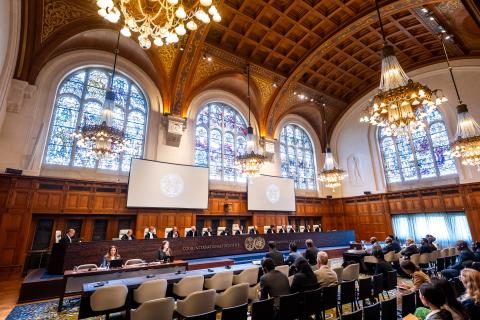
The Court today delivered its Order on the request for the indication of provisional measures submitted by Equatorial Guinea in the case concerning the Request relating to the Return of Property Confiscated in Criminal Proceedings (Equatorial Guinea v. France).
No Temporary Relief for Guinea in Property Dispute
The Hague: The International Court of Justice has turned down a request from Equatorial Guinea for temporary orders aimed at protecting its claimed right to the return of a building in Paris that was seized by French authorities during criminal proceedings.
The court’s decision came in the case known as Request Relating to the Return of Property Confiscated in Criminal Proceedings, pitting Equatorial Guinea against France. Public hearings on Equatorial Guinea’s request for these provisional measures were held on July 15, 2025.
In its order, the court explained that it can only issue such temporary measures if it finds that the rights claimed by the requesting party are at least plausible. Equatorial Guinea argued that it has a right, under Article 57, paragraph 3(c), of the United Nations Convention against Corruption, to get back the building located at 42 Avenue Foch in Paris.
The court looked at that article, which states that a country like France, when asked, “shall … give priority consideration” to three options: returning the property to the requesting country like Equatorial Guinea, giving it back to previous legitimate owners, or providing compensation to victims of the crime.
The judges noted that the wording “shall … give priority consideration,” combined with the list of three choices, indicates that the requested country has some flexibility in deciding what to do. Returning the property to the requesting country is just one of the options that must be given priority.
After reviewing arguments from both sides, the court concluded that Equatorial Guinea had not shown, in this preliminary stage, that it has a plausible right to the return of the building based on the article it cited.
The court recalled that all conditions for issuing provisional measures must be met together. Since it found that the plausibility condition was not satisfied, it did not need to examine the other requirements, such as urgency or risk of irreparable harm.
The judges determined that the current circumstances do not call for using their authority under Article 41 of the court’s statute to issue the requested measures.
The vote on the operative part of the order was 13 to 2 in favor of rejecting Equatorial Guinea’s request, which had been submitted on July 3, 2025. Voting in favor were President Iwasawa, Vice-President Sebutinde, and Judges Tomka, Abraham, Xue, Bhandari, Nolte, Charlesworth, Brant, Gómez Robledo, Cleveland, Aurescu, and Tladi. Voting against were Judge Yusuf and Judge ad hoc Elias.
Judge Tomka attached a declaration to the order. Judge Yusuf attached a separate opinion. Judge Nolte attached a declaration. Judge Tladi attached a separate opinion. Judge ad hoc Elias attached a dissenting opinion.
The broader case stems from an application filed by Equatorial Guinea on Sept. 29, 2022, starting proceedings against France over a dispute about the interpretation and application of the United Nations Convention against Corruption, adopted on Oct. 31, 2003, and also known as the Mérida Convention.
Under a court order dated Dec. 22, 2022, Equatorial Guinea submitted its memorial on July 17, 2023, and France filed its counter-memorial on Feb. 19, 2024. The court later set deadlines for further filings: July 28, 2025, for Equatorial Guinea’s reply and May 28, 2026, for France’s rejoinder, as per a Feb. 27, 2025, order.
Equatorial Guinea’s July 3, 2025, request for provisional measures was prompted by recent events. It argued that the court has initial jurisdiction based on Article 66 of the convention, which allows disputes over its interpretation or application to be brought to the court if negotiations and arbitration efforts fail.
Both countries are parties to the convention—Equatorial Guinea since May 30, 2018, and France since July 11, 2005—without reservations to the dispute settlement clause. Equatorial Guinea said it tried to negotiate, proposed arbitration on Jan. 6, 2022, without response, and thus met the requirements to bring the case.
The request focused on protecting Equatorial Guinea’s claimed right to the return of the building at 40-42 Avenue Foch—referred to interchangeably as 42 Avenue Foch—under Article 57 of the convention.
It described events starting May 27, 2025, when France’s Agency for the Management and Recovery of Seized and Confiscated Assets, or AGRASC, under the ministries of justice and public accounts, asked the president of the Paris judicial tribunal to appoint a court enforcement officer to access the building. This was approved on June 3, 2025.
On June 18, 2025, around 8:30 a.m., a French judicial police commissioner, judicial and national police officers, AGRASC officials, private security personnel, and locksmiths entered the building without advance notice to occupants. They changed locks on the main and rear doors of the first, second, and third floors used by Equatorial Guinea, took the new keys, smashed surveillance cameras, and damaged the gate’s automatic opening system, blocking vehicle access. Police dogs were present.
That same day, Equatorial Guinea’s Ministry of Foreign Affairs, International Cooperation and Diaspora sent a note verbale to France’s Ministry for Europe and Foreign Affairs protesting the entry.
France responded on June 19, 2025, via note verbale, saying it had not been informed in advance of the operation and expressing hope for a quick solution under French and international law, without offering specifics.
On June 24, 2025, Equatorial Guinea informed the court of these events and asked France for assurances by June 27, 2025, that it would not cause irreparable harm or worsen the dispute. France provided no such assurances, including no commitment against selling the building before a final ruling.
Equatorial Guinea argued the court’s initial jurisdiction was clear, the claimed rights were plausible, there was a risk of irreparable prejudice and urgency, and the measures sought were linked to its main claims.
It said the potential sale would violate its rights to property return and cooperation under the convention, prevent restoring the original situation, and breach principles like sovereign equality and non-intervention.
Urgency arose from France’s actions since December 2021, when its president indicated no intent to return assets to Equatorial Guinea’s government, followed by steps toward liquidation, including auctions and the June 18, 2025, inspection. A January 2023 notification to the court did not halt these, and France gave no assurances against imminent sale.
Equatorial Guinea also cited France’s “Programme 370” from a 2021 law, which uses sale proceeds from such assets for development actions in the origin country as identified by France.
It requested the court to order France to: ensure the building is not offered for sale; provide Equatorial Guinea immediate, full, and unimpeded access to the entire building; and refrain from actions that might aggravate, extend, or complicate resolving the dispute.
Equatorial Guinea reserved the right to seek additional measures if needed and to revise its grounds.
The request included annexes such as AGRASC’s May 27 application, the June 3 order, the June 18 and 19 notes verbales, its June 24 letter to the court, a January 2023 letter to the court registrar, a January 2022 note verbale, and a July 2022 AGRASC letter to occupants.
The court, in rejecting the request, did not address these specific arguments beyond finding no plausible right.
– global bihari bureau