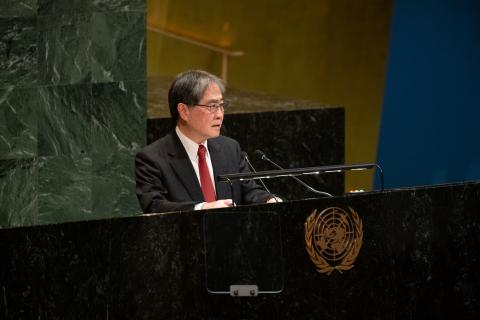
The President of the Court, Judge Iwasawa Yuji, presents the Annual Report of the Court for the judicial year 2024-2025 to the 80th session of the United Nations General Assembly, on October 30, 2025.
Growing Docket Demands Reform Now
ICJ President Iwasawa Admits Strain in Historic UNGA Disclosure
New York: In a historic first, International Court of Justice (ICJ) President Judge Iwasawa Yuji openly admitted to the United Nations General Assembly (UNGA) today that the Court’s unprecedented 24-case docket is jeopardising timely justice.
Delivering a measured yet unprecedented alert to the UNGA, Yuji referred to the Court’s sustained record of 24 pending cases—23 contentious and one International Labour Organization (ILO) advisory—saying they directly challenge the timely issuance of judgments and opinions.
“The Court is well aware of the challenges that its growing workload poses for the timely delivery of judgments and opinions,” he stated, marking the first time an ICJ president has publicly tied caseload expansion to procedural risk in this forum.
The disclosure, embedded in his mandated annual address, underscores a turning point for the world’s principal judicial organ as it nears its 80th anniversary in 2026. The complaint is not about the absolute number—24 is modest compared to national high courts—but the complexity and global stakes of each dispute: genocide claims, climate existential threats, racial discrimination, maritime delimitation, migrant weaponisation, consular immunities, and treaty interpretation across diverse fields. Each requires exhaustive written pleadings, multilingual translations, oral hearings with multiple States, and meticulous deliberations among 15 judges from varied legal traditions.
The Japanese jurist began by emphasising the annual tradition’s value in spotlighting the principal judicial organ’s role within the United Nations (UN) system. After congratulating Annalena Baerbock on her election as President of the Eightieth Session, he transitioned to a concise overview of the judicial year starting August 1, 2024. The docket stood at 23 cases on that date and has held at 24, encompassing delimitation, human rights, immunities, as well as treaty interpretation across diverse fields. The ILO request asks whether the right to strike is protected under Convention No. 87.
Five new contentious filings arrived since last October’s address, though two were removed. Iran instituted proceedings against Canada, Sweden, Ukraine, and the United Kingdom on April 17, 2025, regarding International Civil Aviation Organization (ICAO) Council jurisdiction under Article 84 of the Chicago Convention. France filed against Iran on May 16, 2025, over consular violations in the arrest, detention, and trial of French nationals; France discontinued, and the Court recorded the withdrawal by Order on September 19, 2025. Lithuania targeted Belarus on May 19, 2025, for migrant smuggling under the relevant UN protocol. Russia appealed an ICAO decision against Australia and the Netherlands on September 18, 2025. Sudan charged the United Arab Emirates (UAE) with genocide on March 5, 2025; the case was later withdrawn.
Despite the pressure, the Court held six hearings, including Gabon/Equatorial Guinea merits (September 30 –October 4, 2024), climate obligations (December 2–13, 2024), Sudan provisional measures (April 10, 2025), Occupied Palestinian Territory advisory (April 28 –May 2, 2025), Equatorial Guinea provisional measures (July 15, 2025), and ILO strike (October 6–10, 2025).
It delivered one merits judgment in Gabon/Equatorial Guinea (May 19, 2025), preliminary objections rulings in the paired Armenia/Azerbaijan racial discrimination cases (November 12, 2024), three provisional measures Orders, one suspension, one intervention admissibility ruling, and multiple time-limit extensions. The ILO opinion remains under deliberation.
Most strikingly, the bench issued two advisory opinions in a single year: the unanimous climate ruling on July 23, 2025, after unprecedented participation by 96 States and 11 organisations, which declared Paris parties bound to progressive Nationally Determined Contributions (NDCs) collectively capable of 1.5 °C, fixed United Nations Convention on the Law of the Sea (UNCLOS) baselines against sea-level rise, linked human rights enjoyment to climate protection, and mandated cessation and full reparation for breaches; and the Israel opinion on October 22, 2025, which intensified Fourth Geneva Convention duties amid Gaza’s heightened control since October 7, 2023, ordered United Nations Relief and Works Agency for Palestine Refugees in the Near East (UNRWA) facilitation without impartiality breach, prohibited starvation warfare and population-forcing measures, and upheld Charter immunities and self-determination via UN entities.
The General Assembly posed two questions: obligations to protect the climate system from anthropogenic greenhouse gases, and legal consequences for significant harm caused by acts or omissions.
The Court relied on Intergovernmental Panel on Climate Change (IPCC) reports as the best scientific explanation of climate effects. Applicable law includes the UN Charter, the three core climate treaties (United Nations Framework Convention on Climate Change (UNFCCC), Kyoto Protocol, Paris Agreement), UNCLOS, ozone, biodiversity, and desertification conventions, plus customary duties to prevent transboundary harm and to cooperate.
Human rights treaties and principles—sustainable development, common but differentiated responsibilities, equity, intergenerational equity, precautionary approach—guide interpretation. On October 22, 2025, the Court issued its advisory opinion on Israel’s obligations regarding UN presence and activities in the Occupied Palestinian Territory, pursuant to resolution 79/232 of December 19, 2024. The question covered Israel as an occupying Power and a UN member. The Court examined the Gaza circumstances, noting Israel’s control increased significantly post-October 7, 2023, via military presence and aid blockages between March 2 and May 18, 2025. Fourth Geneva Convention duties intensified alongside hostilities rules. Security concerns do not suspend humanitarian law; good faith limits apply.
Articles 55, 56, and 59 mandate food, medical, and shelter supplies; relief schemes must be facilitated when populations are inadequately supplied.
No evidence showed UNRWA breached impartiality; neutrality informs but does not define it. Israel must enable UNRWA and other impartial actors. Starvation as warfare and population-forcing measures are prohibited. Human rights obligations rise commensurately with diminished UN capacity. Charter Article 2(5) requires cooperation; immunities under Article 105 and the General Convention must be respected. Israel cannot unilaterally restrict UN presence in the occupied territory.
Turning to other rulings, the Court delivered a merits judgment in Gabon/Equatorial Guinea on May 19, 2025, resolving sovereignty and delimitation. Preliminary objections were rejected in the paired Armenia/Azerbaijan racial discrimination cases on November 12, 2024. Hearings covered merits, advisories, and provisional measures without delay. To sustain performance, Iwasawa disclosed an internal working methods review now integrating technology into case management and deliberations—a first in annual reporting. The 2025 budget reinforced staffing; the 2026 submission seeks a modest increase to maintain timeliness. Asbestos remediation at the Peace Palace continues without interrupting sittings. The Judicial Fellowship Trust Fund, established in 2021, supported four fellows each in the 2024–2025 and 2025–2026 cohorts from Brazil, the Republic of the Congo, Eritrea, Guatemala, India, the Islamic Republic of Iran, Kenya, Pakistan, the Philippines, South Africa, Tunisia, and Türkiye—success hinges on donor contributions. Execution will require targeted funding for staff, secure digital platforms, and fellowship expansion—resources Iwasawa implied are non-negotiable as the Court approaches its 80th anniversary in 2026, urging “self-reflection rather than complacency” to preserve impartial, prompt justice amid rising interstate litigation.
Recalling his June 2025 address on the UN Charter’s 80th anniversary, Iwasawa noted the ICJ’s own milestone approaches in 2026. “Such milestones should prompt self-reflection rather than complacency,” he urged, reaffirming commitment to peaceful settlement and legal clarification through impartial reasoning. The Court stands ready to serve and guide via decisions resonating beyond parties, grounded in law.
The address, delivered with understated precision, reaffirmed the Court’s readiness to serve and guide the international community through its decisions and advisory opinions, stressing that while the Court’s jurisprudence often resonates beyond the parties involved, its strength rests on impartiality and adherence to law. The Annual Report records an institution operating under increasing global scrutiny. The diversity of its docket demonstrates how the Court has evolved from a post-war arbiter into a central legal forum for an interconnected world. Yet the ICJ’s challenges remain structural: finite resources, expanding expectations, and the delicate balance between judicial restraint and moral authority.
The President’s appeal to donors and Member States, together with his emphasis on procedural reform and technological adoption, suggested that the ICJ is positioning itself for a new phase—one that blends tradition with adaptability. His closing observation reaffirmed its constitutional role within the United Nations system as both interpreter and guardian of international legality.
As the General Assembly adjourned, the Court’s report served less as a ceremonial review and more as a reminder of the enduring weight that rests upon its bench. The International Court of Justice, on the threshold of its eightieth year, faces a world more fragmented yet more dependent on law than ever before—a paradox that defines both its burden and its purpose.
The address signals a Court embracing adaptability while guarding tradition amid escalating global litigation. Execution will require targeted funding for staff, secure digital platforms, and fellowship expansion—resources Iwasawa implied are non-negotiable to preserve impartial, prompt justice amid rising interstate litigation.