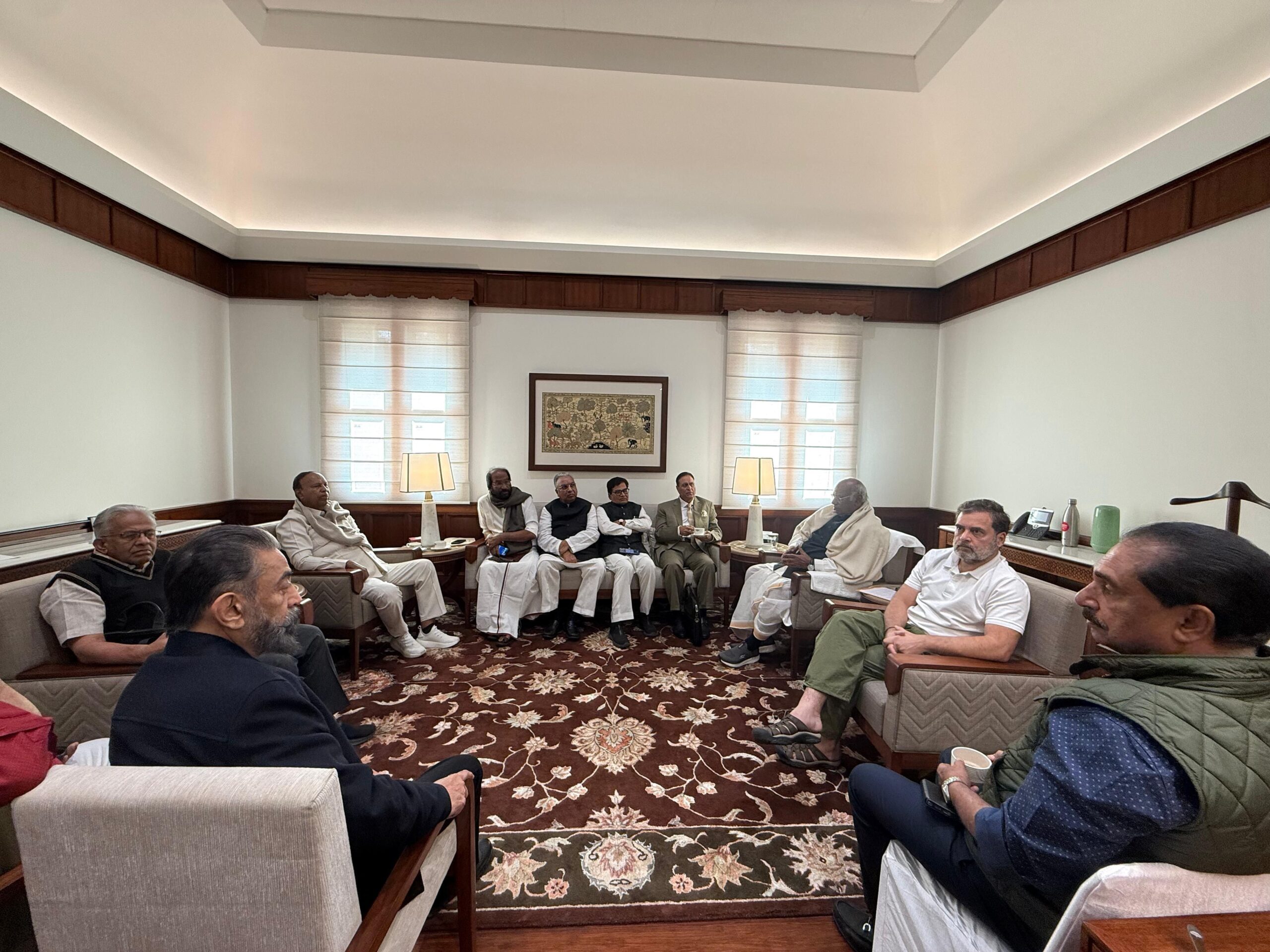
01 Dec 2025 Meeting of INDIA bloc floor leaders | Parliament House | New Delhi
BLO deaths and Herald dispute derail Day One of Session
New Delhi: The opening day of the Winter Session of Parliament today was dominated by two issues that stalled all scheduled legislative business: the reported deaths of Booth Level Officers (BLO) during the Election Commission’s Special Intensive Revision (SIR) of electoral rolls, and the Congress Party’s allegations of selective Enforcement Directorate action in the National Herald case. Opposition MPs demanded that the House set aside the listed agenda and take up an urgent discussion on the fatalities linked to SIR duties, citing recent police-verified deaths in Uttar Pradesh and West Bengal. Government MPs opposed altering the day’s business and insisted that discussion should proceed according to the circulated schedule, resulting in repeated adjournments of both Houses by the afternoon.
The SIR controversy reached the floor through references to individual cases. MPs from the Samajwadi Party and Trinamool Congress cited the suicide of a 46-year-old BLO in Moradabad whose two-page note referred to the inability to meet SIR targets, as well as a video in which he described himself as under severe work pressure. They also mentioned the death of a female BLO in Bijnor due to cardiac arrest, with her family alleging she had worked late into the night on SIR data uploads, and the heart-attack death of a headmaster functioning as assistant BLO in Sambhal, with relatives linking the fatal collapse to stress caused by SIR demands. West Bengal MPs placed on record four fatalities connected to SIR duty in the state, including a case in which a teacher-BLO collapsed after field-verification work. These reports were used to argue that an assessment of workload, timelines and supervision practices was required before the continuing SIR exercise could be considered safe for frontline polling staff.
Government MPs countered that the opening of the session could not be converted into a “matter of urgency determination” by the Opposition and referred to the Prime Minister’s morning remarks outside Parliament that the Winter Session must prioritise “policy and delivery, not drama or slogan-shouting.” The Prime Minister had also urged that younger and first-time MPs be given space to participate in debate and said the session should not become an arena for either “frustration after defeat” or “arrogance after victory.” With neither side conceding procedural ground, the House was repeatedly disrupted and did not advance to substantive legislative discussion.
The second flashpoint emerged after the Congress referenced a press briefing by Dr Abhishek Manu Singhvi held immediately before the session. In that briefing, Singhvi alleged that the Enforcement Directorate’s actions in the National Herald–AJL matter represented a political vendetta. He stated that there had been no money movement, no transfer of immovable property and no government-filed complaint in the original case, arguing that the conversion of AICC loans to equity in Associated Journals Ltd. and the resulting majority shareholding by Young Indian was a lawful restructuring under the Companies Act. Singhvi said a new FIR filed in November was meant to “cure a gap” in the earlier proceedings, maintaining that the Enforcement Directorate could not have acted based solely on a private complaint. These assertions were cited by Congress MPs inside Parliament during protests, but the Chair did not allow debate on the ED issue under the day’s business.
The convergence of the two disputes — SIR deaths and the National Herald investigation — produced a procedural deadlock rather than a negotiated agenda. The presiding officers refused to grant adjournment motions on the two issues, and the Opposition refused to proceed with Question Hour and listed legislative items without discussion on them. Walkouts alternated with floor protests until both Houses were adjourned for the day.
At the close of Day 1, the parliamentary record showed that no legislative item was completed, no timeline was agreed upon for a discussion on the SIR-linked deaths, and no decision was taken on whether the ED matter would be admitted for debate during the session. The Election Commission’s position — that the BLO fatalities are isolated cases and that the revision exercise remains on schedule — stands unaltered. Families in multiple districts continue to publicly attribute deaths to workload pressure, while the Commission maintains there is no demonstrated systemic causation. Parliament has not yet resolved whether either claim will be examined through a formal debate, committee review or independent inquiry.
– global bihari bureau