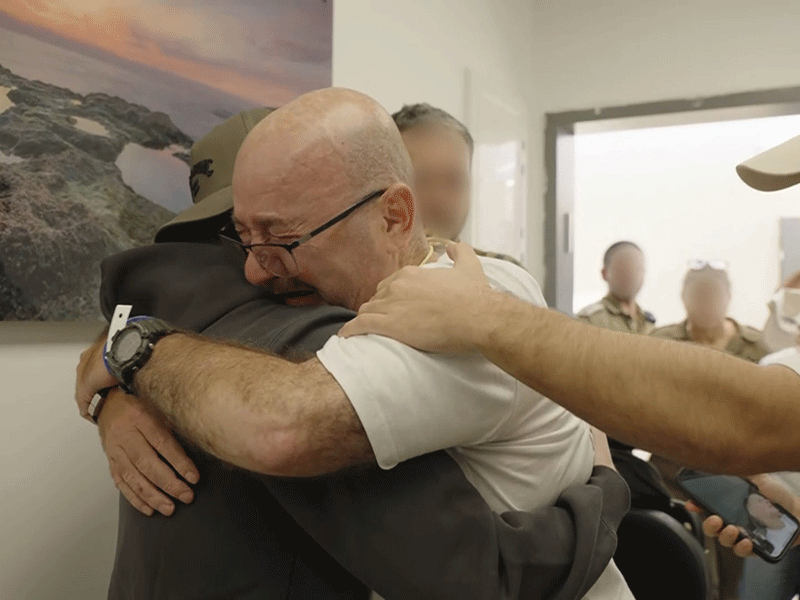
Bar Kupershtein’s emotional meeting with his father© IDF Spokesperson
Hostages as Bargaining Chips in Gaza
Hamas deliberately spared many of the 251 hostages it abducted during its October 7, 2023, attacks on southern Israel, viewing live captives as invaluable bargaining chips for prisoner exchanges rather than executing them outright. Recovered militant documents, cited in Human Rights Watch (HRW)’s comprehensive war crimes report, reveal explicit orders issued to fighters: maximise killings at massacre sites like the Nova music festival—where over 360 revellers were slaughtered—and kibbutzim such as Nir Oz and Nahal Oz to instil paralysing terror and psychological trauma across Israeli society. However, the directives emphasised prioritising the abduction of “high-value” targets—civilians including families, the elderly, women, children, and soldiers from remote military outposts—for rapid transport into Gaza’s vast underground tunnel network, often under gunfire and amid chaotic extractions.
This approach was no desperate improvisation born of battlefield frenzy; it was a premeditated strategy meticulously modelled on Israel’s 2011 Gilad Shalit deal, a historic prisoner swap in which Jerusalem released 1,027 Palestinian detainees—including the shadowy architect of the October 7 attacks, Yahya Sinwar—for the return of a single Israel Defense Force (IDF) soldier. Hamas leaders, in candid Al Jazeera interviews following the assault, openly described such live hostages as instruments for extracting “strategic concessions” that could deter a full-scale Israeli ground invasion, amplify international diplomatic pressure, and secure the freedom of high-profile Palestinian prisoners while exploiting Israel’s profound domestic aversion to risking civilian lives in high-stakes rescue operations.
The strategic rationale extended far beyond immediate tactical gains. Terrorism expert Ariel Merari, in his detailed 2024 Tel Aviv University analysis of militant training manuals and post-attack interrogations, characterised the hostage policy as a “guarantee against complete destruction” of Hamas’s infrastructure and leadership. Militants received specialised training to identify and seize “sensitive” profiles—festivalgoers mid-dance, sleeping families in kibbutz safe rooms, border sentinels—precisely because their prolonged captivity promised outsized propaganda resonance, emotional leverage on Israeli public opinion, and complications for military responses.
HRW’s exhaustive investigation classified the abductions themselves as war crimes and crimes against humanity, underscoring how they served as the dark machinery of delay: by holding live assets, Hamas stalled Israel’s initial counteroffensive, stoked worldwide revulsion through proof-of-life videos and global media coverage, and imposed political constraints on Jerusalem’s leadership amid mounting domestic protests for negotiated releases. Early overtures from Hamas on October 9-10, 2023—proposing the release of groups of hostages in exchange for immediate ceasefires and safe passage guarantees—were swiftly rejected as Israel mobilised its reserves and prepared Operation Swords of Iron, but the group’s calculus ultimately forced a protracted diplomatic siege lasting over two years.
This gruelling negotiation marathon, facilitated by Qatar’s discreet backchannels, Egypt’s border mediation expertise, and relentless U.S. diplomatic pressure under United States President Donald Trump’s administration, yielded hard-won incremental victories that validated Hamas’s approach. The first major breakthrough came in November 2023 with a Qatar-brokered truce freeing 105 hostages—primarily women, children, and elderly—in exchange for a temporary pause in fighting and the release of 240 Palestinian prisoners. Subsequent efforts included the audacious February 2024 IDF raid in Rafah, which rescued Fernando Simon Marman and Louis Har in a nighttime operation that killed 37 militants but highlighted the perils of military extractions. Layered deals in January and February 2025 further eroded Hamas’s hold, including the May 12 release of American-Israeli soldier Edan Alexander after 584 days through Trump-orchestrated talks with Qatari intermediaries. In total, 168 hostages returned alive via these exchanges, daring rescues, and occasional unilateral gestures by Hamas. Tragically, the toll included 38 who perished on or shortly after October 7 from indiscriminate gunfire, mangled vehicle crashes during forced marches to Gaza, or captors’ impatience with injured or resistant victims, with some bodies unceremoniously hauled across the border; an additional 28 died in captivity from deliberate executions, collateral damage from Israeli airstrikes targeting tunnel complexes, medical neglect in unsanitary conditions, or the quiet desperation of suicide, as verified by IDF forensic examinations and exhaustive tallies from the Hostages and Missing Families Forum.
Survivors’ harrowing accounts, emerging from medical debriefs, media interviews, and therapeutic sessions, expose the captors’ ruthless pragmatism: lives were preserved not out of mercy, but as tradeable commodities amid systemic brutality designed to break spirits without fully extinguishing them. Doron Katz Asher, wounded by shrapnel in her leg during the initial abduction chaos and freed in November 2023 alongside her young daughters Raz and Aviv, described to CNN the claustrophobic vise of a Gaza hospital cell turned prison: “They chained us to beds with metal cuffs that rubbed our wrists raw, gave us just one meager meal a day of stale bread and watery rice, and forced us to watch looped footage of the October 7 atrocities while spinning lies that Israel had collapsed and no one was coming—pure psychological warfare to crush our hope.” Her voice cracked in the interview as she recounted the agony of watching her own mother bleed out from gunshot wounds during the brutal transport to Gaza, a memory that underscored the selective sparing of those deemed negotiable. Keith Siegel, the 64-year-old Israeli-American cook whose 484 days of captivity ended in February 2025, staggered into The New York Times interviews 100 pounds lighter, his frame skeletal from chronic malnutrition; he chronicled the suffocating tunnel isolation punctuated by savage beatings, coerced recordings of duress videos pleading for prisoner swaps, and the horrifying finality of guards executing fellow resisters who dared speak out: “They kept me alive deliberately for the cameras and propaganda reels, rationing out crumbs and tainted water just enough to parade me as proof of their unyielding power over us.”
Amit Soussana’s early 2025 liberation peeled back even darker layers in an intimate American Jewish Committee (AJC) confessional: pistol-whipped and threatened at gunpoint under captors’ suspicions of IDF affiliations, she credited fellow hostage Liri Albag—an IDF soldier who endured her own 477-day inferno until January—with a desperate, life-saving intervention, vouching to skeptical guards that Soussana was a harmless civilian and not a military threat, thereby preventing an immediate execution; the sexual violence she suffered at the hands of a captor highlighted the fragile, hushed solidarity that bound survivor groups together against total collapse. Alon Ohel, the young 24-year-old pianist kidnapped mid-festival from Nova and released on October 13 after 737 gruelling days, emerged with vision lost in one eye to the ravages of starvation and vitamin deficiencies, his family revealing to Reuters how he mentally composed and rehearsed intricate symphonies in the pitch-black isolation of tunnels to preserve his sanity and humanity. Matan Zangauker, the 25-year-old son of Nir Oz kibbutz, collapsed into the waiting arms of his mother, Einav, after 738 days—her tireless advocacy through the Hostages Forum serving as an unyielding external lifeline—captured in raw, emotional AP footage of sobs, embraces, and whispered secrets from the void. Luis Har, 70 years old and rescued in February 2024 alongside family members, confided to National Public Radio (NPR) his 140-day odyssey of being shuttled between tunnel segments and surface hideouts: denied any Red Cross visits, tormented by paranoid guards convinced of hidden trackers, and drawing on long-buried memories of childhood dances to soothe the terror of young children in his group, all while publicly opposing further Israeli raids that he believed only courted more captive deaths.
Edan Alexander’s personal saga wove a critical international thread into the crisis, as the last living U.S. citizen hostage until his dramatic May 12, 2025, release brokered by President Trump’s direct negotiations with Qatari intermediaries following his seizure from a Golani Brigade border post. The 21-year-old endured 584 days hooded and manacled through a gauntlet of interrogations in damp tunnels and ad-hoc surface lairs, surviving a catastrophic April airstrike-induced tunnel collapse that gashed his hands with debris and fatally triggered a heart attack in his cellmate, Itzik Elgarat. Emerging gaunt but unbroken at Re’im military base, he enveloped his parents, Adi and Yael, in euphoric cries of relief, later cherishing the profound “simple things” like sharing rooftop beers under open skies, as relayed to ABC News. In his first public address at a September Friends of the Israel Defense Forces (FIDF), a U.S.-based nonprofit organization, gala in Manhattan, Alexander expressed profound gratitude: “Without [Trump’s] work and the administration’s relentless efforts, I would not be here standing with you tonight,” before vowing to re-enlist in the IDF and continue advocating for the 58 hostages still held, declaring with steely resolve, “My story does not end with survival. It continues with service to my country and my people.”
The strategy’s culmination arrived October 13, 2025, when Trump’s ambitious 20-point Gaza peace blueprint secured the handover of the final 20 living male hostages, all aged 19 to 48, transferred in coordinated International Committee of the Red Cross batches—seven from northern Gaza enclaves and 13 from the south—in exchange for nearly 2,000 Palestinian prisoners, including 250 serving extended sentences for affiliations with Hamas and Fatah factions. Airlifted by Israeli military helicopters to hospitals amid thunderous, nationwide celebrations at Tel Aviv’s Hostages and Missing Families Square—a vigil site turned jubilation epicentre—Prime Minister Benjamin Netanyahu lavished praise on Trump as “Israel’s greatest friend ever in the White House,” crediting U.S. leverage on Arab mediators for breaking the deadlock. Trump himself, fresh from a rousing address to Israel’s Knesset and a formal signing ceremony in Egypt alongside Qatari, Egyptian, and Turkish brokers, boldly proclaimed an “end to the Gaza war,” hailing the moment as a historic turning point.
Yet euphoria fractured almost immediately into outrage and unresolved grief: of the 28 promised coffins containing deceased hostages’ remains, only four materialized—preliminarily identified as Guy Illouz (shot at Nova and died in a Gaza hospital), Bipin Joshi (the 23-year-old Nepalese student), Yossi Sharabi, and Daniel Peretz—now undergoing rigorous autopsies at the Abu Kabir Forensic Institute to confirm identities and causes of death. Hamas attributed the delays to Gaza’s rubble-choked devastation from prolonged Israeli strikes, which local health authorities claim resulted in nearly 68,000 Palestinian fatalities; the International Committee of the Red Cross echoed this, warning that full recovery efforts posed a “massive challenge” amid collapsed structures and ongoing security risks, potentially dragging on for weeks or longer. In retaliation, Israel sharply curtailed humanitarian aid convoys to just 300 trucks per day and sealed the vital Rafah crossing point, actions that triggered urgent UN warnings of impending famine and humanitarian catastrophe in the enclave; anguished families, including Tamir Adar’s mother, Yael, publicly beseeched U.S. envoy Steve Witkoff to redouble pressure on mediators for a swift resolution. Trump himself thundered on October 14 via social media: “The dead have not been returned, as promised,” underscoring the deal’s precarious incompleteness.
The ceasefire’s inherent fragility was laid bare in stark, violent terms that very same day, October 13, 2025, when masked Hamas gunmen publicly executed seven men accused of collaborating with Israel—binding their hands behind their backs and gunning them down execution-style in a crowded Gaza City square amid chants of “Allahu Akbar” from onlookers, according to social media video verified by Reuters and corroborated by a Hamas source. These killings formed part of a broader post-truce crackdown that claimed at least 33 lives in its opening hours, with Hamas officials vowing on October 14 to ruthlessly target “violators of order” including armed thieves, drug dealers, and suspected informants, while deploying 7,000 recalled security personnel to patrol aid distribution routes and reassert control over the battered territory—moves that brazenly defied international demands for Hamas disarmament as a precondition for phase two of the agreement. As negotiations over that next phase—encompassing Hamas’s full disarmament, demilitarisation of Gaza, and establishment of a viable governance structure—hang in precarious balance amid renewed tensions, the Hostages and Missing Families Forum remains resolute in its demand for complete repatriation of all remains and captives. The survivors’ unfiltered testimonies stand as an indelible testament: Hamas’s sparing of lives amid the October 7, 2023, horror was never an act of mercy, but a coldly forged weapon of strategic necessity, one that prolonged suffering on all sides while etching a legacy of bartered humanity in the shadows of conflict.
– global bihari bureau