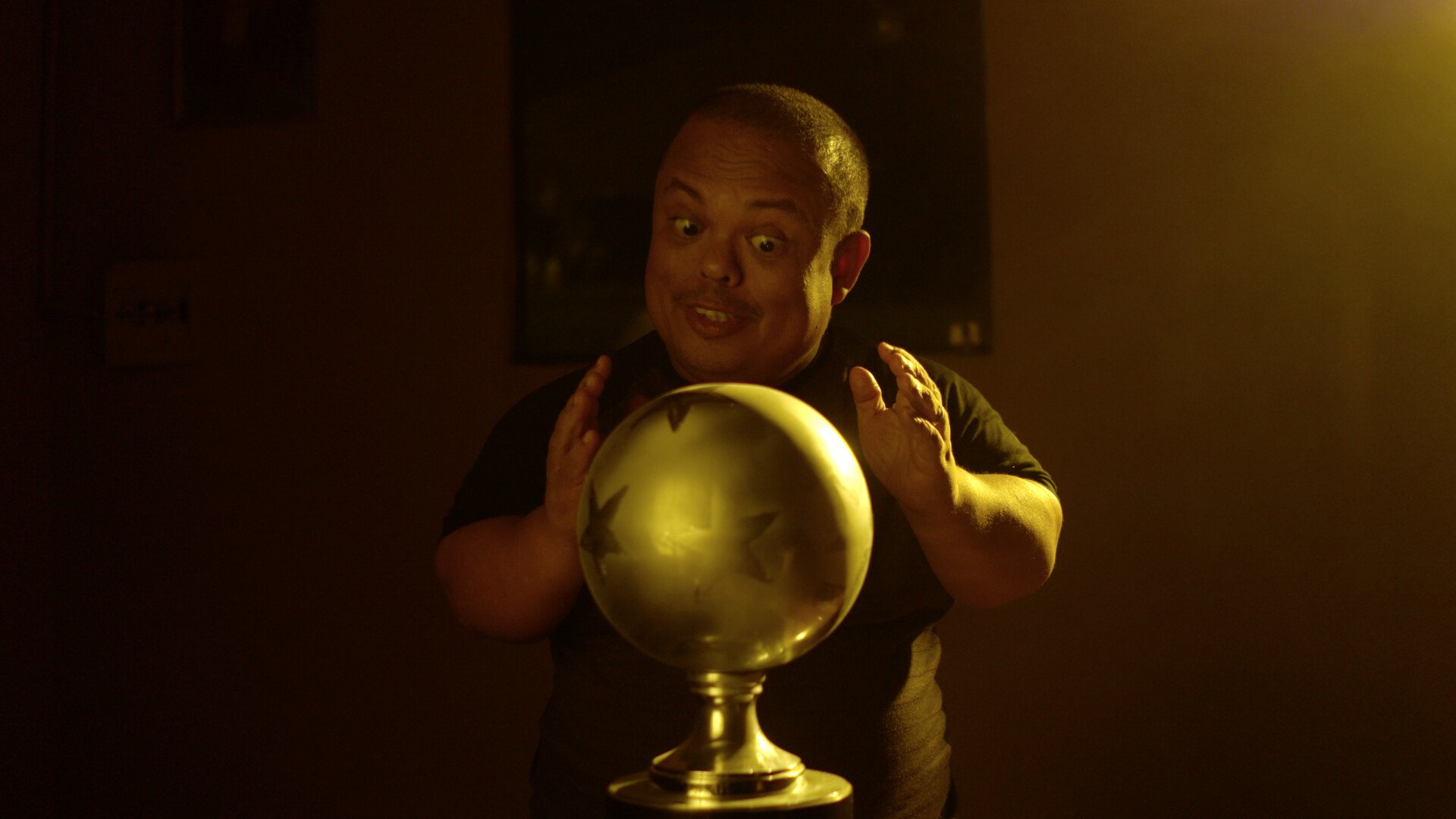
A still from I Mundialito (Small World Cup) – a film from Argentina screened at We Care Film Festival.
 B
BDisability Stories Take Centre Stage at India Habitat Centre
Films of Resilience and Identity Power We Care Festival
New Delhi: A football captain with dwarfism fighting for respect on and off the field, a transgender wheelchair user navigating identity, a girl with Down Syndrome reflecting on her place in the world, and a blind foal learning to trust again — these are among the characters drawing packed audiences to the We Care Film Festival on Disability Issues. The three-day festival opened yesterday at the India Habitat Centre in New Delhi and is running from 3 to 5 December 2025, using cinema to mark the International Day of Persons with Disabilities.
This year’s line-up consists of nine critically acclaimed films of varying formats, lengths and styles.
Highlights include:
- Stride (India, directed by G. Bhargava Rao), which sensitively examines the intersection of disability and transgender identity, portraying the lives of marginalised communities with nuance and empathy.
- Lurgtrum (Russia), which explores themes of disability and animal welfare through the story of a blind foal born in the Tver region, offering a tender reflection on vulnerability and care.
- Cesare Cicardini, a poignant portrayal of the inner thoughts and emotions of a person with Down Syndrome, providing a rare and intimate perspective on daily life and personal aspirations.
- I Mundialito (Small World Cup, Argentina, 2023, directed by Marcel Czombos), which follows the captains of dwarfism football teams as they compete. The documentary skillfully weaves themes of disability, resilience, and the love of sport, while addressing the societal challenges faced by people living with achondroplasia, including ridicule and marginalisation.
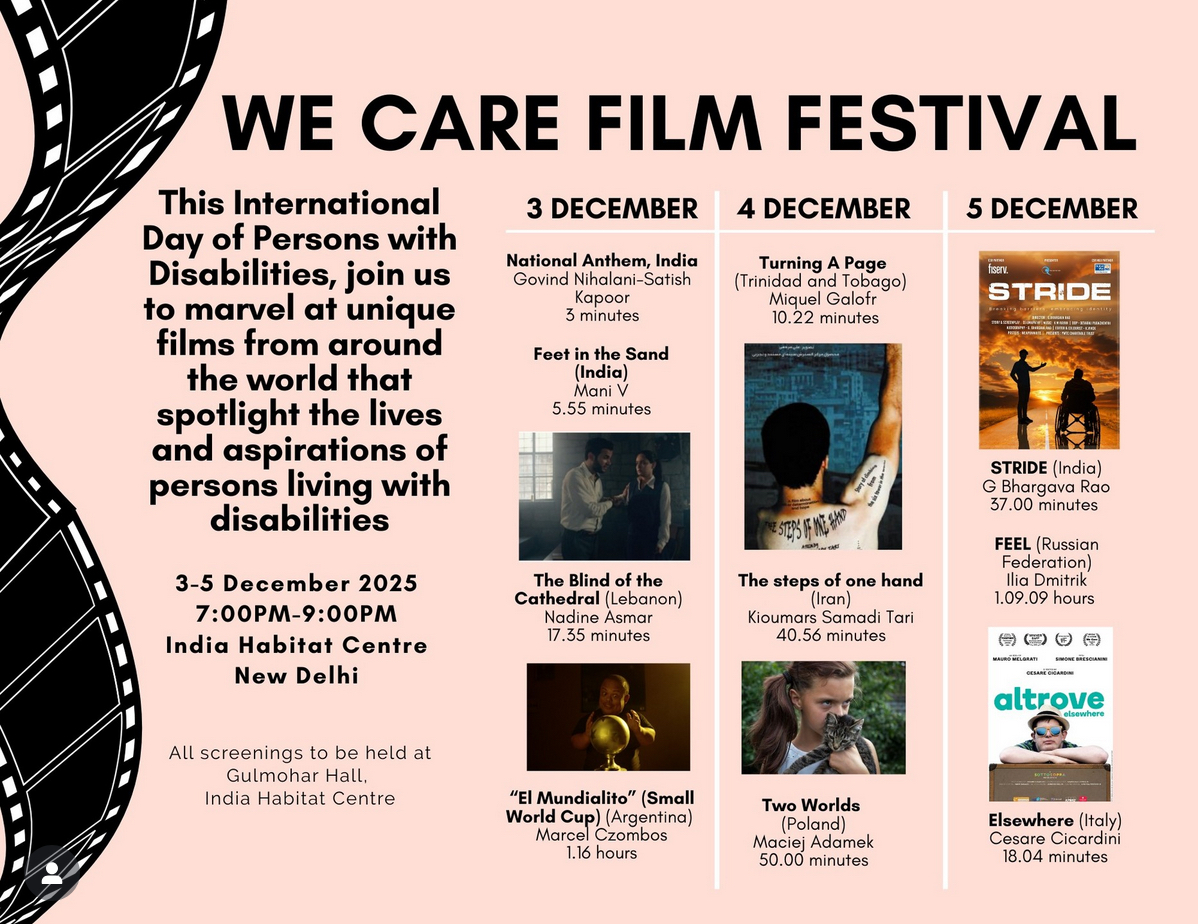
The festival opened with National Anthem from India, a compact three-minute work by Govind Nihalani and Satish Kapoor. It was followed by Feet in the Sand (India; 5.55 minutes), Mani V’s reflection on mobility, memory and self-worth. Lebanese filmmaker Nadine Asmar’s The Blind of the Cathedral (17.35 minutes) brought a contemplative lens to grief, spirituality and disability in fragile surroundings.
The following day, Trinidad and Tobago’s Turning A Page (10.22 minutes) offered audiences a real-time portrait of rehabilitation and learning after a life-altering medical event. Iran’s The Steps of One Hand (40.56 minutes) introduced viewers to a protagonist whose resourcefulness in everyday life becomes a quiet but powerful form of resistance. Polish filmmaker Maciej Adamek’s Two Worlds (50 minutes) traced an intimate family dynamic where a hearing daughter becomes the bridge between her deaf parents and the outside world.
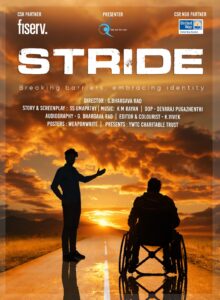 Among the most talked-about titles this season is Stride (India; 37 minutes), directed by G. Bhargava Rao. With the tagline “Breaking barriers, embracing identity,” the film focuses on the intersection of disability and transgender identity, a space cinema rarely approaches with nuance. Its reception on opening night suggested that audiences were ready for narratives that do not sanitise struggle but illuminate dignity. Russia’s Feel (1 hour 9 minutes) and Italy’s Elsewhere (18.04 minutes) complete the programme, offering meditations on self-expression and belonging through sharply different cinematic vocabularies.
Screenings are free and take place from 7:00 PM to 9:00 PM at Gulmohar Hall of the India Habitat Centre, a fully wheelchair-accessible venue. Organised jointly by the Brotherhood, the United Nations Information Centre for India and Bhutan, and the Apeejay Institute of Mass Communication, the festival drew a diverse crowd of students, parents, disability advocates, filmmakers and curious first-timers.
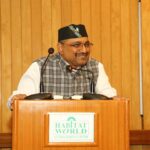
The festival was jointly inaugurated by Prof. K. G. Suresh, Director of the India Habitat Centre; Darrin Farrant, Director of the United Nations Information Centre for India and Bhutan; and Stuti Kacker, former Secretary to the Government of India and former Chairperson of the National Commission for Protection of Child Rights.
Each of the speakers stressed that films like these play a crucial role in questioning stereotypes and broadening public imagination.

Darrin Farrant pointed out that the festival also brings visibility to the often-unnoticed contributions of disabled cast and crew in cinema production. He emphasised that festivals such as We Care play a dual role: raising awareness about the challenges faced by the differently-abled community, whilst also showcasing the vast talent pool of differently-abled cast and crew involved in filmmaking. “This goes a long way in sensitising mainstream society and promoting inclusivity,” he added.
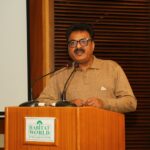
Prof. K. G. Suresh described festival director Satish Kapoor as a “one-man army,” keeping the issue of disability at the forefront of public consciousness in India through cinema across multiple platforms despite numerous challenges.

Stuti Kacker highlighted the role of mass media in creating awareness. Drawing on her experience establishing the Department of Disability Affairs at the Ministry of Social Justice & Empowerment, she cited the Bollywood film Taare Zameen Par as an example of how mainstream cinema can sensitively highlight learning disabilities such as dyslexia, reaching millions and inspiring greater understanding.
Anchoring the event is the larger spirit of the International Day of Persons with Disabilities, observed annually on 3 December, which underscores the right to equal opportunity in education, employment, culture and public life. What keeps the momentum alive at We Care is not messaging alone but the emotional register of the films themselves. Audiences are reminded that disability is not a single monolithic experience but many lives, talents and aspirations unfolding in different directions.
For many viewers last night, the festival worked less like a social campaign and more like a window into lives that deserve to be seen without sentimentality or condescension. In bridging that distance between viewers and the screen, the festival hopes to ensure that conversations about accessibility and inclusion do not end when the auditorium lights come back on.
The We Care Film Festival stands as a testament to the power of cinema to transform perceptions and foster inclusion. By showcasing diverse stories of ability, resilience, and creativity, the festival not only celebrates the talents of persons with disabilities but also encourages society at large to embrace accessibility, empathy, and equality. Through such initiatives, organisers hope to ensure that the voices and experiences of the differently-abled are recognised, understood, and valued across all platforms of public life.