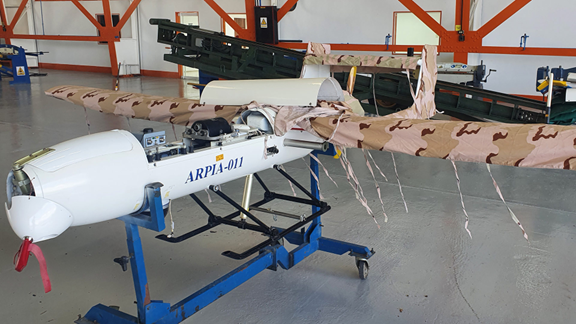
Partially Assembled Mohajer-2 UAV at El Libertador Air Base
U.S. Sanctions Iran-Venezuela Drone and Missile Networks
Treasury Sanctions Iran-Linked Combat Drone Transfers
Washington: The United States today announced a new round of coordinated sanctions targeting what officials described as an expanding Iran–Venezuela weapons nexus, moving simultaneously through diplomatic, financial, and legal channels to disrupt Tehran’s unmanned aerial vehicle (UAV) supply chains and missile procurement networks. The measures, unveiled by the State Department and the Treasury Department’s Office of Foreign Assets Control, designate ten individuals and entities based in Iran and Venezuela for their roles in facilitating the sale, production, and sustainment of Iranian-designed combat drones and missile-related materials.
At the centre of the action is Venezuela-based Empresa Aeronautica Nacional SA, a state-linked aviation firm that U.S. authorities say has played a direct role in acquiring, assembling, and maintaining Iranian unmanned aerial vehicles for the Venezuelan armed forces. According to U.S. officials, the company has overseen the assembly of Mohajer-series drones designed by Iran’s Qods Aviation Industries and has negotiated transactions contributing to the sale of millions of dollars’ worth of Mohajer-6 combat UAVs. These drones, which carry intelligence, surveillance, and reconnaissance capabilities, are rebranded in Venezuela as the ANSU series and form a core part of Caracas’ growing drone fleet.
The Mohajer-6, produced by Qods Aviation Industries, is part of a broader family of Iranian UAVs that U.S. authorities say have been proliferated in defiance of international restrictions. Qods Aviation Industries was designated by OFAC in October 2023 for operating under the ownership or control of Iran’s Ministry of Defence and Armed Forces Logistics, itself sanctioned in September 2020 for materially contributing to Iran’s arms transfers. Both entities are subject to asset freezes under United Nations Security Council Resolution 1737 and Resolution 1747, which impose binding restrictions on Iran’s defence-related activities.
U.S. officials say Empresa Aeronautica Nacional SA also maintains earlier Iranian drone models operated by Venezuela, including the Mohajer-2 derivative known locally as the Arpia or ANSU-100. The ANSU-100 represents an armed evolution of Venezuela’s first domestically produced drone and is capable of launching Iranian-designed Qaem air-to-ground guided bombs, underscoring the operational shift from surveillance to strike capability. The company’s chair, Jose Jesus Urdaneta Gonzalez, was designated alongside the firm for coordinating directly with Iranian and Venezuelan military officials on UAV production and sustainment.
Beyond drones, the sanctions extend deep into Iran’s missile procurement ecosystem. OFAC designated three Iran-based individuals and associated entities involved in efforts to acquire key chemicals for Parchin Chemical Industries, a subsidiary of Iran’s Defence Industries Organisation. These materials include sodium perchlorate, sebacic acid, and nitrocellulose, all of which are used in the manufacture and enhancement of solid-propellant rocket motors commonly employed in ballistic missiles. Sodium perchlorate is a precursor for ammonium perchlorate, a Missile Technology Control Regime–controlled chemical, while sebacic acid and nitrocellulose improve propulsion efficiency and performance.
Parchin Chemical Industries was designated under Executive Order 13382 in 2008, and the Defence Industries Organisation was designated a year earlier, both for their roles in weapons of mass destruction–related proliferation. In addition to U.S. sanctions, both entities remain subject to United Nations asset freezes under Security Council resolutions adopted in response to Iran’s nuclear and missile activities. U.S. authorities allege that Mostafa Rostami Sani, acting through a network of intermediaries and front companies, procured dozens of metric tons of controlled chemicals for Parchin Chemical Industries and coordinated closely with previously sanctioned foreign facilitators.
The action also targets a cluster of Iranian high-technology firms tied to the Islamic Revolutionary Guard Corps’ aerospace and unmanned systems programmes. OFAC designated multiple entities and individuals associated with the Rayan Fan Group, a holding company whose subsidiaries have produced UAV components and aerospace software for the IRGC. Officials said these firms provided technical support critical to Iran’s drone development and broader asymmetric weapons capabilities, reinforcing Washington’s assessment that Iran’s military-industrial complex relies heavily on layered corporate structures to evade sanctions.
In announcing the measures, U.S. officials framed the Iran–Venezuela arms relationship as a direct threat not only to regional stability but to U.S. interests in the Western Hemisphere and the homeland itself. Treasury officials said Iran’s UAV and missile programmes have already endangered U.S. and allied personnel in the Middle East and contributed to instability in commercial shipping lanes in the Red Sea, while the transfer of conventional weapons to Caracas represents a growing security concern closer to U.S. borders.
The sanctions form part of a broader enforcement push following the reimposition of United Nations sanctions and restrictions on Iran on September 27, 2025. Both the State and Treasury Departments described the designations as a continuation of nonproliferation actions taken in October and November, signalling a sustained effort to translate renewed international restrictions into operational pressure. The measures are grounded in National Security Presidential Memorandum 2, which directs U.S. agencies to curtail Iran’s ballistic missile programme, counter its asymmetric and conventional weapons development, deny Tehran a nuclear weapon, and deprive the Islamic Revolutionary Guard Corps of financial and material support.
Legally, the actions were taken under Executive Orders 13382 and 13949, authorities that allow the United States to block property and interests in property of weapons proliferators and those supporting Iran’s conventional arms activities. As a result, all assets of the designated persons within U.S. jurisdiction are frozen, and U.S. persons are generally prohibited from engaging in transactions involving those assets without specific authorisation. Any entities owned, directly or indirectly, 50 per cent or more by designated persons are also automatically blocked.
OFAC warned that sanctions violations may result in civil or criminal penalties, with civil enforcement operating on a strict liability basis, meaning penalties can be imposed regardless of intent. Financial institutions and non-U.S. persons may also face exposure to secondary sanctions for knowingly facilitating significant transactions on behalf of designated entities, including restrictions on maintaining correspondent or payable-through accounts in the United States.
At the same time, Treasury officials reiterated that the objective of sanctions is behavioural change rather than punishment. OFAC noted that its authority includes the ability to remove individuals and entities from the Specially Designated Nationals List when legal criteria are met and that a formal petition process exists for parties seeking delisting. The emphasis, officials said, is on compelling compliance with international norms governing weapons proliferation.
Taken together, the measures reflect a sharpened U.S. focus on interdicting Iran’s weapons networks across regions, from Latin America to the Middle East, using a combination of executive authority, international law, and financial enforcement. As Iran deepens defence cooperation with partners such as Venezuela, U.S. officials signalled that sanctions will remain a primary instrument for constraining what they describe as destabilising and unlawful arms transfers.
– global bihari bureau