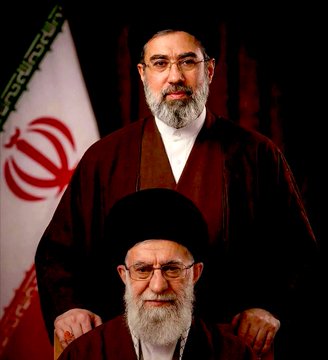
A file photo of Mojtaba Khamenei with his late father Ali Khamenei. Source: X
Iran Names Mojtaba Khamenei as War Escalates
Mojtaba Khamenei Ascends as Iran Faces Multi-Front War
Tehran/Washington/Jerusalem: Iran has officially appointed Mojtaba Khamenei as the country’s new supreme leader following the death of his father, Ali Khamenei, during the opening Israeli and U.S. strikes on February 28. The appointment was confirmed by Iran’s Assembly of Experts shortly after midnight in Tehran on March 9, 2026, and announced publicly in the early hours of the morning. The Assembly of Experts, an 88-member body of senior clerics constitutionally responsible for selecting and supervising the nation’s supreme authority, declared that Mojtaba Khamenei had been chosen by a decisive vote, calling on all Iranians to unite behind him as the country faces external aggression and an ongoing war.
Mojtaba Khamenei, 56, is a low-profile but powerful figure in Iran’s political and security establishment. Unlike his father, he has never held an elected office or a senior public role. Yet, he has cultivated extensive ties with the Islamic Revolutionary Guard Corps and other security institutions and has played a decisive behind-the-scenes role for years. Analysts note that these connections likely secured his support among senior clerics and military leaders during the emergency succession, ensuring continuity in Iran’s leadership at a moment of unprecedented crisis. The appointment has drawn widespread commentary describing it as a dynastic or hereditary shift, a sharp irony in a system founded on revolutionary anti-monarchy principles, yet Iranian authorities frame it as a move to safeguard stability amid war.
The transition occurred against the backdrop of an intensifying conflict that began on February 28, when joint U.S.-Israeli strikes killed Ali Khamenei and targeted Iran’s strategic nuclear and military infrastructure. Within hours of Mojtaba’s appointment, Iran launched its first direct missile and drone barrage against Israel, including ballistic missiles reportedly of Emad and Qadr types with Khaibar warheads. Sirens blared across Israeli cities, including Jerusalem, with reports of explosions in central areas. Concurrently, missiles and drones struck Gulf targets, hitting facilities in the United Arab Emirates, Bahrain, Saudi Arabia, Qatar, Kuwait, and Oman. Two fatalities were reported in Saudi Arabia, and the refinery and oil/water infrastructure suffered damage. These immediate retaliatory strikes underscore Tehran’s determination to respond decisively to both the leadership transition and ongoing military operations.
The Iranian leadership’s rapid consolidation was evident as the IRGC, armed forces, and senior officials, including President Pezeshkian and Foreign Minister Araghchi, publicly pledged complete allegiance and self-sacrifice to Mojtaba Khamenei. Pro-regime rallies erupted in Tehran and other cities, with citizens waving flags and celebrating what state media termed “a new era of dignity.” This rapid alignment demonstrates the hardline continuity within Iran’s power structures and suggests that hopes for internal fragmentation or moderation are unlikely in the immediate term. Analysts also highlight the personal stakes for Mojtaba Khamenei: reports indicate that he lost multiple family members—including his mother, wife, and sister—in the initial February 28 strikes, a factor shaping both internal political determination and Iran’s uncompromising posture.
Israeli Prime Minister Benjamin Netanyahu, in a series of statements, described the ongoing operations as essential for Israel’s survival. He claimed that Israeli and U.S. forces had achieved near-total control of Iranian airspace, neutralised senior Revolutionary Guard officials, and degraded Iran’s nuclear, missile, and military infrastructure. Netanyahu said the operations also targeted Hezbollah in Lebanon, Hamas in Gaza, and the regime in Syria, framing the campaign as a multi-front effort to reshape regional power dynamics. He urged the Iranian people to “take their destiny into their own hands” and indicated that Israel’s operations would continue without pause until perceived threats were neutralised. Israeli forces additionally launched overnight strikes in Tehran, Qom, and other Iranian cities, hitting military and energy infrastructure and causing explosions and toxic smoke plumes. Netanyahu also reported ongoing operations to locate long-missing Israeli personnel, including navigator Ron Arad, highlighting Israel’s continued commitment to its strategic and historical objectives.
The United States, meanwhile, confirmed additional military casualties during the latest phase of the conflict, including the death of an eighth service member in attacks on regional bases. Former President Donald Trump reacted sharply to Mojtaba Khamenei’s appointment, calling it “unacceptable” and warning that the new leader would not “last long” without U.S. involvement. He reiterated joint U.S.-Israeli coordination in the conflict and suggested that regime change in Iran remains an active objective, raising the stakes for the nascent leadership in Tehran.
The conflict’s impact on the global economy and energy markets has been profound. Oil prices surged past $110–$117 per barrel in early March 9 trading, reflecting halted tanker traffic through the Strait of Hormuz and disrupted maritime supply, which accounts for roughly 20 per cent of global crude flows. Additional attacks on energy infrastructure in Iran and the Gulf have heightened fears of prolonged supply shocks, with analysts warning that Brent and WTI prices could spike further if disruptions continue. Maritime incidents, including damaged vessels, have compounded concerns, and global financial markets have reacted with increased volatility.
Across the region, Iranian and proxy activity has expanded beyond the immediate U.S.-Israel confrontation. Hezbollah has intensified clashes along Israel’s northern border, Houthis have signalled engagement, and strikes or attempted strikes on Gulf states hosting Western military facilities have been reported. Security analysts caution that ongoing instability along the Afghanistan-Pakistan border and other South Asian hotspots could intersect with the wider Middle Eastern conflict, raising the risk of a broader regional crisis.
Iran has framed its actions as legitimate self-defence under Article 51 of the United Nations Charter, emphasising that U.S. forces have used neighbouring states’ airspace and territory for strikes on Iran, endangering regional security. Iranian officials argue that attacks on fuel depots and energy infrastructure constitute defensive measures against economic and environmental warfare, and they assert that all measures taken are proportionate to the aggression faced. Tehran has also stressed its commitment to maintaining friendly relations with regional states based on mutual respect, despite the ongoing operations.
For Mojtaba Khamenei, the immediate challenges are immense. He must consolidate authority over Iran’s complex political, clerical, and military institutions while overseeing a country under direct attack, facing rising casualties, economic disruption, and potential internal dissent. His personal losses in the February 28 strikes add a layer of intensity to Iran’s military posture, and the pledges of allegiance by hardline elements suggest that policy continuity and resistance to compromise will define his early tenure. International observers note that the dynastic nature of the succession, combined with the ongoing war, marks a critical juncture for both Iran and the broader Middle East.
The crisis shows no immediate signs of abating. Israel and the U.S. continue targeted operations, Iran and its proxies are responding with missile and drone strikes, regional spillover is expanding, and global energy markets are under strain. The conflict, now entering a crucial post-appointment phase, threatens to become a prolonged, multi-front geopolitical flashpoint with implications for regional stability, energy security, and international diplomacy. Analysts and governments continue to monitor developments closely, noting that the actions in the next days and weeks could define the balance of power in the Middle East for years to come.
– global bihari bureau