 By Deepak Parvatiyar*
ECI’s Defence: Trust or Trap?
New Delhi: Just days ago, the Election Commission of India (ECI) fired back at critics, insisting its purge of 65 lakh voters from Bihar’s rolls is transparent and constitutional—a bold claim now under the Supreme Court’s microscope as the state’s elections loom. The Court’s August 14, 2025, order, demanding searchable deletion lists by August 19 and a compliance report by August 22, thrusts the ECI into a high-stakes test: can its rapid response and clarifications quell a rising tide of distrust, or will they reveal a system struggling to uphold democratic fairness?
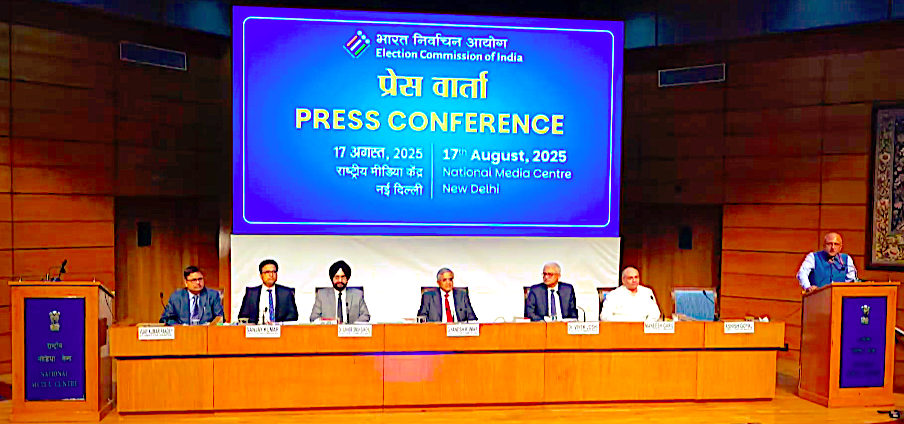
The ECI’s Special Intensive Revision (SIR), which cut millions from Bihar’s voter rolls since January 2025, has sparked accusations of disenfranchising migrants, minorities, and opposition voters, threatening the integrity of the upcoming assembly polls. The Supreme Court, led by Justice Surya Kant, ordered the ECI to publish booth-wise deletion lists—specifying reasons like death, migration, or duplicates—accessible online by EPIC number. Public notices must flood vernacular media, radio, TV, and social platforms, with Aadhaar enabling challenges until September 1, 2025. Citing a “trust deficit,” the Court aims to protect vulnerable voters, like migrant workers, from bureaucratic barriers. The ECI complied within 56 hours, uploading lists to district and state electoral websites, as confirmed by Chief Election Commissioner Gyanesh Kumar on August 17.
The ECI’s August 16 and 17 clarifications have stirred the pot. On August 16, it dismissed a viral AI-generated video shared by the Congress party as misleading, insisting the SIR involves Sub-Divisional Magistrates, Booth Level Officers, electors, and parties transparently. On August 17, Kumar rejected demands for polling station CCTV footage or machine-readable voter lists, citing privacy and a Supreme Court order, and called opposition claims of “vote theft”—including a 1.5 lakh voter fraud allegation—an “insult to the Constitution.” He urged affidavit submissions for irregularities and clarified Aadhaar’s role in contesting deletions. These statements, meant to restore confidence, face backlash amid social media outcry, with thousands of negative comments on the ECI’s YouTube press conference video reflecting persistent distrust.
Politically, the divide is sharp. Opposition leaders, citing 2024 election errors like mismatched voter data, demand digital audits, while the ruling coalition defends the SIR as routine, accusing rivals of fueling distrust. Public frustration—evident in complaints about wrong photos or deceased voters listed—amplifies the stakes. The August 22 hearing could set a nationwide standard for roll revisions, potentially mandating tech-driven audits or standardised processes.
A related case provides context: the 2023 Chief Election Commissioner Act, replacing the Chief Justice of India with a government-nominated minister in the ECI’s appointment panel, faces Supreme Court review for clashing with the 2023 Anoop Baranwal verdict, which mandated a panel of the Prime Minister, Leader of Opposition, and Chief Justice to ensure ECI independence. Deferred since May 14, 2025, it underscores fears of eroded independence, colouring perceptions of the Bihar crisis.
The human toll—migrant workers fighting to reclaim voting rights—meets systemic questions: can the ECI’s compliance and clarifications rebuild trust, or will they fall short? A strong August 22 ruling could drive reforms like digital voter verification or independent oversight, aligning India with global electoral norms, such as those in South Africa or Canada, where autonomous commissions and transparent data bolster voter confidence. Inaction risks entrenching doubts, casting shadows over every ballot.
As Bihar’s polls approach, the ECI’s moves and the Court’s verdict will signal whether India’s democracy can fortify its core or face deeper fractures.
*Senior journalist