Plan Drives e-Access, Inclusion Steps
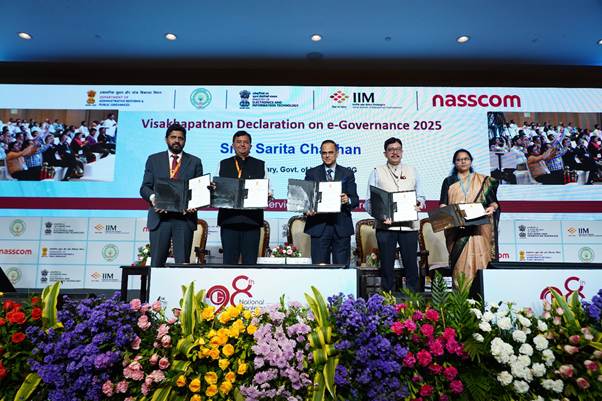
Visakhapatnam: A strategy to enhance India’s e-governance through civil service reforms, AI adoption, and inclusive digital access was formalised in the Visakhapatnam Declaration, adopted to support the “Viksit Bharat 2047” vision. Concluded on Tuesday, September 23, 2025, the 28th National Conference on e-Governance (NCeG), co-hosted by the Department of Administrative Reforms and Public Grievances (DARPG), the Ministry of Electronics and Information Technology (MeitY), and the Government of Andhra Pradesh, convened in Visakhapatnam for two days to shape this plan.
Anchored by the theme “Viksit Bharat: Civil Service and Digital Transformation,” the conference aligned with the principle of “Minimum Government, Maximum Governance.” Delegates from 18 ministries, states, and union territories examined technologies such as artificial intelligence, machine learning, blockchain, geographic information systems, the Internet of Things, and data analytics to enhance governance efficiency and transparency. Proposals include scaling AI-driven platforms such as Digital India BHASHINI for multilingual communication, Digi Yatra for streamlined travel, and NADRES V2 for disaster management, with a focus on ethical and transparent implementation for sector-specific services.
State-level initiatives identified for national replication include Madhya Pradesh’s SAMPADA 2.0 for industrial land allocation, Bengaluru’s eKhata for digital property tax management, Maharashtra’s Rohini Gram Panchayat for rural e-services, and the National Highways Authority of India’s Drone Analytics Monitoring System (DAMS) for infrastructure oversight. Grassroots models from panchayats in Rohini (Maharashtra), West Majlishpur (Madhya Pradesh), Suakati (Odisha), and Palsana (Gujarat) were cited for their effective digital service delivery, with plans to expand these nationwide to bolster local governance.
Efforts to bridge connectivity gaps target regions like the North-East and Ladakh through mandatory e-services under the National e-Services Delivery Assessment (NeSDA) framework. Digital literacy programmes for women, youth, and marginalised communities aim to ensure equitable participation. Cybersecurity measures, including Zero-Trust architecture, post-quantum encryption, and AI-driven monitoring, are specified to protect sectors such as transportation, defence, and public services. Support for the National Agri Stack rollout seeks to provide farmers with access to credit, advisories, and markets, while promoting climate-smart farming practices.
V. Srinivas, DARPG Secretary, speaking at the valedictory session, praised Andhra Pradesh for hosting the conference in Visakhapatnam, a shift from state capitals, and described it as one of the most substantive e-governance gatherings recently. He congratulated the 2025 National e-Governance Awards recipients for their digital innovations and launched the 2026 awards website, encouraging nominations. Srinivas highlighted Andhra Pradesh’s real-time governance and WhatsApp-based service delivery as replicable models, expressing gratitude to officers and partner institutions for their year-long efforts in organising the event.
A whole-of-government approach is advocated to equip civil services with digital competencies and agile, data-driven frameworks. Collaboration among government, industry, academia, start-ups, and civil society is urged to co-create scalable solutions for challenges like urban mobility, healthcare access, and environmental monitoring. Andhra Pradesh’s vision to position Visakhapatnam as a premier IT and innovation hub through investments in infrastructure, special IT zones, and industry-academia partnerships is endorsed.
Sarita Chauhan, DARPG Joint Secretary, read the declaration, while S.N. Tripathi, Director General of the Indian Institute of Public Administration, emphasised administrative capacity-building. K. Bhaskar, Andhra Pradesh’s Secretary for IT, Electronics and Communications, highlighted local digital initiatives like the Real-Time Governance Society, which enhances citizen services through real-time monitoring and feedback.
Attendees stressed that emerging technologies must serve as enablers of transparent, sustainable, and citizen-focused governance, with cybersecurity, digital trust, and resilient infrastructure as national priorities. The conference pledged to strengthen ties between government, industry, academia, start-ups, and civil society to develop scalable digital solutions. The Visakhapatnam Declaration outlines steps for India’s e-governance efforts, aiming to enhance service delivery and citizen empowerment through accessibility, security, and innovation.
– global bihari bureau