 By Vidyadhar Date*
Bullocks, Sandal and Streets: Mumbai’s Living Tradition
Mahim Urs: Colour, Devotion and Quiet Civic Rituals
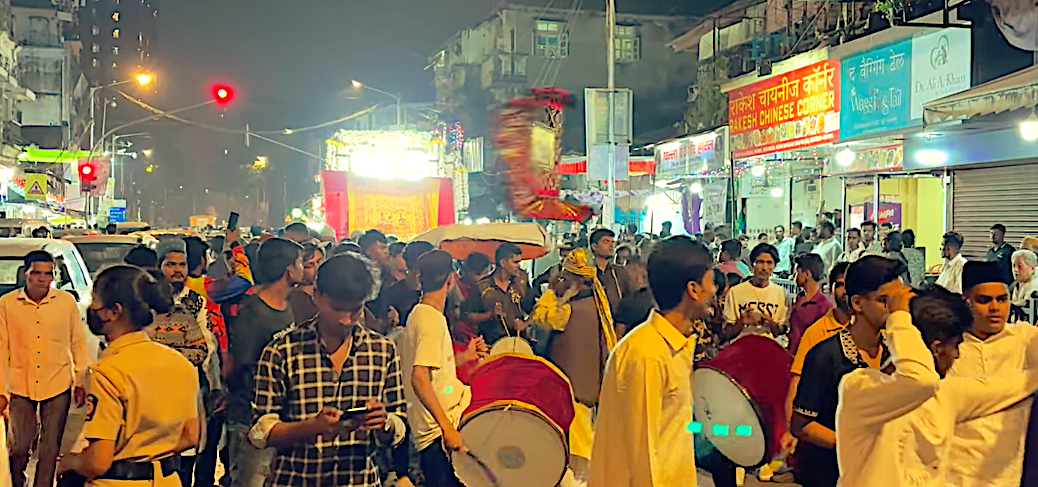
Mumbai: I noticed several processions moving steadily towards the Mahim dargah last evening as the annual Urs of the Sufi saint gathered momentum. The scene was rich with colour but mercifully restrained in sound. Near the shrine, the lanes were thick with people, and the presence of food stalls and old eateries added their own quiet seduction to the air. It was one of those evenings when the city feels dense yet oddly unhurried.
What caught my attention most was the manner in which the processions were led. At their head were bullock carts, moving at an unforced pace, clearly chosen to honour custom rather than convenience. In a city where most public religious gatherings now rely on motorised vehicles and sound systems, the sight felt almost defiant in its simplicity.
These were sandal processions — offerings carried during Urs in which fragrant sandalwood paste, flowers and cloth coverings are taken in slow ceremonial movement to the saint’s tomb. The ritual has long been part of the Mahim observance, drawing participants from different neighbourhoods and backgrounds. The emphasis is not spectacle but reverence: measured steps, subdued music, incense rather than amplification.
The streets around the dargah were crowded but not chaotic. Volunteers and police personnel quietly guided people along narrow passages, regulating the flow without drawing attention to themselves. Temporary traffic restrictions had clearly been put in place, allowing the processions to move without confrontation between pedestrians and vehicles — no small achievement in that part of the city.

This is what gives Mumbai its occasional moments of grace. For most of the year, the city’s streets are synonymous with congestion, impatience and noise. Yet on evenings like this, tradition interrupts the routine. The presence of ritual slows time, offering people a shared pause in otherwise difficult urban lives. Western cities long ago smoothed out such interruptions; their streets are efficient, predictable, and emotionally neutral. Ours, for all their dysfunction, still allow space for inherited rhythms.
The sandal procession itself represents more than religious observance. At Mahim, it has historically involved participation across communities, including the local police station, which continues to play a visible organisational role. This blending of civic authority with faith-based practice is neither forced nor performative; it has grown organically over decades.
Some observers object to the presence of animals on public roads, arguing that streets should exist exclusively for motor traffic. Such objections ignore the obvious: cars pollute, occupy disproportionate space, and impose invisible costs on everyone else. The bullocks I saw were not overworked or distressed; they were decorated, unhurried, and treated with care.
India’s traditional relationship with domesticated animals has many flaws, but it is not one of casual cruelty. There are days in the calendar when animals are relieved of labour and ritually honoured — Pola in Maharashtra being one example. Similar observances exist across regions, reflecting an understanding that animals are participants in social life, not merely tools.
This contrasts sharply with the West’s historical treatment of animals in public sport. Bullfighting, even in its supposedly refined variants, has normalised violence for entertainment. Horse racing, too, hides its cruelties behind glamour and betting, far from public view.
Earlier this week, I happened to watch a film at Alliance Française that echoed these concerns. The film follows a woman who enters a male-dominated bull sport and gradually begins to see events from the animal’s perspective. As the narrative unfolds, the consequences of ignoring that perspective become impossible to dismiss.
The film, Animale, is set against a regional bull tradition that claims to avoid bloodshed. Yet the story exposes the strain imposed on animals when spectacle overrides empathy. The bulls, pushed beyond tolerance, retaliate — a reminder that violence, even when ritualised, leaves scars.
Defenders of European bull sports often cite their non-lethal variants as evidence of reform. Yet the broader picture remains bleak. Hundreds of thousands of bulls are killed each year worldwide in festival contexts, and many countries have responded by banning such practices outright. Even in places where bullfighting remains legal, several cities have chosen to end it.
Against this backdrop, the evening at Mahim felt instructive rather than nostalgic. Here was a ritual that involved animals without exploiting them, faith without aggression, crowds without cacophony. The bullock carts moved on, the sandal offerings passed hand to hand, and the city briefly remembered an older way of being together — imperfect, slow, and quietly humane.
*Senior journalist