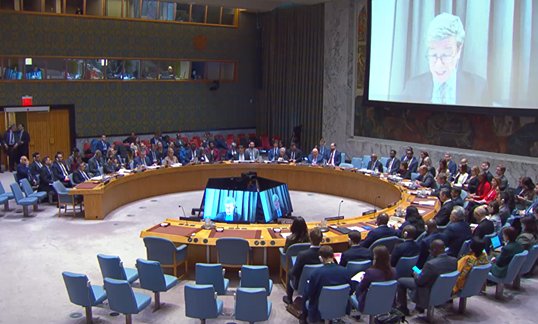
The UNSC Emergency Meeting on Venezuela today. ©UN Web TV
Venezuela Debate Signals Strain on Rules-Based Order
UN Security Council Divided Over Use of Force in Venezuela
UN Warns Venezuela Action Could Redefine State Sovereignty
Venezuela Exposes Deep Fault Lines Among Global Powers
New York: The emergency meeting of the United Nations Security Council (UNSC) on Venezuela on January 5 exposed a world no longer divided simply between intervention and non-intervention, but fractured along lines of geography, power, precedent and perceived legitimacy. What unfolded in the chamber was less a debate about Nicolás Maduro as an individual than a test of whether force, coercion and extraterritorial action can be normalised when political objectives align with strategic interests.
That tension was set early in the session by Under-Secretary-General for Political and Peacebuilding Affairs Rosemary DiCarlo, speaking on behalf of Secretary-General António Guterres, who warned the Council that it was meeting “at a grave time” following the January 3, 2026, United States military action in Venezuela, cautioning that the episode risked setting a dangerous precedent for international relations.
DiCarlo told the Council that early on January 3, United States forces were active across Caracas and in the northern states of Miranda, Aragua and La Guaira, adding that “the extent of casualties resulting from these actions remains undetermined.” She noted that President Donald Trump had publicly announced a “large-scale strike against Venezuela, and its leader, President Nicolás Maduro,” and had later stated that the United States would “run the country until such time that we can do a safe, proper and judicious transition.”
According to DiCarlo, Venezuelan authorities characterised the operation as a military aggression carried out in civilian and military areas and as a flagrant violation of the UN Charter. As the meeting convened, President Maduro and his wife, Cilia Flores, were being held in New York on criminal charges brought by U.S. authorities.
Latin America: Resistance to Militarisation, Not Unity on Maduro
From Latin America, the strongest institutional resistance to the United States’ action came from countries that framed Venezuela not as an ideological ally or adversary, but as a regional stability problem that must not be militarised.
Brazil rejected the intervention outright. Its representative, Sérgio França Danese, stressed that “South America is a zone of peace,” warning that bombings on Venezuelan territory and the capture of its president crossed an unacceptable line under international law. Mexico similarly argued that the Security Council has an obligation to act “without double standards,” cautioning that regime change imposed through force and extraterritorial measures has historically exacerbated conflicts and weakened societies.
Chile drew a sharp distinction between political condemnation and military action. While explicitly stating that Santiago does not recognise the Maduro government, its delegate emphasised that “the serious violations of human rights… do not have a military solution,” urging de-escalation, elections and citizen participation. Colombia focused on immediate regional consequences, warning that the Charter permits the use of force only in exceptional circumstances, such as self-defence, and that uncertainty could trigger new migratory flows with high humanitarian costs.
Cuba adopted the most confrontational tone from the region, accusing Washington of “hegemonic and criminal plans” and describing the seizure of Maduro and Cilia Flores as kidnapping driven by a quest for control over Venezuela’s natural resources. Although rhetorically stark, Havana’s intervention aligned with the Secretary-General’s warning that the prohibition on the use of force must not be eroded by selective application.
Argentina stood apart. Its representative welcomed President Trump’s “decisive action,” arguing that it could help end repression and drug trafficking linked to Venezuela, while urging international support for a peaceful transition and calling attention to an Argentine citizen detained in Venezuela since 2024. The divergence highlighted how sharply regional consensus fractures when assessments of Maduro’s legitimacy override concerns about method.
Europe: Legitimacy vs. Law
The European response in the Council split along familiar lines of legality, legitimacy, and alliance obligations. NATO members—including the United Kingdom, France, and Sweden—focused on a combination of political condemnation of Maduro’s regime and support for multilateral mechanisms, balancing critiques of governance with adherence to legal norms. The UK’s James Kariuki stated that “Maduro’s claim to power was fraudulent,” highlighting poverty, repression, and state collapse, while reaffirming the UN Charter’s principles as “essential for maintaining global peace, security and the rule of law.” France and Sweden echoed this emphasis on legitimacy but cautioned that enforcement must occur through collective action rather than unilateral force.
By contrast, non-NATO European states—such as Ireland and Latvia—with long-standing traditions of military restraint, placed greater emphasis on process, legality, and multilateral oversight. Latvia’s Sanita Pavļuta-Deslandes described the Maduro regime as rooted in corruption, organised crime, and drug trafficking, linking it to repeated violations of international law, including support for Russia’s aggression against Ukraine. At the same time, she stressed that unilateral military action undermines the international legal order. Ireland similarly underscored that respect for the Charter and the principles of international law is foundational, regardless of political preferences, warning that selective application of force risks hollowing out the very legal norms Europe relies upon as a security guarantor.
Russia, while often analysed under Asia’s strategic lens in global debates, participated in the Council through its European lens. Ambassador Vassily Nebenzia condemned the United States’ “armed aggression against Venezuela in violation of international law,” calling on members to abandon double standards and not justify “such an egregious act of aggression” out of fear of the “American global gendarme.” He emphasised that U.S. actions generate “fresh momentum for neocolonialism and imperialism,” reflecting Russia’s longstanding European security concerns and strategic positioning.
The European divide thus illustrates NATO members’ alliance-driven alignment, balancing legitimacy and legal norms, the cautious law-centric approach of non-NATO states, and Russia’s assertive stance defending sovereignty and contesting Western unilateralism—a spectrum of approaches within the European geopolitical context.
Taken together, Europe’s interventions revealed a continent wrestling with two imperatives: confronting authoritarian governance and transnational crime, while preserving the legal architecture that constrains power politics. The result was a carefully calibrated response—politically critical, legally cautious, and strategically divided.
Asia: China’s Singular Voice and Strategic Silences
Among Asian members of the Security Council, China was the only country to intervene substantively in the debate over Venezuela. Beijing’s representative condemned the United States’ actions as “unilateral, illegal and bullying acts”, accusing Washington of “wantonly trampling upon Venezuela’s sovereignty, security and legitimate rights and interests” and warning of a grave threat to peace in Latin America and beyond. China urged the United States to heed the “overwhelming voice of the international community and return to dialogue,” emphasising the importance of multilateralism over military coercion.
Other Asian UNSC members — South Korea and Pakistan — did not speak during the session. Far from indicating disinterest, their strategic silence can be interpreted as a deliberate, cautious positioning. By abstaining from public comment, these states avoided:
- Direct confrontation with the United States, a major security partner (particularly for South Korea).
- Publicly legitimising unilateral force, which could set dangerous precedents for norms they themselves rely on regionally.
- Becoming entangled in Latin American disputes that have no immediate bearing on their regional interests, while still signalling solidarity with the rules-based order through abstention.
Africa: Absence That Carries Meaning
No African Member State – Democratic Republic of the Congo, Liberia, and Somalia -addressed the Council during this emergency meeting. Yet Africa’s absence from the speakers’ list was itself noted implicitly through repeated references to selective enforcement of international law and the disproportionate impact of weakened norms on smaller and less powerful states.
These concerns—raised explicitly by Latin American, Asian and civil society speakers—resonate strongly across Africa, where memories of externally driven regime change, coercive sanctions and unilateral interventions remain acute. The repeated insistence by multiple delegations that the prohibition on the use of force must apply universally, without exception or hierarchy, implicitly reflected anxieties shared by many African states, even if not voiced directly in the chamber.
In that sense, Africa was present not through statements, but through the subtext of the debate: as a region whose security and sovereignty are deeply affected by whether international law operates as a binding framework or a discretionary tool of power.
Venezuela: Sovereignty and Precedent
Venezuela’s own intervention framed the crisis as a test of the international system itself. Samuel Moncada, Venezuela’s representative, warned the Council that not only his country’s sovereignty was at stake, but also “the credibility of international law” and the authority of the United Nations.
He said Venezuela had been subjected to an “illegitimate armed attack” by the United States on 3 January, lacking any legal justification and constituting a flagrant violation of the UN Charter, the Geneva Conventions and the principle of sovereign equality. Warning that tolerating the “kidnapping of a Head of State” and attacks on civilians would signal that “the law is optional,” Moncada argued that the aggression was driven by Venezuela’s natural resources and geopolitical position.
Law, Not Force
Civil society and independent expertise sharpened the legal stakes. Mercedes De Freitas of Transparencia Venezuela detailed how corruption and criminal networks have hollowed out state institutions, leaving citizens vulnerable to hunger, extortion and repression—undermining any claim that military force offers a solution. Jeffrey Sachs framed the issue starkly, telling the Council that the question was whether any Member State has the right “by force, coercion or economic strangulation” to determine another country’s political future, invoking Article 2(4) of the UN Charter.
Summing up the institutional anxiety running through the debate, DiCarlo warned that rules of international law had not been respected and that the situation, while critical, still allowed space to prevent a wider conflagration. The Secretary-General, she said, remained convinced that “the power of the law must prevail.”
What emerged from the chamber was not consensus, but convergence on one fear: that the prohibition on the use of force is being tested in real time. Whether the Venezuela episode becomes an exception or a template may determine not only the country’s future, but the credibility of international law itself.
– global bihari bureau