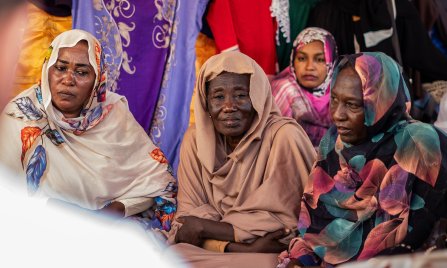
Photo source: IOM
Treasury Targets JEM Leader, BBMB Militia
Washington: The United States, Egypt, Saudi Arabia, and the United Arab Emirates issued a joint statement today outlining a detailed roadmap to restore peace and security in Sudan, a nation gripped by a civil war that erupted in April 2023 between the Sudanese Armed Forces (SAF) and the paramilitary Rapid Support Forces (RSF), leading to the world’s largest humanitarian crisis.
The conflict, rooted in a power struggle between SAF leader General Abdel Fattah al-Burhan and RSF commander General Mohamed Hamdan Dagalo, also known as Hemedti, has displaced over 14 million people—more than a quarter of Sudan’s 48 million population—and killed an estimated 150,000, with widespread reports of war crimes including ethnic massacres in Darfur, famine affecting 25 million facing acute hunger, and outbreaks of diseases like cholera that have claimed hundreds of lives since June. For ordinary Sudanese families, this means children orphaned amid rubble in Khartoum, farmers in Darfur losing livestock to siege and starvation, and refugees in camps like Zamzam facing confirmed famine conditions, where a day’s meal might be a shared handful of sorghum amid 50-degree heat and relentless shelling.
The statement, released by the U.S. State Department at 12:50 PM EDT today, followed extensive consultations among the foreign ministers of the four nations, known as the Quad, hosted by the United States. The ministers described the war as provoking the world’s worst humanitarian crisis, with grave risks to regional stability from spillover violence, refugee flows overwhelming neighbours like Chad and South Sudan, and threats to Red Sea shipping routes vital for global trade.
The principles emphasise Sudan’s sovereignty, unity, and territorial integrity as essential for peace, rejecting any fragmentation that could leave families in RSF-held areas like el-Fasher—under siege since May 2024, trapping 260,000 civilians, including 130,000 children in what UNICEF calls an “epicentre of child suffering”—cut off from aid and basic services. The ministers asserted there is no viable military solution, noting the status quo inflicts unacceptable suffering on everyday people, from market vendors in Omdurman killed in crossfire to herders in North Kordofan displaced by RSF advances that have razed villages and triggered cholera epidemics infecting over 9,000 since June. They urged all parties to ensure rapid, safe, and unhindered humanitarian access throughout Sudan via all necessary routes, protect civilians per international humanitarian law and the Jeddah Declaration, and cease indiscriminate attacks on civilian infrastructure, such as the repeated shelling of hospitals in Khartoum that has left facilities like South Hospital closed and patients like sepsis-stricken infants untreated amid looted supplies. The statement specifies that Sudan’s future governance must be determined by its people through an inclusive, transparent transition, free from control by warring factions, allowing ordinary citizens—many of whom protested for civilian rule in the 2018-2019 revolution that ousted Omar al-Bashir—to reclaim decision-making from militias that have derailed democratic hopes.
The Quad called for an immediate humanitarian truce of three months to facilitate aid delivery across Sudan, where over 30 million—two-thirds of the population—require assistance but face bureaucratic blocks and attacks on convoys that have left 7 million without support in recent months alone. This would lead directly to a permanent ceasefire, initiating a nine-month process to establish an independent, civilian-led government with broad legitimacy and accountability, crucial for long-term stability and preservation of state institutions amid a health system collapse that has idled schools for 17 million children and fueled malnutrition, killing thousands. The ministers explicitly stated that Sudan’s future cannot be dictated by violent extremist groups linked to the Muslim Brotherhood, whose influence—resurgent since Bashir’s 30-year Islamist rule ended in 2019—has fueled regional violence, obstructed ceasefires, and allied with Iran to supply drones and weapons to SAF-aligned militias, prolonging suffering for families caught in crossfire.
The ministers pledged to monitor implementation timelines closely and affirmed readiness to use good offices for full compliance, including reconvening for further steps amid stalled talks like the Jeddah process, disrupted by foreign meddling from powers like the UAE backing RSF gold smuggling and Iran aiding SAF Islamists. They highlighted that external military support to conflict parties prolongs the war and exacerbates regional instability, deeming an end to such aid essential, as seen in RSF’s UAE-supplied armoured vehicles and SAF’s Iranian drones that have bombed markets, killing dozens in a single September airstrike. Additional commitments include exerting efforts for a negotiated settlement involving SAF and RSF, pressing parties to safeguard civilians and infrastructure while ensuring aid reaches those in need—like the 2.6 million returnees from Pakistan and Iran facing biometric registration halts—promoting Red Sea security against Houthi threats, countering transnational threats from terrorist groups, and denying space to actors profiting from the conflict, such as militias looting hospitals and farms.
The Quad underscored dedication to ending Sudanese suffering—evident in scenes of women scarred by SAF airstrikes in Darfur camps or boys treated for sepsis in looted West Darfur hospitals—and restoring peace, in coordination with African and Arab states, the United Nations, and international partners. They discussed urgent humanitarian and early recovery needs, committing to rally global support and build on recent aid meetings, where funding has lagged at half the required $4.2 billion despite 30.4 million in need. Ministers confirmed ongoing discussions at ministerial and sub-ministerial levels to advance coordinated efforts, including support for the Jeddah process led by Saudi Arabia and the United States for a permanent ceasefire, and Egypt’s Sudanese civil and political forces forum, which convened its first round in Cairo in July 2024 despite UAE-Egypt rifts delaying prior Quad talks. They agreed to continue consultations at the Quad ministerial meeting later in September 2025.
In parallel actions, the U.S. Department of the Treasury announced sanctions on two Sudanese Islamist actors—Gebreil Ibrahim Mohamed Fediel, known as Gebreil, and the Al-Baraa Bin Malik Brigade (BBMB)—pursuant to Executive Order 14098, which targets persons destabilising Sudan and undermining its democratic transition. The sanctions, detailed in a Treasury press release, aim to curb Islamist influence and Iran’s regional activities, which have fueled destabilisation, conflict, and civilian suffering. Sudanese Islamists, notably during the 30-year rule of former President Omar al-Bashir until 2019, have historically undermined stability, including derailing the civilian-led transitional government and Framework Political Agreement, contributing to the April 2023 outbreak of fighting between SAF and RSF.
Under Secretary of the Treasury for Terrorism and Financial Intelligence John K. Hurley stated, “Sudanese Islamist groups have formed dangerous alliances with the Iranian regime. We will not stand by idly and allow them to threaten regional and global security. The Treasury Department is using our powerful sanctions tools to disrupt this activity and protect U.S. national security.” The conflict has killed an estimated 150,000 people and displaced over 14 million, creating the world’s worst humanitarian crisis. Islamists continue obstructing ceasefires and receiving support from Iran’s Islamic Revolutionary Guard Corps (IRGC), a designated foreign terrorist organisation, which has supplied drones and technical expertise, exacerbating violence in areas like Omdurman, where market bombings have left vendors’ stalls in ashes.
Gebreil, Sudan’s Finance Minister and chairman of the Justice and Equality Movement (JEM), a Darfuri group linked to Islamist revolutionary architect Hassan al-Turabi, faces sanctions for leading JEM, which has deployed thousands of fighters against RSF, destroying towns like Geneina, where mass graves hold evidence of ethnic killings, and causing thousands of civilian deaths and displacements. Gebreil travelled to Tehran in November 2024 to strengthen political and economic ties with Iran, including discussions on arms deals that have bolstered SAF’s arsenal amid a war economy where gold smuggling funds RSF operations. BBMB, originating from the Bashir-era Popular Defence Forces, has contributed up to 20,000 fighters against RSF using IRGC-provided training and weapons, and stands accused of arbitrary arrests, torture, and summary executions of perceived RSF affiliates in detention centres across Khartoum, where human rights groups have documented over 100 cases since 2023. BBMB and similar militias hinder war resolution by aligning with SAF to control strategic oil fields and trade routes, deepening the conflict’s economic stakes.
The designations block all U.S.-held property and interests of Gebreil and BBMB, requiring reporting to the Office of Foreign Assets Control (OFAC). Entities owned 50 per cent or more by blocked persons are also blocked. U.S. persons are generally prohibited from transactions involving blocked property unless licensed or exempt, with violations risking civil or criminal penalties on a strict liability basis. Financial institutions risk secondary sanctions for dealings with designated entities, including contributions or services to or from blocked persons, as the U.S. seeks to prevent Sudan from becoming a haven for threats to American interests and ensure Islamists never regain power.
– global bihari bureau