Critical Minerals: Strategic Convergence, Uneasy Questions
Washington’s Minerals Strategy Tests New India Alignment
Washington: The United States today unveiled an ambitious and interventionist plan to reshape the global critical minerals market, proposing a preferential trade zone with enforceable price floors and coordinated tariffs to insulate supply chains from what it calls market distortion and geopolitical leverage. India, represented by External Affairs Minister Dr S. Jaishankar, responded by stressing de-risking rather than bloc-building, warning against excessive concentration and underlining the need for structured international cooperation.
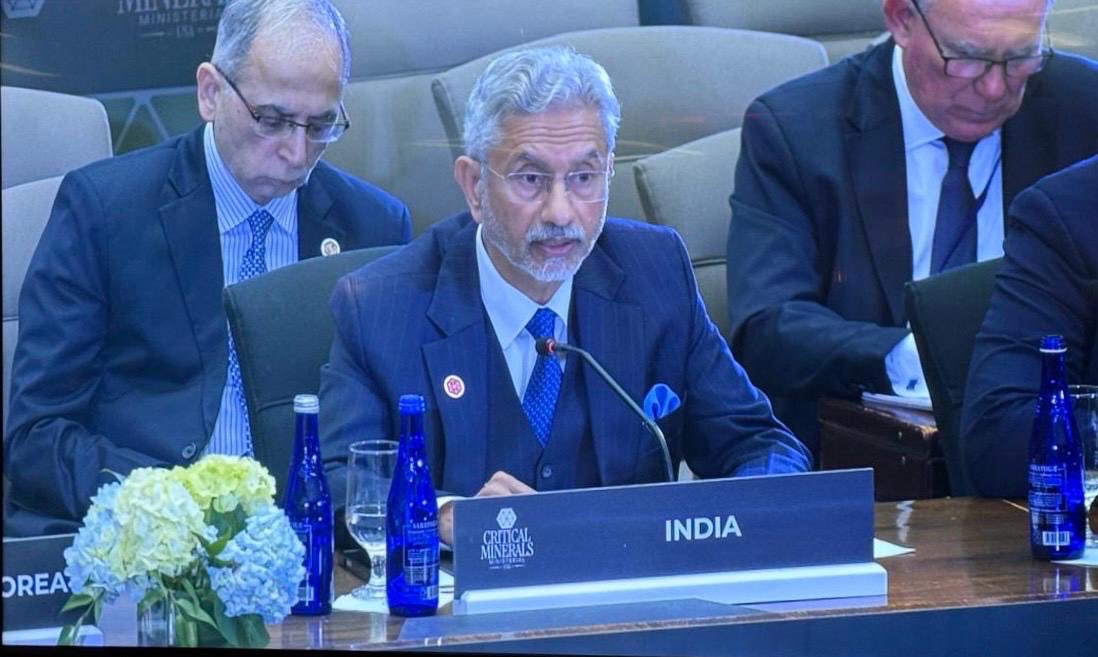
Speaking at the Critical Minerals Ministerial in Washington, DC, Dr Jaishankar highlighted that the central vulnerability in today’s mineral economy lies in over-dependence on a narrow set of suppliers and brittle supply chains. He argued that resilience must be built through diversification and rules-based cooperation rather than unilateral control mechanisms. He outlined India’s own efforts to strengthen supply security through the National Critical Minerals Mission, the Rare Earth Corridors initiative and a framework of responsible commerce. He also conveyed India’s support for the FORGE initiative on critical minerals, signalling willingness to engage multilaterally while stopping short of endorsing the more protectionist elements of the US proposal.
FORGE, or the Framework for Resilient and Green Supply Chains for Critical Minerals, is the new multilateral platform launched by the United States as a successor to the Minerals Security Partnership. It is designed to coordinate investment in mining, processing and refining across partner countries, promote environmentally sustainable and labour-responsible supply chains, and reduce exposure to supply concentration and market manipulation. With participation from more than 50 countries and the European Union, FORGE seeks to align industrial policy with climate and security objectives while offering an alternative to fragmented bilateral deals in the critical minerals sector.
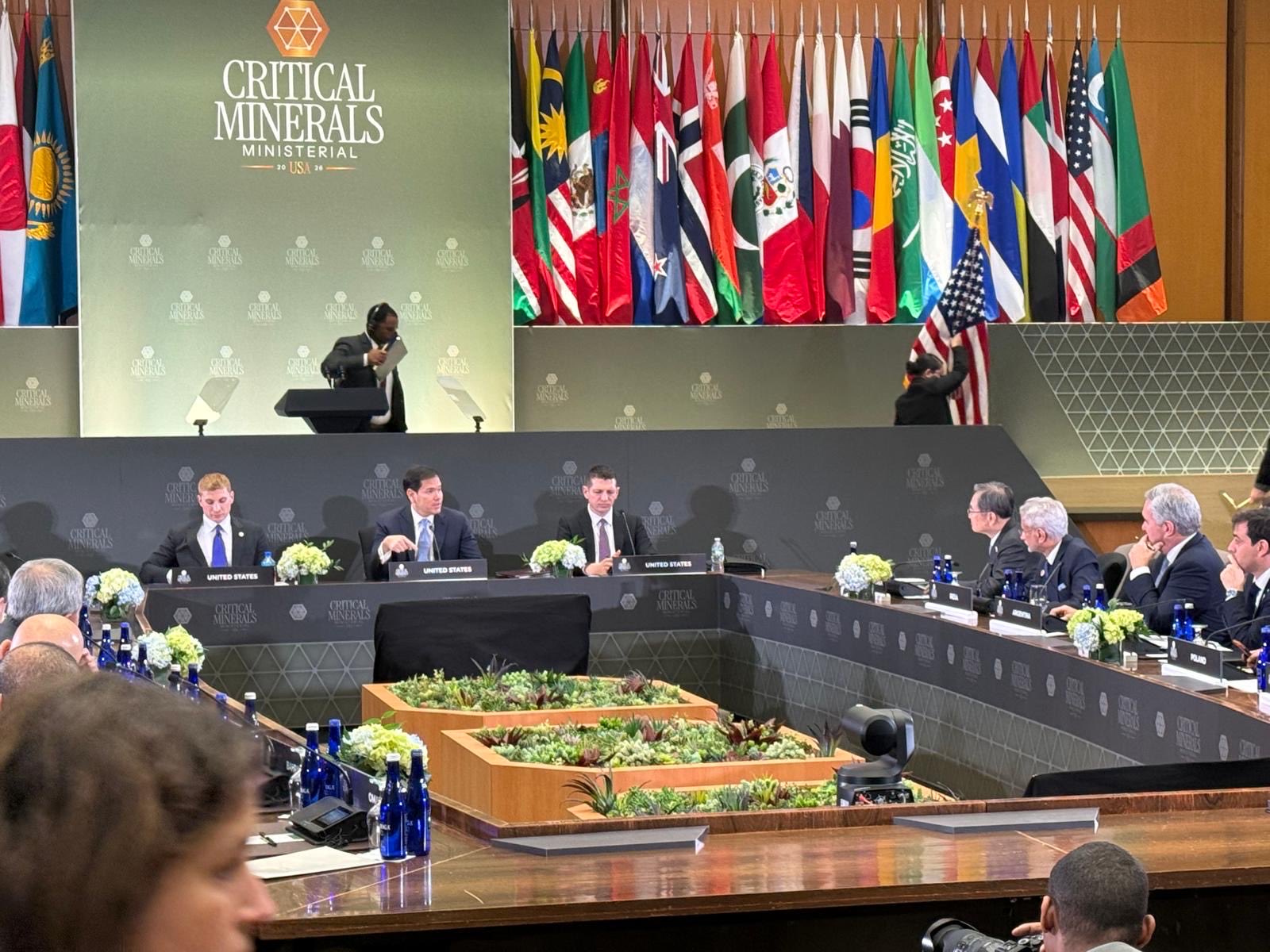
The ministerial brought together delegations from more than 50 countries across Asia, Europe, Africa, the Middle East and the Indo-Pacific. Reported participants included Japan, South Korea, Australia, Germany, Canada, France, the United Kingdom, Italy and New Zealand, along with the European Union. Resource-rich states such as the Democratic Republic of the Congo and several Latin American and African partners were also represented, underlining the breadth of interest in reshaping global critical minerals supply chains beyond a narrow group of producers.
The American move, however, was framed in far more strategic and security-driven terms by Vice President of the United States JD Vance, who described critical minerals as the “real things” on which modern economies ultimately run, alongside oil and gas. He argued that the current global market is “failing” because it is excessively concentrated, chronically volatile and vulnerable to what he described as foreign flooding of supply that collapses prices and kills projects in their infancy. According to Vance, this pattern has repeatedly forced lithium mines, gallium recovery centres and other projects to shut down after years of planning when sudden oversupply drives investors away.
Vance said the Trump administration views this as a national security problem rather than merely a commercial one, pointing to missile defence systems, energy infrastructure, advanced manufacturing and emerging technologies as being hostage to supply chains that can “vanish in the blink of an eye.” He claimed that previous US administrations, particularly the Biden administration, had never conducted a serious mapping of global supply chain deficiencies, leaving the United States exposed.
In response, the administration has mobilised public financing tools on an unprecedented scale, including up to 100 billion dollars in lending authority through the Office of Strategic Capital, direct equity stakes in mining and processing companies, and the creation of Project Vault, America’s first domestic critical minerals stockpile. Vance said the US had not built a primary smelter since 1980 and has now announced two new facilities, one already fully funded. The objective, he said, is to build “ironclad” end-to-end industrial supply chains that generate domestic jobs while also securing allied economies.
The centrepiece of the US proposal is the creation of a preferential trade zone for critical minerals, with reference prices fixed at each stage of production. These prices would operate as a floor, enforced through adjustable tariffs to prevent undercutting by low-cost foreign producers. Vance argued this would eliminate strategic dumping and ensure predictable prices so that long-term investment becomes viable. He invited allies and partners to join what he described as a trading bloc that would guarantee stable access in emergencies and protect domestic miners and refiners from being driven out of business by subsidised competition.
The U.S. Secretary of State Marco Rubio reinforced this framing by linking economic security directly to national security. In his opening remarks and later press availability, Rubio said critical minerals underpin everything from mobile phones and artificial intelligence systems to defence industries. He traced America’s vulnerability to a historical neglect of mining, recalling how the Mountain Pass rare earth discovery in California had once powered the jet age, space age and computer age, before being abandoned as mining was outsourced and manufacturing hollowed out.
Rubio argued that advanced economies had become “blinded” by glamorous downstream technologies while neglecting upstream extraction and processing, eventually outsourcing not just manufacturing but their future. He compared the present moment to the 1970s oil crisis, when concentration of supply became a geopolitical weapon and led to the creation of the International Energy Agency. The current initiative, he said, seeks to replicate that logic for minerals, protecting every stage of production from mining to refining and manufacturing from non-market disruption.
He cited more than 10 billion dollars in recent agreements across five countries and the launch of FORGE as a successor to the earlier Minerals Security Partnership. He emphasised that 55 partners were now involved, including 54 countries and the European Union, and that new framework agreements were to be signed later in the day. A price forward mechanism, to be presented by the United States Trade Representative, would ensure commodities do not fall below a viable threshold, shielding investors from predatory pricing.
Yet beneath the rhetoric of partnership and shared prosperity lies a more cynical calculation. US officials repeatedly described current pricing as distorted by “strategic dumping” and overproduction, without naming countries, while warning that concentration could be used as geopolitical leverage. The proposed trade zone, with tariffs and enforced price floors, represents a shift away from free markets toward managed trade in the name of security. It also risks redrawing global mineral flows along political lines.
India’s intervention stood out for its emphasis on de-risking rather than decoupling. Dr Jaishankar’s stress on diversification, structured cooperation and responsible commerce suggests concern that a rigid bloc could reproduce the very concentration it seeks to escape, only under a different flag. India’s support for FORGE, alongside its domestic initiatives such as the National Critical Minerals Mission and Rare Earth Corridors, signals an attempt to balance strategic alignment with autonomy.
For Washington, the stakes are openly industrial and geopolitical: reindustrialisation, job creation, and insulation from what it views as hostile supply manipulation. For India, the calculus is more complex, involving access, resilience and space to pursue its own mineral diplomacy without being locked into a single pricing and tariff regime designed in Washington.
What emerges from the ministerial is not merely a technical discussion of lithium, cobalt or rare earths, but a contest over who sets the rules of the next industrial economy. The United States is proposing to replace a volatile global market with a managed alliance-based system. India is cautiously endorsing cooperation while warning against new forms of dependency.
The convergence on diversification masks a deeper divergence on method. Where Washington speaks of enforceable price floors and preferential zones, New Delhi speaks of de-risking and structured international cooperation. Both acknowledge that excessive concentration is dangerous. They differ on whether security will come from blocs or from broader, more flexible networks.
In that tension lies the future of critical minerals diplomacy: a shared diagnosis of vulnerability, but competing prescriptions for control.
– global bihari bureau