From Repair to Readiness: MH‑60R Sustainment Secured
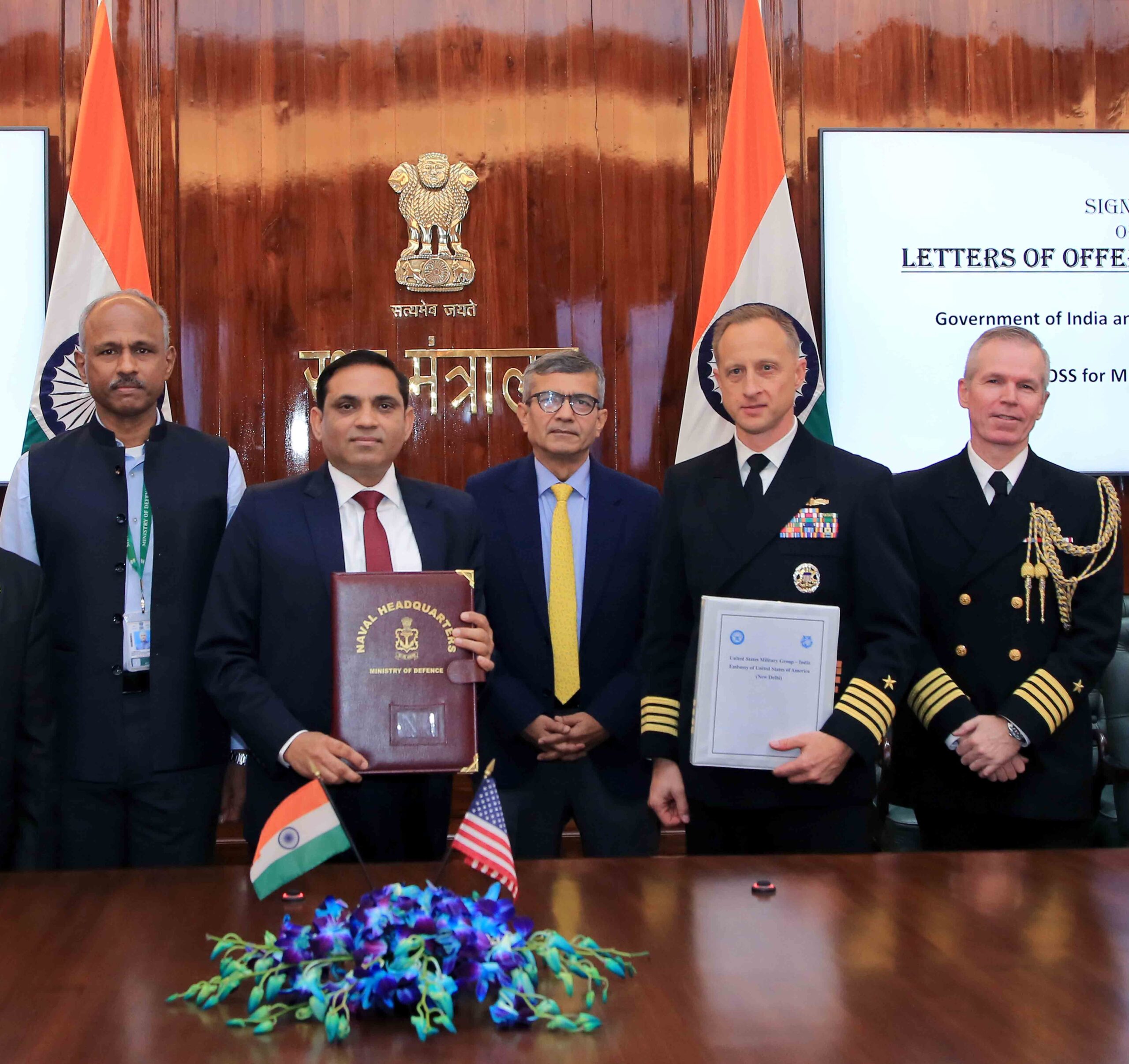
New Delhi: In a year defined by tense trade negotiations and geopolitical recalibrations, India today advanced a cornerstone of its maritime defence: the Ministry of Defence (MoD) formalised Letters of Offer and Acceptance (LOAs) with the United States government under the U.S. Foreign Military Sales (FMS) programme. Valued at approximately ₹7,995 crore, the agreements cover a five-year sustainment package for the Indian Navy’s MH‑60R Seahawk helicopter fleet — encompassing both aircraft already delivered and those still en route to India, completing the contracted 24-unit fleet. Public sources indicate that roughly 19–20 helicopters have been inducted, with the remainder expected by year-end, underscoring a subtle but important nuance: sustainment covers the full fleet, even as induction continues.
At first glance, the ceremony in New Delhi — witnessed by Defence Secretary Rajesh Kumar Singh — was a procedural milestone. Yet, beneath the ceremonial gloss lies a far more intricate interplay of operational, industrial, and strategic imperatives. The LOAs are designed not just to provide Follow-on Support (FOS) and Follow-on Supply Support (FOSS), but to catalyse a long-term domestic maintenance ecosystem, establishing intermediate-level repair and Periodic Maintenance Inspection (PMI) facilities in India. These facilities promise faster turnaround, higher availability, and a gradual reduction in reliance on U.S. technical infrastructure — a step aligned with the government’s Aatmanirbhar Bharat initiative. For local industry, particularly MSMEs, the potential is clear: production, calibration, maintenance, and testing of components could move from aspiration to operational reality.
The MH‑60R is far from an ordinary rotorcraft. It is a technologically sophisticated, multi-role maritime helicopter, equipped for anti-submarine warfare, anti-surface operations, surveillance, search-and-rescue, and multi-mission maritime deployment. Its sensor suite includes multi-mode radar, dipping sonar, sonobuoys, electronic support measures, secure communications, infrared systems, and a full complement of torpedoes and anti-ship missiles. Designed to operate in all-weather conditions, the Seahawk can launch from both shore bases and naval vessels, enabling the Indian Navy to project power and maintain situational awareness across vast stretches of the Indian Ocean, where maritime competition is intensifying.
Operational sustainment is, therefore, not a bureaucratic luxury but a strategic imperative. The LOAs ensure that spares, repairs, technical support, and inspection cycles are institutionalised within India, allowing helicopters to maintain high sortie rates and remain mission-ready in both primary and secondary roles. Analysts caution that any disruption in the supply chain — whether spares, software tools, or technical data — could compromise the operational tempo of a fleet designed to safeguard India’s critical sea lanes.
Yet the agreement arrives against a complex geopolitical backdrop. In August 2025, the U.S. imposed tariffs on a range of Indian exports — textiles, leather goods, and footwear — and tightened controls on dual-use technologies and high-end aerospace components. Investment climate reporting has raised concerns about regulatory predictability and intellectual property protection in India. Despite these frictions, defence collaboration persists: the MH‑60R LOAs exemplify a compartmentalised approach, where operational military cooperation is insulated from broader economic disputes. Analysts in New Delhi and Washington note, however, that the long-term transition from sustainment to licensed local production — and the expansion of Indian industrial participation — will require consistent U.S. support and continued bureaucratic alignment.
Historical precedent offers both caution and encouragement. Platforms such as the P-8I Poseidon, C-17 Globemaster III, and C-130J Super Hercules demonstrate that while operational readiness can be quickly established under FMS, the evolution toward self-reliant industrial ecosystems — with local repair, spares production, and technology absorption — can take years. India’s intermediate-level repair facilities are intended to bridge this gap, enabling domestic technicians and firms to acquire high-value skills, contribute to spares and maintenance cycles, and eventually participate in critical component production. Without robust cooperation and export-control compliance, however, bottlenecks in technical data transfer or component licensing could slow the pace of indigenisation.
Strategically, the LOAs highlight a paradox. U.S.–India relations are simultaneously tense and cooperative. Commercial disputes and tariffs signal friction, yet the sustained operational support of the MH‑60R fleet demonstrates recognition of India’s strategic value in the Indo-Pacific. The agreements reflect a calibrated approach: India’s immediate operational needs are secured, its strategic partnership reinforced, and the foundation laid for long-term domestic capability building — all under the shadow of broader trade and technology pressures.
In practical terms, this translates into enhanced fleet reliability, faster repair cycles, and mission-ready helicopters capable of sustained deployment across dispersed bases and ships. The agreement is as much about industrial evolution as operational necessity: domestic maintenance infrastructure, skill development, and eventual participation in licensed component production could mark a significant step in India’s maritime self-reliance, even as full fleet deliveries are completed.
Ultimately, the success of this arrangement will not be measured in ceremonial signings or press statements, but in maintenance logs, spares availability, operational deployment cycles, and the emergence of a self-sufficient domestic industrial ecosystem. India’s Navy stands to gain a resilient, technologically potent fleet, the industrial base an opportunity to grow in sophistication, and the bilateral defence relationship with the U.S. a reaffirmation of strategic trust — all while navigating the complex currents of global trade and technology diplomacy.
– global bihari bureau