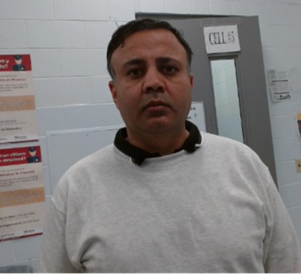
Varun Datta
Indian Citizen Varun Datta Listed in US Immigration Crackdown
Washington: The United States immigration authorities have detained Varun Datta, identified as an Indian national, as part of a nationwide enforcement drive under the newly enacted Laken Riley Act, which mandates federal detention for certain undocumented immigrants accused or convicted of serious criminal offences, the U.S. Department of Homeland Security (DHS) said.
DHS stated that Datta, “a criminal illegal alien from India,” is among more than 17,500 individuals arrested and detained across the United States following the implementation of the law, which the department described as the first piece of legislation signed by President Donald Trump after returning to office. In its Office of Public Affairs release, DHS said Datta has been convicted in the United States on four counts of sexual assault, in addition to resisting a law enforcement officer and driving under the influence of alcohol. He was also charged, the department said, with shoplifting, trespassing and battery. DHS did not specify whether these latter charges resulted in convictions, underscoring the distinction under U.S. law between adjudicated offences and pending allegations.
Beyond these assertions, DHS has not made public further personal or case-specific details about Datta, including his age, the state in which he was arrested, the duration or nature of his stay in the United States, his visa or immigration status prior to detention, or whether his convictions followed a trial or a plea agreement. The department has also not disclosed the jurisdiction or courts in which the criminal cases were heard, or whether the convictions arose under state criminal law or involved any federal proceedings, details that can be relevant to both sentencing and subsequent immigration action.
It is important to place Datta’s detention in context. U.S. authorities have not released any nationality-wise breakdown of the more than 17,500 individuals detained under the Laken Riley Act, making it unclear how many Indian nationals are included in this category. Between January and March 2025, the Indian government informed Parliament that 636 Indian nationals had been deported from the United States, and another 295 individuals with final orders of removal were under verification by the Ministry of External Affairs. These cases largely involve civil immigration violations such as visa overstays or unauthorised entry, and are not limited to criminal detainees under the Laken Riley Act.
Against this backdrop, Varun Datta’s detention stands out because DHS has publicly linked it to serious criminal convictions under the Act, rather than civil immigration violations alone.
It is also important to note that the term “alien,” repeatedly used in U.S. government statements and laws, is a legal classification under American immigration statutes. In U.S. law, an “alien” refers to any person who is not a citizen or national of the United States, regardless of country of origin. The category includes individuals who may have entered the country without authorisation, overstayed visas, or otherwise lack lawful immigration status, and does not by itself imply criminal guilt. Criminal liability arises only from charges or convictions under U.S. law, which are legally distinct from immigration status.
Under international norms, including the Vienna Convention on Consular Relations, foreign nationals detained abroad are entitled to request that their consular authorities be informed of their detention. As of now, DHS has not stated whether the Indian Embassy or Indian consulates in the United States have been formally notified in Datta’s case or whether consular access has been sought or granted.
The detentions are being carried out under the Laken Riley Act, named after a Georgia nursing student who was killed by a Venezuelan national who, according to U.S. authorities, had previously been arrested and released multiple times before committing the crime. DHS has said the law was enacted to prevent repeat releases of undocumented immigrants accused of serious offences. The Act mandates federal detention for those accused of or convicted of crimes, including theft, burglary, assault on law enforcement officers, and offences resulting in death or serious bodily injury. Sexual assault cases, such as those cited against Datta, fall within the category of offences that trigger mandatory detention under the statute.
DHS said the nationwide arrests included a recent 14-day enforcement campaign known as ‘Operation Angel’s Honor’, launched in memory of Laken Riley. According to the department, Immigration and Customs Enforcement (ICE) arrested 1,030 individuals during this operation alone, all described as undocumented immigrants accused of crimes covered under the Act.
In a statement included in the DHS release today (Indian Standard Time), Homeland Security Secretary Kristi Noem said the administration had directed federal agencies to detain and remove individuals it describes as violent criminal offenders, arguing that earlier enforcement policies had resulted in repeat releases into U.S. communities. “President Trump has empowered us to arrest and remove the millions of violent criminal illegal aliens unleashed on the United States by the previous administration. Now, these criminals will face justice and be removed from our country. We can never bring Laken back, but we can do everything in our power to bring these heinous criminals to justice. I am so proud of what our brave men and women of ICE have done to remove these criminals from America’s streets,” Kristi said.
DHS maintains that individuals detained under the Act will remain in federal custody while their cases proceed and, where applicable, face removal from the United States.
At the same time, under U.S. law, individuals held in immigration detention retain the right to legal representation at their own expense and may challenge both criminal convictions and immigration actions through available appellate and judicial review mechanisms. DHS has not indicated whether Datta has exercised these rights or whether any appeals or review petitions are currently pending.
From India’s perspective, cases involving Indian nationals detained abroad are typically addressed through official verification and consular engagement rather than public intervention. In past instances, the Ministry of External Affairs has said its role is to confirm citizenship, ensure access to legal counsel where requested, monitor welfare, and engage with foreign authorities on procedural matters, without intervening in the judicial process of another country.
At present, all information relating to Varun Datta’s detention and criminal record is based solely on the DHS press release. No independent court records or additional official documentation have been made public to corroborate or expand upon the department’s claims.
– global bihari bureau