Global Trade Reels as Policy Chaos Punishes the Vulnerable
Geneva: A relentless tide of policy unpredictability is reshaping global trade, driving up costs, rattling financial markets, and inflicting the deepest wounds on developing economies, according to the latest Global Trade Update from United Nations Trade and Development (UNCTAD). Unlike past disruptions from tariffs, pandemics, or geopolitical tensions, this systemic uncertainty has become a structural force in the global economy, slowing investment, disrupting supply chains, and widening the chasm between nations.
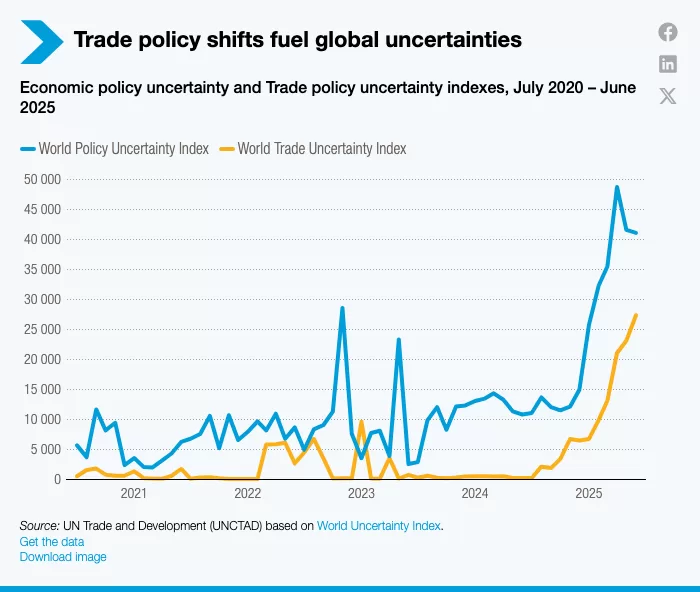
The World Trade Policy Uncertainty Index soared to record levels in the first quarter of 2025, underscoring the pervasive unpredictability that now defines global commerce. Businesses are grappling with agonising decisions: stockpiling goods, rerouting shipments, or paying exorbitant transport costs to navigate the chaos.
In early 2025, volatility in US imports surged compared to the previous year, even before new tariffs took effect, as companies scrambled to front-load inventories in anticipation of policy shifts. UNCTAD warns that the cost of this uncertainty often surpasses the financial burden of tariffs themselves. Small exporters and developing economies, with limited access to finance or logistics, bear the heaviest burden, struggling to absorb the shocks that wealthier nations can better withstand.
The fallout extends far beyond ports and trade routes, threatening financial and macroeconomic stability. Exchange rates are swinging wildly, capital flows are tightening, and borrowing costs are climbing. For developing countries, where access to trade finance is already scarce, this translates into squeezed credit and slashed investment opportunities. With global interest rates remaining high, the added burden of unpredictability deepens fiscal fragility, severely limiting governments’ ability to fund growth and social development programs, leaving vulnerable populations even more exposed.
Perhaps the most insidious impact is the erosion of trust and cooperation. When policies are unclear or rules are selectively applied, governments resort to unilateral actions, triggering cycles of retaliation that ripple across global supply chains. UNCTAD data highlight stark disparities: while advanced economies maintained relatively steady import trends in early 2025, developing countries faced sharper swings, with least developed countries experiencing a delayed but steeper spike in volatility later in the year. This underscores a grim reality: the most vulnerable economies are the most exposed to the punishing effects of trade uncertainty.
The cost of this unpredictability is clear, punishing those least equipped to endure it. Yet, UNCTAD points to pathways forward. Diversifying markets, strengthening trade agreements, and providing firms with advance notice of policy shifts can mitigate risks. Above all, restoring stability and predictability is essential for businesses to invest confidently, for countries to foster growth, and for trade to fulfil its role as a driver of development. As uncertainty emerges as the new tariff, its price is being paid across the global economy, with developing nations suffering the most profound losses.
– global bihari bureau