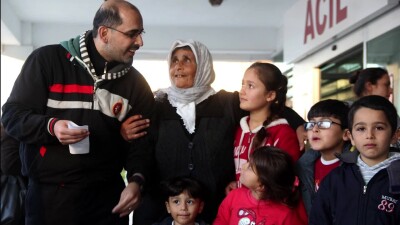
Syria prison survivor Riyad Avlar
Survivor’s Quest: Justice for Syria’s Vanished
Geneva: The graffiti on the walls of Sednaya prison in Syria still haunts Riyad Avlar like whispers from the grave. Scrawled in desperate ink by prisoners who called it the “human slaughterhouse,” one message lingers: “First day, severe beating.” It was December, just after the Bashar al-Assad regime crumbled, when the gates finally swung open, spilling out survivors like Riyad after more than two decades inside.
Now, from his home in Türkiye, this 48-year-old Syrian human rights defender is channelling that nightmare into a relentless quest for answers. With the United Nations at his side, he’s piecing together the fates of those who never emerged, fighting for justice for Syria’s disappeared. One mother’s words, shared with him in quiet grief, capture the unbreakable thread of hope amid the horror: When he broke the news that her son had died in detention, she paused, then said, “I accept this, but I have not lost hope. One day, my son will walk in and meet you here.” Her resilience mirrors the spirit of families who’ve clung to uncertainty for years, refusing to let go until truth arrives.
Riyad’s own release in 2017 didn’t close the book on his ordeal—it cracked it wider. Arrested in 1996 at age 19, fresh from his rural village in Turkey where he’d gone to study in Syria, he vanished into the regime’s grip. Held incommunicado for 15 agonising years, he endured solitary confinement, torture, and a silence so profound his family only confirmed he was alive through a friend’s mother’s plea. “I saw my brother twice, for 15 minutes each, in more than two decades,” he recalls, his voice steady but edged with the weight of isolation. Denied a fair trial, slapped with fabricated charges, he lived in the shadow of execution’s constant dread. When freedom came, his mother didn’t speak at first. She simply held him close, breathing him in, as if etching the scent of her son into memory forever. Years later, cradling his own toddler son—whom he’d missed entirely in those lost years—Riyad finally understood that fierce, wordless embrace.
That personal scar fuels his work today, but it’s the collective wound of Syria’s missing that keeps him awake. Before joining the UN’s Independent Institution on Missing Persons in Syria’s first Advisory Board, Riyad poured his survival into the Association of Detainees and the Missing of Sednaya Prison (ADMSP). Founded by fellow ex-detainees like him, the group has grown into a lifeline: a hub for documentation, emotional support, and fierce advocacy. “Our mission,” Riyad says, “is to empower survivors and the families of the disappeared to be central actors in transitional justice, accountability, and reparations in Syria.” They’ve built two vital databases since starting up. The first captures face-to-face testimonies from Sednaya survivors—and, since 2021, from detention centres across the country. These accounts name abusers, pinpoint last sightings of the lost, and map patterns of cruelty, turning raw pain into evidence. The second gathers pleas from families hunting for traces of their loved ones, often delivering the first solid confirmation of a fate long feared.
Every step is measured with care, guided by a “do-no-harm” ethos that Riyad holds sacred. “Every interview is conducted face-to-face, with careful attention to avoid re-traumatisation,” he explains. Beyond the records, ADMSP runs a centre brimming with healing: psychotherapy for shattered minds, physiotherapy to mend battered bodies, and group therapy circles where survivors and relatives confront the void of disappearance together. They even stand as shields against heartbreak’s cruel twists—extortionists peddling false leads for cash. The association verifies those whispers, sparing families fresh deception. “Everyone suffers in their own way,” Riyad reflects. Mothers endure years of unanswered prayers, their days hollowed by absence. Wives and children battle stigma, harassment, and even exile. “But what unites them is the right to know.”
The scale of that right is staggering. According to the Syrian Network for Human Rights, at least 181,312 people remain arbitrarily detained or forcibly disappeared—among them 5,332 children and 9,201 women. It’s a ledger of loss that the UN Independent Institution on Missing Persons in Syria, launched by the General Assembly in 2023, was created to confront. Riyad earned his seat on its 11-member Advisory Board from over 250 applicants, joining voices from victims’ families, Syrian civil society, and global experts. Their mandate is clear and urgent: unravel the fates of the missing, bolster their kin, and pave paths to accountability. “The task is immense,” Riyad tells UN News from his home in Türkiye. “But with cooperation between Syrian organisations and the international community, the institution can establish clear protocols for notification, psychological support, and recognition of the disappeared.”
For Riyad, this isn’t an abstract duty—it’s a heavy mantle he wears with quiet fire. To fellow survivors, his message rings like a vow: “We must raise our voices and demand justice—not revenge—but accountability and reparations. We are alive, and that is a responsibility.” Re-entering the world after 20 years felt like thawing from a deep freeze into a dizzying future. “When I was arrested, phones were those old push-button ones,” he says with a wry smile. “When I got out, I saw ones you just touch with your finger. Life had changed so much, I was shocked. The village I left was underdeveloped—no paved roads, no cars, water from wells, and no sewage. Now, taps inside houses, everything modern. It was as if someone had frozen me and released me into a science fiction movie.” Bit by bit, he adapted, choosing to stride forward because stagnation wasn’t an option.
At the heart of it all, Riyad insists, families of the missing must never be abandoned to silence. Every Syrian household deserves to know—to mourn with dignity, to heal without half-truths. Truth, he believes, is the bedrock of Syria’s tomorrow, intertwined with transitional justice where survivors and their loved ones don’t just witness the reckoning but help forge it. In the graffiti’s echo and a mother’s unyielding hope, Riyad Avlar sees not just scars, but the seeds of a reckoning long overdue.
– global bihari bureau