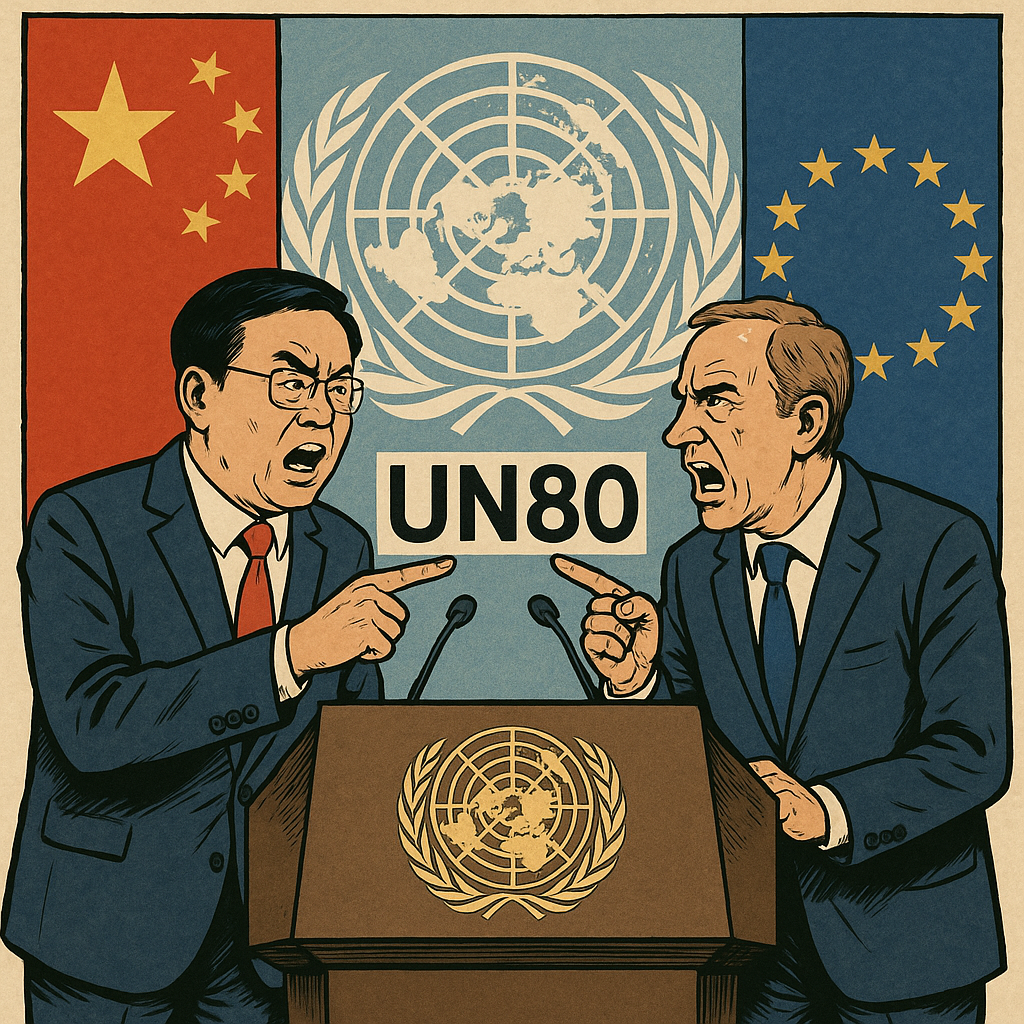
Beijing/Brussels/New York: As the United Nations (UN) marks its 80th anniversary with the UN80 Initiative, a significant effort to modernise its institutions amid global crises, tensions between China and the European Union (EU) have escalated over Beijing’s role in the restructuring.
At a regular press conference today, Chinese Foreign Ministry Spokesperson Guo Jiakun strongly defended China’s commitment to multilateralism, rejecting EU claims of overreach, while the EU’s recent sanctions on Chinese entities linked to Russia intensify the dispute.
The controversy, set against the UN80’s reform agenda launched by Secretary-General António Guterres in March and the upcoming 25th China-EU Summit, highlights a critical moment in China-EU relations, with global governance and bilateral ties in focus.
The EU’s concern about China’s influence stems from Beijing’s active lobbying of Global South governments, particularly in Africa and Southeast Asia, to shape UN80 outcomes. European diplomats suspect China is pushing its agenda, with unverified claims of meetings to secure support, though specific details remain unconfirmed. The EU fears this could tilt the UN toward Chinese interests, such as integrating elements of the Belt and Road Initiative into UN projects or securing key posts, potentially undermining Western influence. Some EU officials have called this an attempt to dominate the UN, a charge lacking concrete evidence but reflecting unease.
China’s contributions to UN80 include prioritising developing countries’ voices, as Guo Jiakun stated, “We support reforms to reinforce multilateralism… taking seriously the opinions of developing countries for a just global governance system.” Beijing also backs expanding the Security Council with more non-permanent seats for the Global South, a proposal it promotes through forums. The EU objects, arguing this could weaken the authority of the five permanent members—especially the U.S. and UK—and allow China to steer sensitive issues like human rights, though no formal vote has occurred.
The diplomatic rift widened with the EU’s decision to sanction two Chinese banks—Bank of Kunlun and China Construction Bank—and five companies, including Hong Kong-based Transsion Holdings, on Friday, July 18, 2025, as part of its 18th package against Russia over the Ukraine conflict, marking the first such action against Chinese financial entities. Guo Jiakun responded, “China opposes unilateral sanctions lacking United Nations Security Council authorisation,” defending $240 billion in 2024 trade with Russia and citing a 15% drop in dual-use exports in 2025 per official Chinese data. He accused the EU of harming Chinese companies’ interests without proof, with the Commerce Ministry threatening retaliatory tariffs on $856 billion in 2024 bilateral trade, though specific rates remain unannounced.
This escalation, ahead of the 25th China-EU Summit in September 2025, challenges their shared multilateralism rhetoric. The summit, marking 50 years of China-EU diplomatic ties and coinciding with UN80, holds high stakes. Guo Jiakun emphasised its significance, noting, “As two major forces in building a multipolar world, two big markets supporting globalisation, and two great civilisations advocating cultural diversity, the upcoming summit receives international attention.” He highlighted 50 years of growth, with trade rising from $2.4 billion to $785.8 billion and investment stock from near zero to $260 billion, plus cooperation on climate and people-to-people exchanges benefiting nearly two billion people. However, he acknowledged challenges, with some EU members framing China as a “partner-competitor-rival,” exaggerating trade issues, and accusing it on Ukraine disrupting ties. China hopes the summit will build on this history, urging the EU to adopt a “comprehensive, dialectical, and forward-looking perspective” to plan the next 50 years of cooperation, opening a brighter future for their comprehensive strategic partnership amid global turbulence.
The UN80 Initiative, unveiled on March 13, 2025, at UN Headquarters in New York, aims to streamline the UN’s operations and reinforce multilateralism as trust in global bodies wanes amid conflicts, displacement, and climate challenges. Guy Ryder, Under-Secretary-General for Policy and chair of the UN80 Task Force, described it as a necessary review, stating, “This is a good time to see how fit for purpose we are in challenging circumstances for multilateralism.”
The initiative targets three areas: improving efficiency by cutting red tape and moving functions to lower-cost duty stations like Nairobi or Geneva, reviewing nearly 4,000 mandate documents—tasks set by the 193 member states through General Assembly or Security Council resolutions—from a backlog of over 40,000 mandates, and considering structural changes across the UN system, including realigning specialized agencies. Using artificial intelligence for data analysis, the process allows member states to decide on mandates, with initial proposals from seven thematic clusters—covering peace, humanitarian action, development, human rights, training, research, and agencies—submitted by mid-June, and broader plans due by the end of July.
Guterres stressed this strengthens the UN, which supports over 130 million displaced people, feeds 120 million, vaccinates half the world’s children, and drives peacekeeping and climate efforts, despite a liquidity crisis from delayed contributions to the $3.72 billion 2025 budget, with only 75 member states fully paid by March 11, as reported by the UN. The General Assembly adopted a resolution on July 18 supporting UN80, though EU nations like Denmark labelled the process “premature,” reflecting ongoing divisions.
The EU’s worries reflect a fear of losing UN sway, with China’s lobbying and Security Council proposal seen as strategic, though evidence is limited. The sanctions risk pushing China closer to Russia, where energy deals grew 20% since 2024 per Reuters. As UN80 progresses, member states’ decisions—potentially via a 2026 intergovernmental process—will shape its direction, with China-EU relations at a crossroads. Platforms like X show public interest in Beijing’s rise, while the UN’s credibility depends on resolving this tension.
– global bihari bureau
–