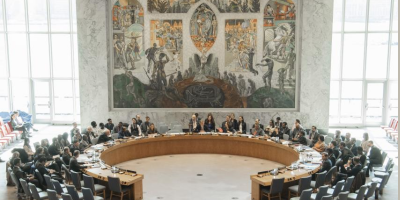
File photo of UNSC
Security Council Deadlock Triggers Iran Snapback Sanctions
Geneva: The United Nations Security Council’s efforts to extend sanctions relief under the Joint Comprehensive Plan of Action (JCPOA) on Iran’s nuclear programme ended in deadlock, leading to the reimposition of sanctions after France, Germany, and the United Kingdom triggered the “snapback” mechanism. On 26 September, the Council rejected a draft resolution aimed at a six-month technical extension of the ten-year term specified in resolution 2231 (2015) by a vote of nine against, four in favour, and two abstentions.
The draft resolution, tabled by China and the Russian Federation, sought to buy time for diplomacy and encourage continued engagement between Iran and the International Atomic Energy Agency (IAEA). It would have postponed the expiry of JCPOA-related sanctions provisions until 18 April 2026 and urged all initial participants to resume negotiations. China described the Iranian nuclear issue as at a “critical juncture” and emphasised that the extension was intended to allow more time for diplomatic solutions, not to favour any side. Moscow underscored that Tehran had shown flexibility, including signing a September 9 agreement with the IAEA covering all nuclear facilities, even those attacked in June 2025.
Despite these diplomatic overtures, France, the United Kingdom, and the United States opposed the extension. Paris highlighted Iran’s lack of transparency on its enriched uranium stockpile and failure to resume comprehensive communication with the IAEA, while London insisted that Iran’s nuclear programme remained unverifiable and threatened global non-proliferation. Washington, aligned with its European partners, reaffirmed that the snapback would restore UN sanctions targeting Iran’s nuclear, ballistic missile, conventional arms, and destabilising activities.
Following the Council’s failure to adopt the resolution, the United Nations formally reimposed sanctions on September 27, 2025, pursuant to six previous Security Council resolutions: 1696, 1737, 1747, 1803, 1835, and 1929. The restored measures require Iran to suspend uranium enrichment, heavy water, and reprocessing activities, prohibit the use of ballistic missile technology, maintain an embargo on arms exports, enforce travel bans and asset freezes on designated individuals and entities, and authorise seizure of prohibited cargo.
In a press release, U.S. Secretary of State Marco Rubio underscored that the snapback process, initiated on August 28, 2025, concluded in “an act of decisive global leadership” by France, Germany, and the United Kingdom. Rubio stated that the sanctions target the threats posed by Iran’s nuclear, missile, conventional arms, and destabilising activities and that diplomacy remains the preferred solution. He emphasised that for a negotiated settlement to succeed, Iran must engage in direct talks in good faith, without stalling or obfuscation. Absent such cooperation, the snapback measures are designed to pressure Tehran to comply with its obligations and act in the interest of both its people and global security.
Iran’s Foreign Minister, Seyed Abbas Araghchi, dismissed the resolution and the sanctions as “legally void, politically reckless and procedurally flawed,” reaffirming Tehran’s commitment to the Non-Proliferation Treaty since 1970 and its right to peaceful nuclear energy. He accused the United States and the E3 (France, Germany, the United Kingdom) of undermining diplomacy through unilateral action, including attacks on nuclear facilities and assassinations of scientists. Araghchi insisted that Iran would “never respond to threats or pressure” and stressed that dialogue under the JCPOA remains the only viable solution.
Delegates from countries that voted against the draft, including Denmark, Slovenia, Greece, Panama, Sierra Leone, and the United States, highlighted Iran’s non-compliance with transparency and verification measures, asserting that snapback sanctions are a lawful enforcement of Security Council mandates. Abstaining delegations, including Guyana and the Republic of Korea, stressed the importance of continued dialogue and a comprehensive diplomatic approach. Algeria, China, Russia, and Pakistan had advocated for the extension, arguing that buying time was essential to enable negotiations and avoid escalation.
The dual developments — the Council’s deadlock and the activation of snapback sanctions — leave the Middle East at a delicate juncture. While sanctions target Iran’s nuclear, missile, and conventional arms programmes as well as destabilising activities, opportunities for dialogue remain open, particularly regarding IAEA oversight and direct U.S.-Iran talks. Analysts warn that the situation could escalate if either side resorts to unilateral military actions or if Tehran retaliates economically or politically.
The Security Council’s actions underscore the tension between enforcing non-proliferation obligations and pursuing diplomacy. As sanctions take effect, the international community faces the challenge of balancing pressure with incentives for Iran to comply with JCPOA obligations. The coming weeks will be critical for determining whether renewed engagement can prevent further escalation or whether the snapback sanctions mark the beginning of a more confrontational phase in the Iranian nuclear issue.
– global bihari bureau