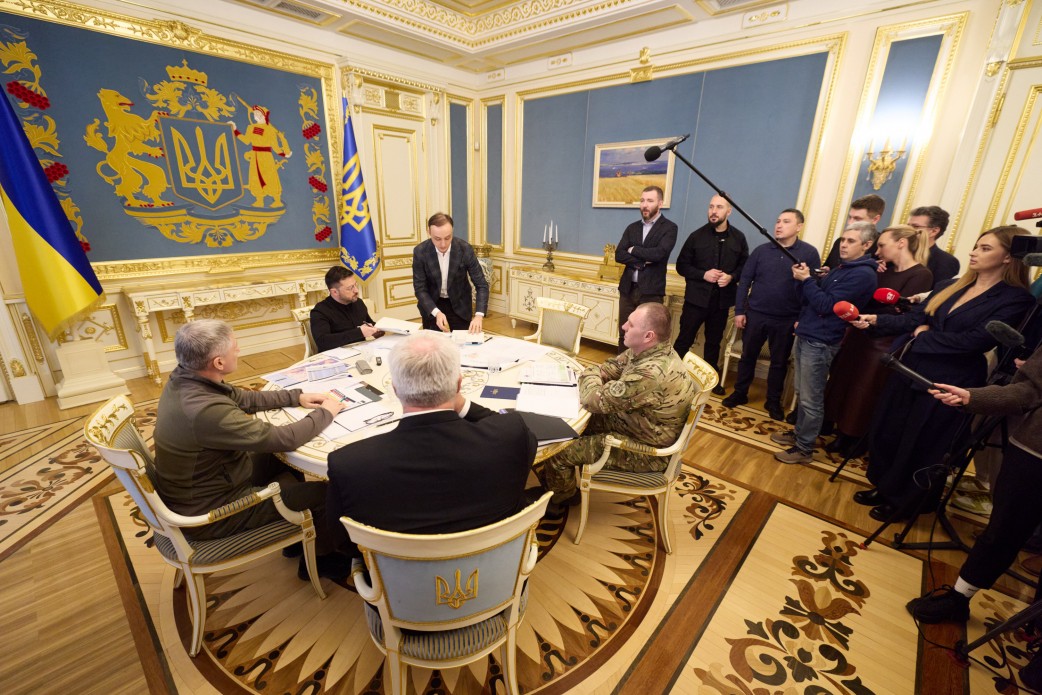
President of Ukraine Volodymyr Zelenskyy signing two decrees against Russia today.
30% Rise in Civilian Deaths Amid Drone War
UN Warns of Winter Energy Crisis
Ukraine Sanctions 55 Russian Targets
Russia Bans EU Officials
Kyiv/New Delhi: Ukraine tightened the noose on Russia’s war machine on October 31, 2025, with sanctions on 55 individuals and entities, over 160 strikes on fuel infrastructure since January, and a list of more than 300 abducted children—complete with verified Russian addresses—delivered to international partners for repatriation. The United Nations, briefing from Geneva the same day, warned that escalating attacks on Ukraine’s power grid threaten a humanitarian catastrophe as winter deepens, civilian deaths rise 30 per cent, and aid funding plummets to half of last year’s level. Russia countered by expanding its entry ban on European Union officials.
President Volodymyr Zelenskyy signed two decrees from the National Security and Defence Council of Ukraine. The first imposes personal restrictive measures on 14 pro-Russian propagandists—12 Ukrainian citizens and two Russians—who justify Russia’s armed aggression, deny the occupation of Ukrainian territories, and receive funding from coal industry profits in the temporarily occupied areas of Donbas, according to the official decree text published on the presidential website. The second targets 10 individuals and 31 legal entities—primarily residents of Russia, but also including those from China and Iran—who are involved in producing and supplying equipment and components to Russia’s military-industrial complex in circumvention of international sanctions. This provides company executives, owners, and Iranian state bodies and entities that have supplied military products to Russia, as detailed in the decree.
This action fits a broader 2025 pattern: Ukraine has synchronised 11 sanction packages with partners, including six with the European Union and alignments with the United States, Canada, and the United Kingdom. Preparatory work has been completed to incorporate the European Union’s 19th sanctions package—adopted October 23 by the EU Foreign Affairs Council—within Ukrainian jurisdiction, and proposals have been submitted for the forthcoming 20th package. A coordination meeting reviewed the year’s strategy, directing the Security Service of Ukraine, the Ministry of Foreign Affairs, and the Foreign Intelligence Service.
Service to prioritize by year-end Russia’s shadow tanker fleet (estimated at over 600 vessels bypassing oil price caps), energy companies (generating approximately $180 billion in oil revenues for Russia in 2024 despite sanctions), and all enterprises sustaining military production.
Ukrainian forces have conducted over 160 long-range strikes on Russian fuel infrastructure since January 2025, verified by Maxar and Planet Labs satellite imagery showing fires and operational halts at more than 30 refineries, including Rosneft and Gazprom Neft facilities. Russian emergency ministry statements acknowledged 28 such incidents in August and September alone, correlating with a 20–27 per cent decline in gasoline and diesel processing capacity, according to Kpler shipping data and analysis by CyberBoroshno. These strikes have contributed to a 15–20 per cent year-on-year increase in domestic fuel prices in Russia, per Rosstat data, straining military logistics.
The Foreign Intelligence Service compiled and delivered to partners a list of more than 300 abducted Ukrainian children, including full names, surnames, birth dates, and precise addresses in Russia where they are being held, to prevent Russian denials and advance repatriation efforts. This list supports the International Coalition for the Return of Ukrainian Children, co-chaired by Ukraine and Canada, which has facilitated the return of 1,274 children as of April 2025 against 19,546 cases verified by the Ukrainian Ombudsman’s office and Yale Humanitarian Research Lab, with estimates suggesting up to 200,000 total abductions since 2022.
Military updates centred on Pokrovsk in Donetsk Oblast, where Ukrainian units repelled 40 Russian assaults on October 31, inflicting heavy losses. The Ukrainian General Staff reported over 1,200 Russian personnel casualties in the region during the previous seven days. Pokrovsk, a pre-war city of 61,000 residents, now shelters fewer than 3,000 civilians under near-constant artillery and glide-bomb strikes. The United Nations Office for the Coordination of Humanitarian Affairs (OCHA) registered 57,000 evacuees from Donetsk Oblast at transit centres in 2025, with 80 per cent citing shelling as the primary reason for displacement.
In Moscow, President Vladimir Putin convened a videoconference with the permanent members of the Security Council of the Russian Federation on October 31. The agenda included ensuring steady and responsive operation of the defence manufacturing complex—Russia produced over 3,000 tanks and 1.5 million artillery shells in 2024, according to estimates from the Stockholm International Peace Research Institute—and additional measures for road safety as cold weather sets in, with potential ice on roads. The Ministry of Foreign Affairs of the Russian Federation announced a significant expansion of the list of individuals prohibited from entering Russian territory under Federal Law No. 114-FZ of August 15, 1996, On the Procedure for Exit from and Entry into the Russian Federation.
The expanded list targets representatives from European Union institutions, member states, and several other European nations, aligning with Brussels’ policies. It includes personnel from security agencies and commercial organizations supplying military assistance or dual-use goods to Ukraine; individuals facilitating blockades of Russian vessels and cargo or undermining Russia’s territorial integrity; officials involved in pursuing Russian leadership over alleged illegal detentions and deportations from Ukrainian territory; advocates for establishing a tribunal against Russian officials; those pushing for confiscation of Russian state assets or diversion of profits to benefit Ukraine; sanction enforcers; and members of national parliaments and the European Parliament who voted for anti-Russian resolutions, alongside civil activists and academics noted for Russophobic rhetoric. The ministry described the European Union’s 19th sanctions package as an illegitimate escalation undermining the United Nations Security Council’s prerogatives, stating it would not influence Russia’s pursuit of national interests or support for a multipolar world order.
In Geneva, United Nations Resident and Humanitarian Coordinator in Ukraine Matthias Schmale briefed reporters on October 31 about continuous attacks on energy production sites and distribution facilities as the fourth war winter approaches. He noted that forecasts predict colder temperatures than the previous year, with infrastructure damage potentially outpacing repair rates. The UN Human Rights Monitoring Mission documented 31 attacks on energy infrastructure in September 2025—a 15 per cent increase from August—with October seeing three large-scale barrages targeting civilian areas. Thursday’s assault involved 705 munitions, including 653 Shahed-type drones and 52 missiles (nine of which were ballistic), causing power outages for 1.5 million consumers and water supply disruptions for 80 per cent of Kyiv, according to reports from Ukrenergo and Kyivvodokanal.
Schmale expressed particular concern for residents in high-rise apartment buildings in frontline cities such as Zaporizhzhia, Kharkiv, or Dnipro, where prolonged loss of electricity or safe water during severe cold could trigger a major crisis within a crisis, overwhelming available response resources. He characterised the targeting of energy capacity at the start of winter as directly impacting the civilian population and a form of terror, creating a pervasive sense that nowhere is safe. During his nearly 18 months in Ukraine, Schmale has observed a rising mental health toll from the war.
The conflict has become increasingly technological, with unmanned aerial vehicles responsible for one-third of all recorded civilian casualties in 2025. Overall, civilian deaths have increased by 30 per cent compared to 2024, with short-range drone systems alone accounting for 395 deaths and 2,635 injuries since February 2022, according to data from the UN Human Rights Monitoring Mission. The World Health Organization has verified 364 attacks impacting healthcare facilities in Ukraine between January and October 2025, including an October 28 strike that severely damaged a children’s hospital in Kherson City, injuring one child and three health workers, and an October 31 incident in the central Vinnytsia region where a seven-year-old girl died in hospital following a strike.
Schmale shared a personal experience from visiting a kindergarten in Kharkiv shortly after it was hit by three missiles on October 29. He described imagining parents dropping off children in the morning, only to be called back two and a half hours later to collect traumatised youngsters who had just survived the event, emphasising that the notion of safety for vulnerable people and children is being violated repeatedly. In Kharkiv Oblast alone, 14 educational facilities were struck in October 2025.
Regarding Ukrainian territories occupied by the Russian Federation, Schmale warned that the longer the war continues, the greater the risk of forgetting the vulnerable populations there. Approximately one million people in these so-called temporarily occupied territories require assistance and face ongoing attacks on fundamental rights, including citizenship. Occupying forces are insisting that Ukrainians register for Russian documents, with non-compliance resulting in classification as illegal and potential deportation or arrest, according to UN human rights reports and local testimonies. This includes 1,800 documented cases of forced registration in Zaporizhzhia and Kherson oblasts since January 2025, with vulnerable groups comprising 300,000 children, 400,000 elderly, and 200,000 individuals with chronic illnesses, per OCHA estimates.
Humanitarian funding for Ukraine shows a sharp downward trend, according to the OCHA Financial Tracking Service. In 2022, over $4.01 billion supported operations. In 2023, the figure was $2.61 billion. In 2024, despite competing global crises, it reached $2.23 billion. As of October 31, 2025, with two months remaining, funding stands at $1.1 billion—representing a 50 per cent annual drop and covering only 35 per cent of the $3.1 billion 2025 appeal. This decline has forced prioritisation: shelter, food, and water assistance reached 3.6 million people by June 2025, but winter preparedness programs, including heating and insulation, remain funded at 22 per cent, with OCHA projecting a maximum reach of 4.8 million people by year-end without additional contributions.
Schmale described the situation on the ground in Kyiv and during extensive travels to frontline areas as feeling increasingly like a protracted war. Earlier phases in 2025 brought cautious optimism about a possible resolution, but current conditions convey no sense of an imminent end. Humanitarian actors remain deeply concerned as the conflict shows no signs of abating, with Russian advances averaging 100–200 meters per day in Donetsk Oblast at cost of over 1,000 casualties daily, according to Ukrainian General Staff estimates.
Ukraine’s integrated approach—sanctions, long-range strikes, and diplomatic pressure on child abductions—imposes measurable costs on Russia’s war-sustaining capacity, even as domestic and allied resources strain. The synchronisation of 11 sanction packages in 2025, including full domestic adoption of the EU’s 19th package, reflects proactive alignment with Western mechanisms. The fuel infrastructure campaign has achieved tangible disruption: Russian domestic gasoline prices rose 18 per cent year-on-year by September 2025, per Rosstat data, while export revenues from refined products fell 12 per cent in the third quarter, according to Russian customs service figures.
Russia’s retaliatory entry ban expansion, while symbolically escalating diplomatic friction, follows a pattern established in 2023–2024 when over 1,200 EU citizens were barred. It targets operational layers of European support—logistics, legal advocacy, and mid-level security coordination—without affecting high-level channels. Putin’s Security Council’s focus on defense manufacturing reliability aligns with verified production increases: Russia assembled 3,200 tanks and armoured vehicles and 1.5 million artillery shells in 2024, per Stockholm International Peace Research Institute estimates, sustaining offensive momentum despite losses exceeding 650,000 personnel since 2022, according to Ukrainian and Western intelligence assessments.
The UN’s warning of a winter energy crisis is grounded in empirical trends. Ukraine entered the 2024–2025 heating season with 13.5 gigawatts of installed capacity—down from 56 gigawatts pre-war—after losing 70 per cent of thermal generation and 30 per cent of hydroelectric capacity, per Ukrenergo data. September’s 31 attacks represent a 15 per cent monthly increase, with October’s barrages causing $500 million in estimated damage, according to the Kyiv School of Economics. Thursday’s assault alone triggered emergency blackouts in 15 regions, with repair crews unable to access 40 per cent of damaged sites due to proximity to front lines.
Civilian casualty patterns underscore the war’s technological evolution. Drones—predominantly short-range FPV models—account for 33 per cent of 2025 fatalities, up from 18 per cent in 2024, per UN Human Rights Monitoring Mission data. The 30 per cent overall increase in civilian deaths reflects both intensified Russian strikes and Ukrainian defensive operations in populated areas. Healthcare infrastructure has borne a disproportionate burden: the World Health Organization’s 364 verified attacks include 112 on hospitals, 182 on clinics, and 70 on ambulances, resulting in 62 health worker deaths and 198 injuries.
The conflict’s protracted nature is evident in both military and diplomatic stagnation. Russian forces control approximately 19 per cent of Ukrainian territory, with advances concentrated in Donetsk Oblast at 1,200–1,500 daily casualties, per Ukrainian General Staff and Western intelligence estimates. Diplomatic initiatives—including Zelenskyy’s Victory Plan presented to NATO in October—have not yielded breakthroughs, while Russia’s rejection of ceasefire proposals without territorial concessions maintains the deadlock. Ukraine’s asymmetric campaign inflicts economic and reputational costs, but the UN’s convergence of energy vulnerability, casualty trends, and funding gaps signals a widening disparity between tactical resilience and strategic sustainability.
– global bihari bureau