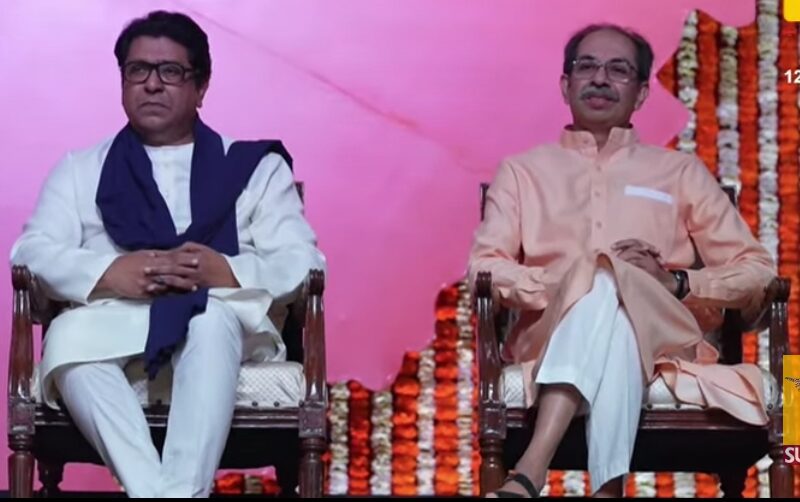
Raj Thackeray and Uddhav Thackeray sharing the dais in Mumbai today.
 By G. Krishna Mohan Rao*
Thackeray Reunion Targets BJP’s Marathi Base
The reunion of Uddhav Thackeray, president of Shiv Sena (UBT), and Raj Thackeray, chief of Maharashtra Navnirman Sena (MNS), comes at a time when both cousins face existential challenges in their political careers.
Uddhav, the son of Shiv Sena founder Balasaheb Thackeray, and his cousin Raj are leveraging the “Marathi Manoos” sentiment to revive their dwindling political fortunes. Their joint appearance at a rally, where they hinted at a possible political alliance, has sparked speculation about a realignment of forces in the state.
However, this move is not without risks. Political observers note that the cousins’ aggressive push for Marathi pride, framed as a resistance against Hindi imposition, could alienate non-Marathi voters, potentially driving them towards the Bharatiya Janata Party (BJP). The rally saw fiery speeches accusing the ruling BJP of dividing Maharashtrians, but the Thackerays’ fight extends beyond the saffron party to the “official” Shiv Sena led by Deputy Chief Minister Eknath Shinde, who toppled Uddhav’s Maha Vikas Aghadi (MVA) government in 2022 by aligning with the BJP.
Also read:
The Thackeray cousins have reunited after nearly two decades of estrangement, potentially reshaping Maharashtra’s volatile political landscape. The cousins, whose falling out in 2005 led to Raj’s breakaway from the Shiv Sena to form the MNS, shared a public platform last Saturday at a “victory rally” named “Awaz Marathicha” (Marathi’s roar). The rally was organised to celebrate the BJP-led Mahayuti government’s rollback on what the Thackerays termed the “Hindi imposition” issue, following the government’s attempt to introduce Hindi as a third language in primary schools. This development has not only united the cousins but also galvanised the opposition, marking a significant moment in Maharashtra’s politics.
The language debate, which lies at the heart of this reunion, has stirred deep emotions in Maharashtra. The Mahayuti government’s flip-flop on introducing Hindi in primary schools united the opposition, with the Thackerays leading the charge. While Chief Minister Devendra Fadnavis eventually retreated on the policy, the damage was done, providing the Thackerays with a potent issue to rally around. However, the movement has taken a darker turn, with MNS workers reportedly attacking non-Marathi traders and vandalising a businessman’s office for opposing their stance on Hindi. Critics argue that the Thackerays are weaponising the language issue to assert Marathi supremacy, a tactic that risks deepening social divides in a state known for its cosmopolitan fabric. Such actions, they warn, cannot be condoned in a democratic setup.
The Thackerays’ strategy appears to be centred on regaining their Marathi voter base, particularly in the context of upcoming local body elections, including those for the high-stakes Brihanmumbai Municipal Corporation (BMC) and civic bodies in Thane, Pune, and Nashik. The BMC polls, in particular, are a key target, with the cousins aiming to capitalise on Balasaheb’s legacy to secure a foothold in Mumbai’s civic body. However, Uddhav’s Shiv Sena (UBT) is part of the MVA coalition, which includes the Congress and Sharad Pawar’s NCP (SP). Any move to bring Raj’s MNS into the MVA fold would require delicate negotiations, as existing allies may need to make concessions to accommodate the MNS, a party that carries the baggage of Raj’s controversial anti-migrant and anti-Muslim rhetoric.
The Congress, a key MVA constituent, finds itself in a dilemma. While it has maintained silence on the Thackeray reunion, party leaders privately express concerns about the implications of aligning with Raj, whose polarising politics could undermine Congress’s secular credentials. As a pan-Indian party eyeing a revival in the Hindi heartland, including poll-bound Bihar, Congress cannot afford to be seen as endorsing an anti-Hindi stance. A senior Congress leader remarked, “The Thackerays are eyeing only the BMC elections. We want to go alone in the BMC polls. We have never allied with anyone for these elections.” Another leader highlighted the party’s precarious position in Mumbai, noting, “It is a tricky situation. Congress does not have much support in Mumbai. We are neither with the Marathi Manoos nor the Gujaratis. Our support base is only the minorities.”
Meanwhile, Eknath Shinde, the Deputy Chief Minister and leader of the “official” Shiv Sena, faces his own challenges within the Mahayuti alliance. Shinde, who has maintained a measured tone amid the Thackeray reunion, is wary of losing clout, particularly as some BJP leaders view him as a temporary ally rather than a long-term partner. Political analysts suggest that the BJP might tacitly encourage the Thackerays to weaken Shinde’s influence ahead of the 2029 assembly elections. In his response to the “victory rally,” Shinde targeted Uddhav but refrained from attacking Raj, a move seen as calculated to avoid further alienating Marathi voters.
The potential Thackeray alliance poses a significant challenge to the BJP’s dominance in Maharashtra, particularly in urban and semi-urban areas like Mumbai, Thane, Pune, and Nashik, where a united Thackeray front could sway Marathi voters. The BJP also risks being outflanked on its Hindutva agenda, as the Thackerays seek to reclaim Balasaheb’s legacy. However, the MNS’s dismal electoral performance—securing only 1.56 per cent votes across 125 seats compared to Shiv Sena (UBT)’s 10.03 per cent in 95 seats—raises questions about Raj’s ability to add significant value to the alliance. Moreover, his ruffian politics could trigger a reverse consolidation of non-Marathi votes, further complicating the MVA’s calculations.
As Maharashtra’s political landscape braces for more twists in the run-up to the local body polls, the Thackeray cousins’ reunion has injected fresh uncertainty into an already volatile scene. While their shared stage has rekindled hopes of a Marathi resurgence, the path ahead is fraught with challenges. The cousins must navigate internal differences, coalition dynamics, and the risk of social polarisation to translate their rhetoric into electoral success. For now, the “Awaz Marathicha” rally has sent a clear message: the Thackerays are back, and they mean business. Whether this reunion will reshape Maharashtra’s politics or fizzle out remains to be seen.
*Senior journalist